
Industrial Fruit Processing: A Step-by-Step Guide for Modern Processing Plants
August 13, 2026
Countries Leading the Fruit Processing Opportunity in Africa
August 22, 2026
Why Fruit Processing is the Next Big Opportunity in Africa
Introduction – Africa’s Untapped Fruit Processing Potential
The continent produces a remarkable variety of fruits—from mangoes, pineapples and citrus to bananas, plantains, passion fruit and avocados. Yet the value created from this agricultural abundance is still far smaller than its potential.
Africa’s fruit industry presents a paradox.
Much of Africa’s fruit production is oriented towards domestic consumption, while significant post-harvest losses and infrastructure constraints limit how much value can be captured from this production. Africa faces significant challenges in moving perishable fruit from farms to consumers while preserving its value. Food and Agriculture Organization (FAO) estimates that 23.0% of food was lost in sub-Saharan Africa in 2023, compared with a global average of 13.3%; fruits and vegetables recorded the highest global commodity-level loss rate at 25.4%.
The latest OECD-FAO Agricultural Outlook 2025-2034 identifies fruits as an important source of nutrition and income in Africa and expects fruit production to increase through 2034. It also highlights Africa’s growing opportunities created by regional trade initiatives such as the African Continental Free Trade Area (AfCFTA).
These trends are shifting the focus from exporting raw agricultural commodities to building local industries that transform fresh produce into higher-value products. Among these, fruit processing stands out as one of the most promising sectors, offering opportunities for entrepreneurs, manufacturers, governments, and investors to create sustainable businesses while supporting agricultural development.
Africa Produces Millions of Tonnes of Fruit Every Year
Africa’s advantage begins with geography.
Its different climatic zones support a wide range of tropical, subtropical and temperate fruits. The OECD-FAO Agricultural Outlook identifies plantains and cooking bananas as the most important fruits produced in Africa by both quantity and value, followed by bananas. Algeria, South Africa, Egypt, Morocco and Nigeria are identified among the continent’s leading fruit-producing countries by production value.
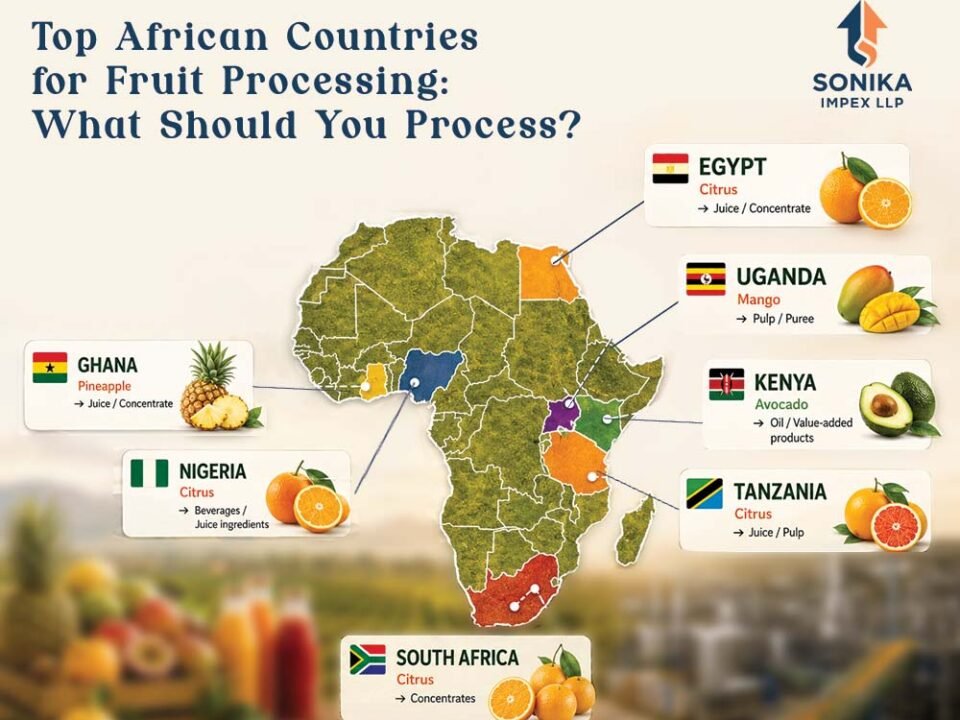
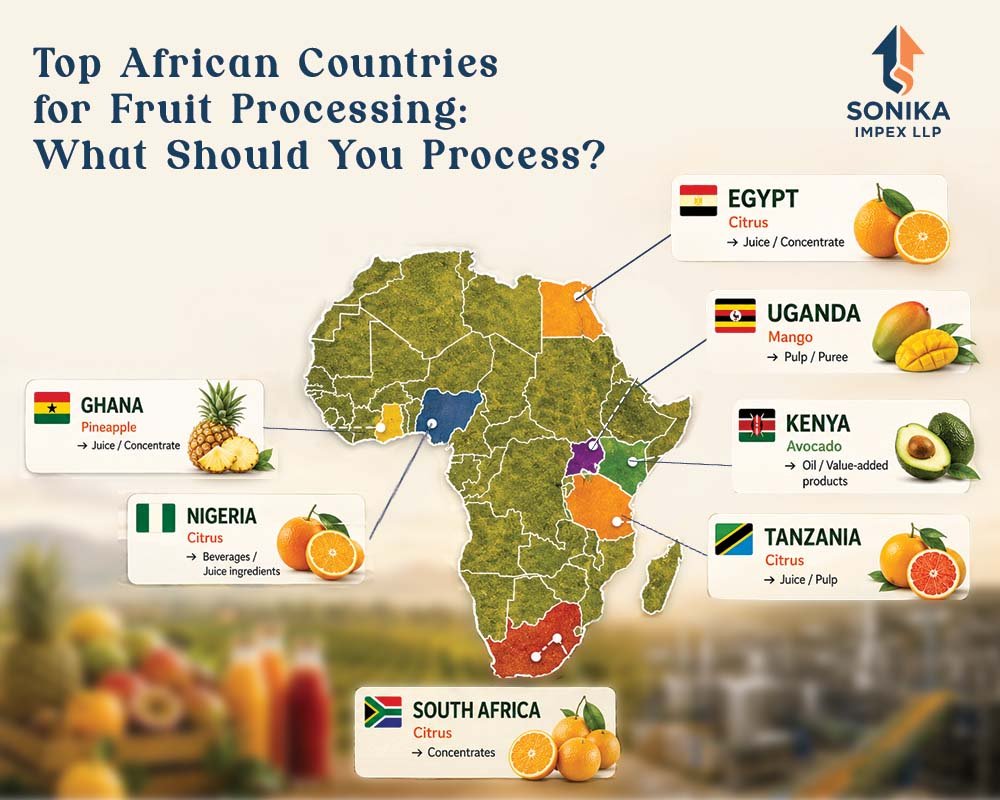
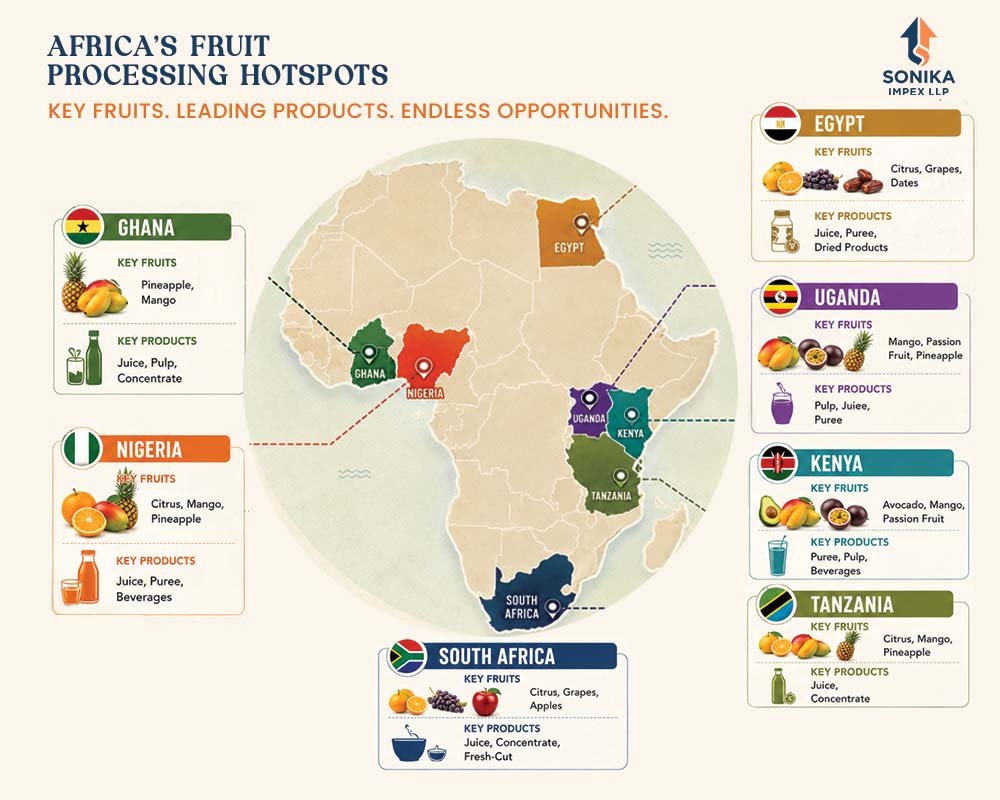
Different regions offer different fruit-processing possibilities:
| Region/Country | Potential Fruit Opportunities | Possible Processing |
| Ghana | Pineapple, mango | Juice, pulp, concentrate |
| Uganda | Mango, passion fruit, pineapple | Pulp, juice, puree |
| Kenya | Avocado, mango, passion fruit | Puree, pulp, beverages |
| Tanzania | Citrus, mango, pineapple | Juice, concentrate |
| Nigeria | Citrus, mango, pineapple | Juice, puree, beverages |
| South Africa | Citrus, grapes, apples | Juice, concentrate, fresh-cut |
| Egypt | Citrus, grapes, dates | Juice, puree, dried products |
Map showing COUNTRIES With their major fruits.
- Ghana
- Uganda
- Kenya
- Tanzania
- Nigeria
- Côte d’Ivoire
But production alone does not automatically create a profitable processing industry.
Three questions matter:
How much fruit is being produced?
How much is being consumed locally?
And how much value is being captured through processing?
Production is Growing-but Productivity Still Has Room to Improve
The OECD-FAO outlook expects African fruit production to increase through 2034, driven partly by moderate expansion in cultivated area. However, the report also notes that productivity remains relatively low and that growth will be constrained by environmental and infrastructure challenges.
This creates an interesting investment equation.
More production does not necessarily mean more exports of fresh fruit. In fact, when production is highly seasonal, a larger harvest can create pressure on local markets if there is insufficient storage, transportation or processing capacity.
A processing industry provides another outlet.
More fruit production
↓
More raw material available to processors
↓
More pulp, juice, puree and concentrate
↓
More products for domestic and export markets
This is the point where agriculture starts becoming industrial manufacturing.
Local Consumption is Already a Major Market
It is tempting to think that Africa’s fruit-processing opportunity is primarily about exports. The reality is more nuanced.
The OECD-FAO reports that the majority of fruit production in Africa is oriented towards domestic consumption. At the same time, fruit trade within Africa has expanded, with apples, unspecified fruit juices and bananas among the commonly traded fruits by value. Exports outside Africa are more heavily represented by citrus and grapes, particularly from South Africa, Egypt and Morocco.
There are potentially three markets:
Domestic consumers → Regional African markets → International markets
For a processor, this diversification can be strategically valuable. A plant producing juice, pulp or puree can develop products for local retail while also supplying food and beverage manufacturers or regional buyers.
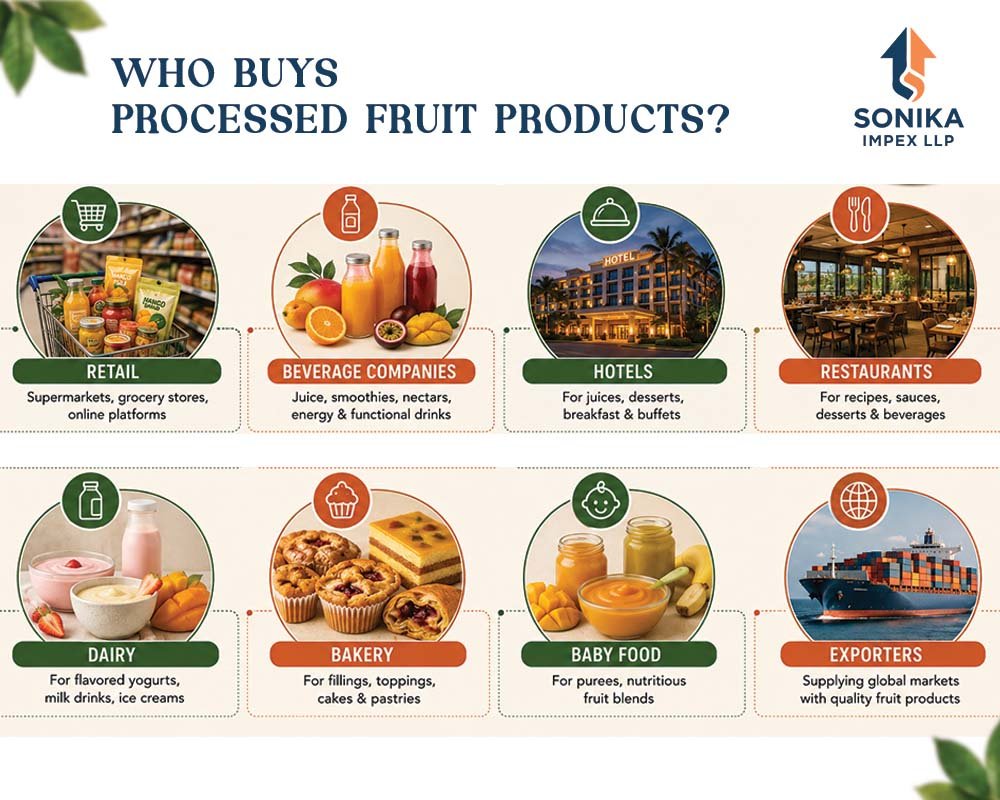
“Three Markets for African Fruit Processors”
Domestic: retail, hotels, restaurants, beverage companies
Regional: neighbouring African markets through intra-African trade
International: concentrates, pulp, juice, fresh and processed products
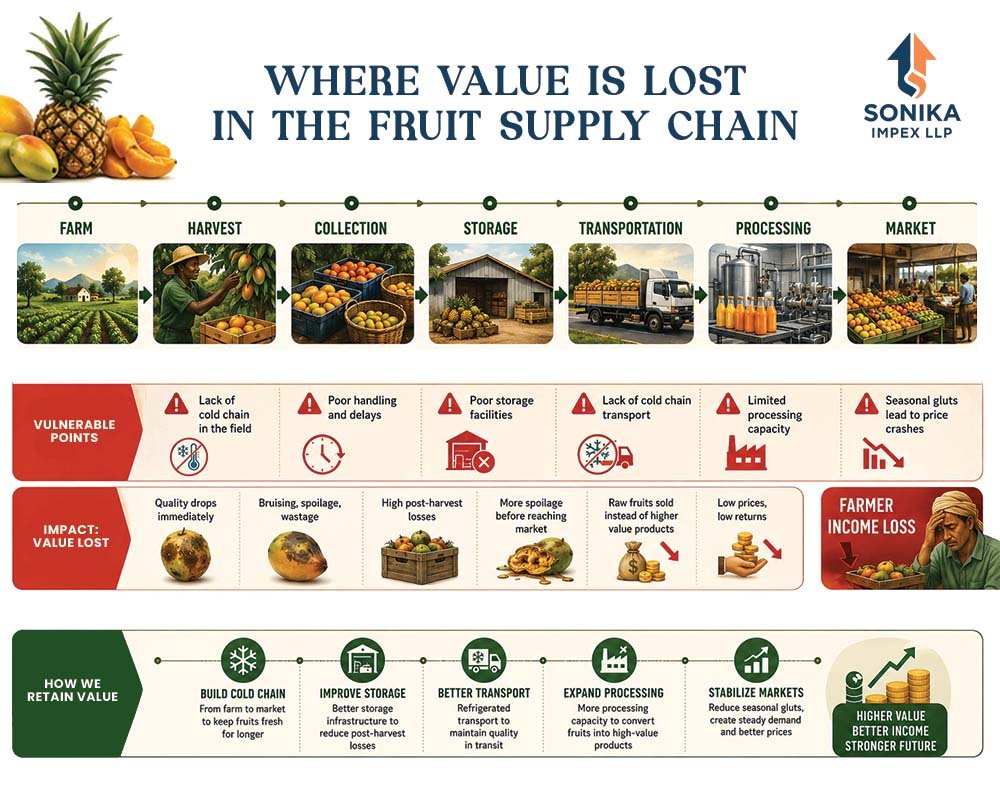
The Real Problem: Valuable Fruit Can Be Lost Before It Becomes a Product
Fruit processing becomes particularly important because it is perishable, seasonal and highly sensitive to temperature, handling and transportation time. A farmer can harvest a healthy, high-quality crop and still lose value if the fruit spends too long waiting for collection, transport, storage or a buyer.
This creates a familiar cycle:
High harvest → market oversupply → falling prices → unsold fruit → spoilage → farmer losses
Processing can interrupt that cycle.
A mango does not have to reach the consumer as a fresh mango. It can become mango pulp, puree, nectar, juice, concentrate or an ingredient for another food product.
Likewise, pineapple can move into juice, concentrate, dried products or other value-added applications.
This is why processing capacity should not be viewed simply as another factory investment. It can become an important link between agricultural production and reliable markets.
A recent World Bank report put the wider transportation challenge into stark numbers: 37% of Africa’s perishable food is lost in transit, according to its 2025 analysis. The World Bank also found that transport inefficiencies can add up to 30% to the final cost of goods.
The World Bank has repeatedly highlighted the importance of improving food supply chains, noting that inadequate infrastructure and inefficient transport can contribute to food losses, delays and price volatility. For fruit processors, the lesson is straightforward:
The closer that processing capacity is to reliable raw-material supply, and the better the connection between farms, collection centres and factories; the greater is the opportunity to preserve value.
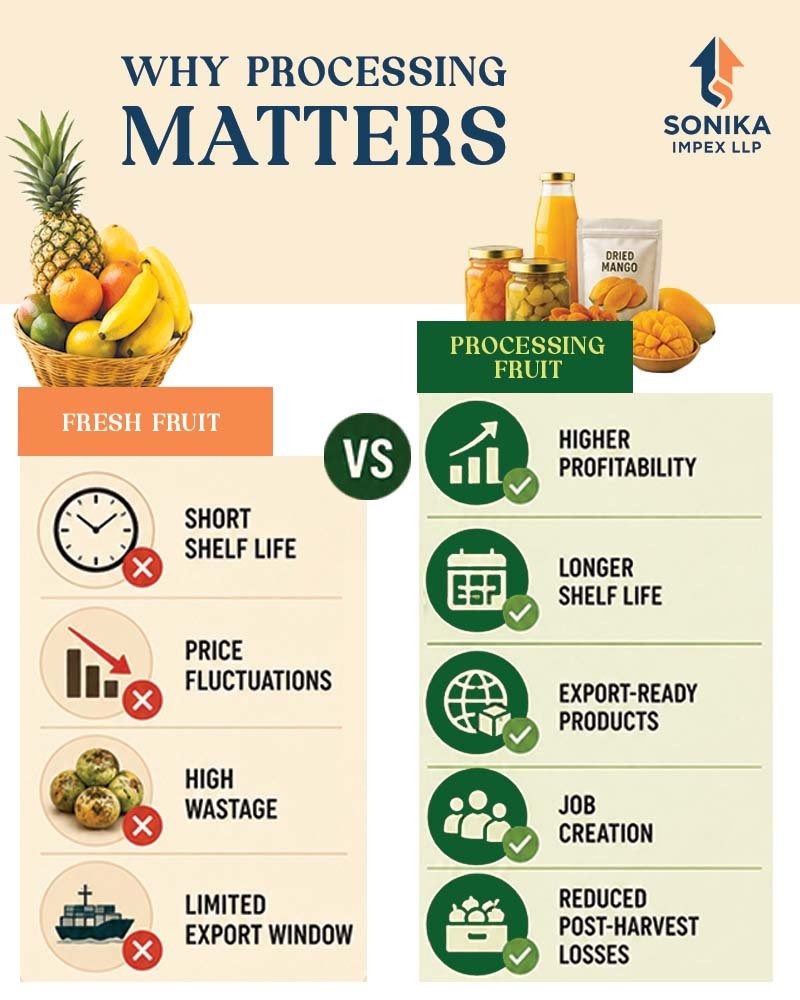
Fruit Processing Changes the Economics of the Harvest
This is where the business case becomes more compelling.
Fresh fruit has a limited selling window. A processed product can have a substantially longer commercial life when appropriate processing, packaging and storage technologies are used.
Once processed, the same agricultural resource can serve a much broader industrial market.
Mango → Pulp → Puree → Nectar → Beverage/Food Ingredient
The same principle applies to other fruits.
| Fruit | Potential Value-Added Products |
| Mango | Pulp, puree, nectar, beverage ingredients |
| Pineapple | Juice, concentrate, dried products |
| Passion fruit | Pulp, juice, concentrate |
| Citrus | Juice, concentrate and selected by-products |
| Guava | Pulp, puree, beverages |
| Papaya Apple | Puree, beverages, processed foods Juice, Concentrate, Pomace-based products |
Processing does not automatically make a crop more profitable. A plant still needs reliable raw material, competitive operating costs, suitable technology and a market for its products.
The Market Opportunity Goes Beyond Bottled Juice
Fruit processing is sometimes reduced to one product: juice.
That is far too narrow. A modern processing facility can manufacture or supply:
- Juice
- Nectars
- Fruit pulp
- Purees
- Concentrates
- Frozen fruit
- Dried fruit
- Jams and preserves
- Fruit-based ingredients
- Selected natural extracts
And these products can feed several industries- dairy manufacturers, bakeries, confectionery companies, hotels, restaurants, baby-food manufacturers and beverage producers.
This diversification matters when designing a processing project.
A plant should not be designed simply because a particular fruit is available. A processing plant designed around multiple products can potentially use different fruit varieties and production windows throughout the year, helping improve equipment utilization and reduce dependence on a single product.
That is the difference between buying machinery and building a viable processing business.
Africa’s Competitive Advantages
Africa’s food market is changing alongside its population and cities.
As urban consumers become more dependent on formal retail and packaged foods, demand grows for products that offer convenience, consistency and longer shelf life.
The World Bank’s recent work on African agriculture describes the continent’s food and agriculture system as a major opportunity for job creation, investment and regional trade. It estimates that Africa’s food market could reach $1 trillion by 2030, driven by population growth, consumer spending and global food demand.
The opportunity therefore extends beyond exporting fruit.
A processor can potentially serve:
Local consumers → Supermarkets → Hotels & restaurants → Institutional buyers → Regional African markets → International markets
This creates a much broader customer base than the traditional fresh-fruit supply chain.
AfCFTA Could Make Regional Processing More Attractive
The African Continental Free Trade Area (AfCFTA) is designed to deepen trade integration across the continent. For food processors, stronger regional trade can make it more commercially attractive to establish processing facilities that serve multiple markets.
The OECD-FAO expects AfCFTA and continued urbanisation to facilitate intra-African fruit trade and support more formal fruit value chains.
The opportunity can therefore be viewed as:
Local farms
→ Regional processing plant
→ Value-added product
→ Domestic + regional markets
That is particularly relevant for countries such as Ghana and Uganda.
This is important because a processing plant does not necessarily have to depend entirely on its domestic market.
A strategically located facility can potentially source fruit from surrounding agricultural regions and sell finished products across neighbouring markets, subject to applicable trade, regulatory and food-safety requirements.
This creates an interesting model:
Local agricultural production → Regional processing facility → Value-added food product → Multiple African markets
The opportunity is particularly relevant for products such as fruit pulp, concentrate and shelf-stable beverages that can be transported more efficiently than highly perishable fresh fruit.
One of the biggest advantages for African food processors is that the potential market does not stop at the national border.
However, AfCFTA should not be treated as a magic solution. Tariffs, standards, border procedures, transport costs, currency risks and market access still influence whether a particular export strategy works.
The Business Case: From Agricultural Commodity to Industrial Product
The difference between selling raw fruit and processing it is fundamentally a difference in where value is captured.
| Fresh Fruit Model | Processing Model |
| Limited shelf life | Extended commercial life |
| Seasonal sales pressure | Ability to process during peak harvest |
| Primarily fresh-market dependent | Multiple product categories |
| Greater exposure to perishability | Better preservation |
| Limited processing employment | Factory and supply-chain jobs |
| Lower value addition | Higher value-added potential |
| Fresh-market distribution | Domestic + regional + export possibilities |
Processing also creates economic activity beyond the factory itself.
A new plant can generate demand for:
- Farmers and aggregators
- Packaging suppliers
- Maintenance technicians
- Equipment operators
- Laboratory personnel
- Transport providers
- Cold-storage services
- Warehousing
- Distribution
- Marketing and retail
A recent World Bank-backed agro-processing project in Côte d’Ivoire demonstrates how investment in value addition can translate into industrial employment. Domestic cashew-processing capacity increased from 68,515 tonnes in 2015 to 350,000 tonnes in 2024, while the programme reported more than 18,000 jobs created, 66% of them held by women. Although cashew is a nut rather than a fruit, the example illustrates the broader economic impact that organized agro-processing can have on an agricultural value chain.
There is another reason to look beyond exports: Africa’s own food market is expanding.
Africa is developing a larger consumer base while urbanisation changes how food is purchased, distributed and consumed.
For fruit processors, this can create demand for convenient products such as:
- Ready-to-drink juices
- Nectars
- Fruit beverages
- Purees
- Processed fruit ingredients
- Packaged and shelf-stable products
The opportunity is therefore both agricultural and consumer-driven.
Countries Leading the Opportunity
Instead of only Ghana/Uganda, compare
| Country | Key Fruits | Opportunity |
| Ghana | Pineapple | Juice |
| Uganda | Mango | Pulp |
| Kenya | Avocado | Puree |
| Tanzania | Citrus | Juice |
| Nigeria | Orange | Beverage |
Very SEO-friendly.
Technology is Transforming Fruit Processing
The opportunity is real, but building a factory does not guarantee success.
Fruit processing is technically demanding.
Raw material varies by season. Fruit maturity affects yield and quality. Processing conditions affect shelf life. Packaging influences distribution. Utilities can significantly influence operating costs.
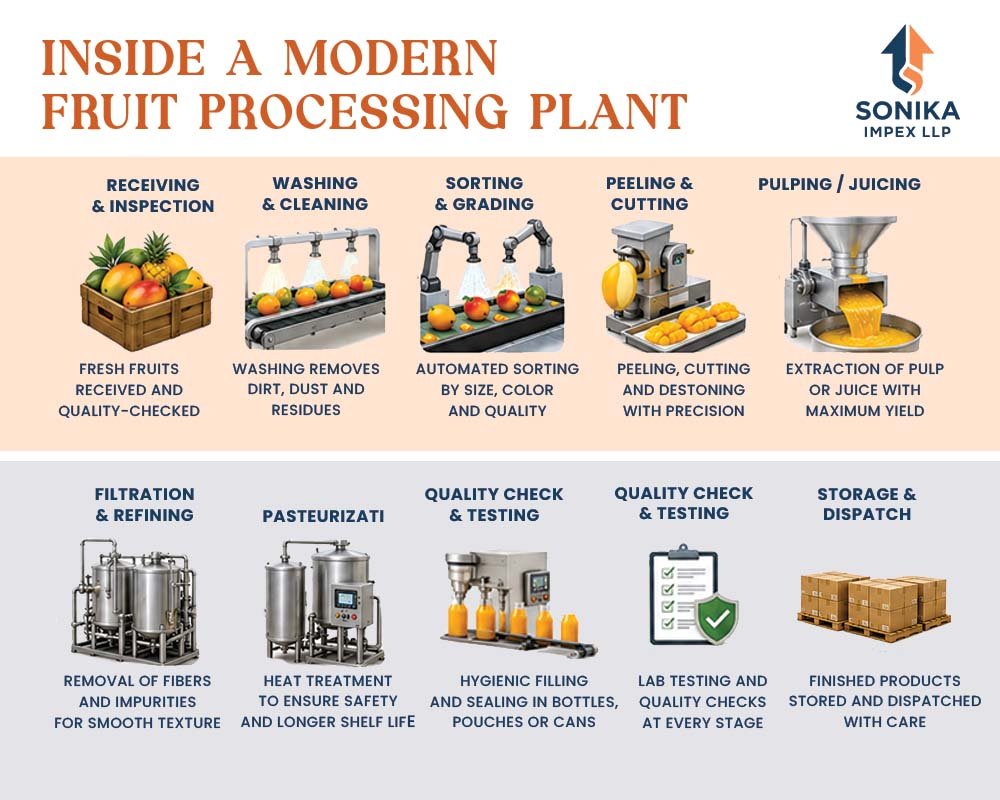
A modern plant may therefore require:
- Sorting and grading
- Washing
- Peeling / preparation
- Extraction or pulping
- Filtration
- Blending
- Pasteurisation
- Filling
- Packaging
The correct configuration depends on the fruit and product.
A mango-pulp plant is not the same as an orange-juice plant. A plant supplying industrial concentrate is not the same as a consumer-facing RTD juice facility.
This is why technology selection should follow the business case, not precede it.
Why Turnkey Fruit Processing Plants are the Future
The biggest mistake an investor can make is to treat a processing project as a machinery-purchasing exercise.
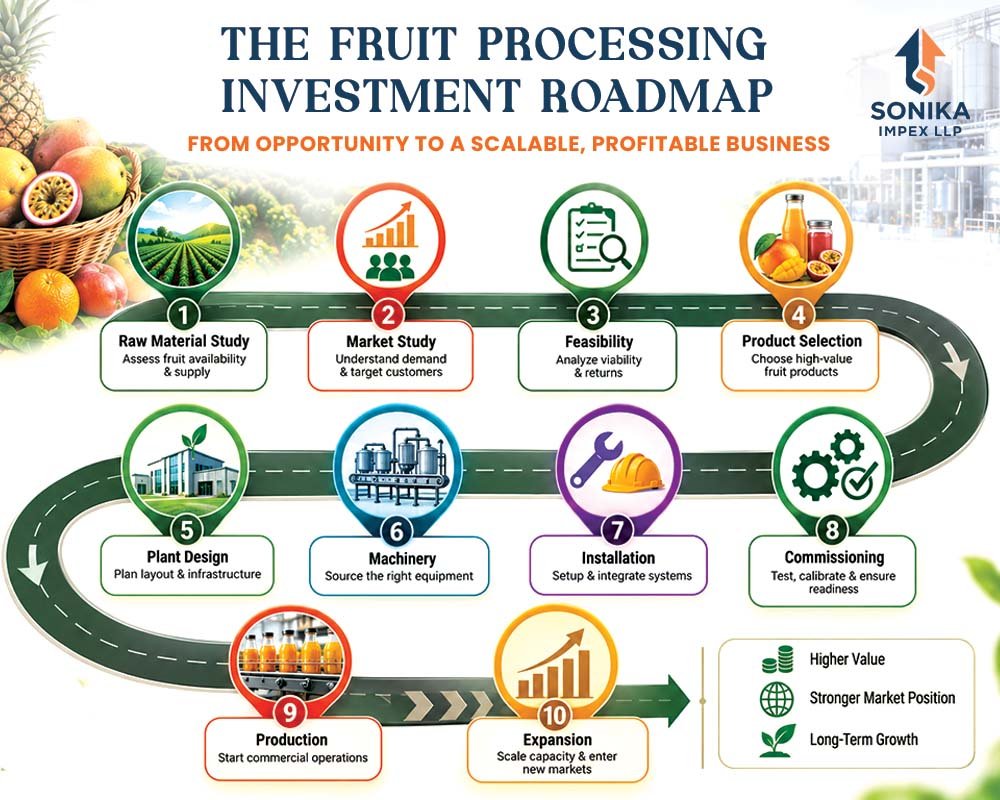
A successful plant starts much earlier – with the business model and feasibility study.
Before equipment is selected, the project should answer questions such as:
- Which fruits are consistently available?
- What is the annual and seasonal raw-material supply?
- What products have realistic market demand?
- Who will buy the finished products?
- What production capacity is appropriate?
- What utilities are available?
- What packaging format suits the target market?
- What food-safety standards must be met?
- What can be done with processing by-products?
- Can the plant expand in the future?
Only after these questions are addressed should machinery and plant configuration be finalized.
This is where a turnkey approach becomes particularly valuable.
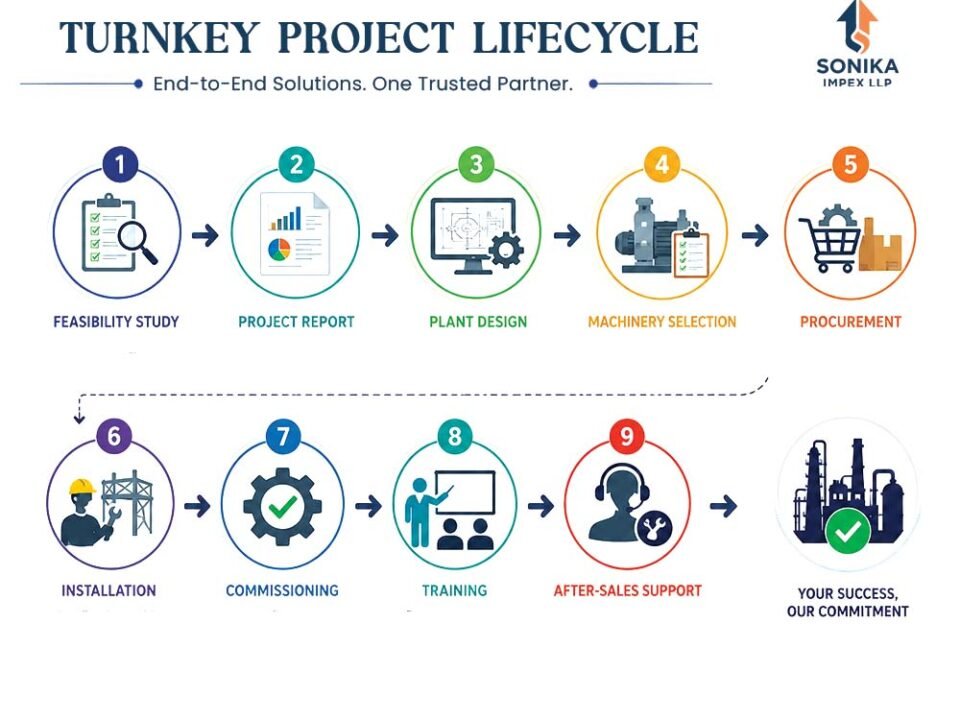
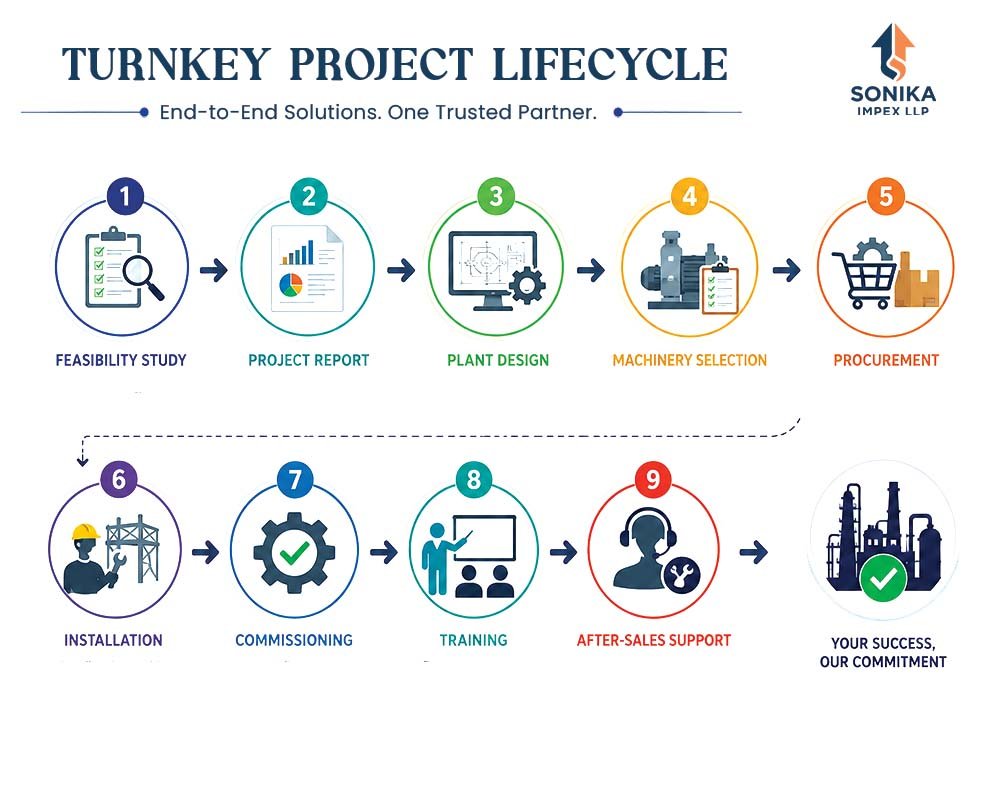
A turnkey project can bring together feasibility, process engineering, plant layout, machinery selection, procurement, installation, commissioning, operator training and technical support under one coordinated project.
For African investors, this can reduce the risk of creating a collection of machines that work individually but fail to function as an efficient production system.
The Opportunity is Not Just in Growing More Fruit
Africa’s fruit-processing opportunity is ultimately a value-chain opportunity.
The continent has the agricultural base. It has a rapidly expanding food market. It has a growing need for employment and industrialisation. It has regional trade ambitions through AfCFTA.
But there are still gaps between production and value creation.
The OECD-FAO expects African fruit production to increase through 2034, while simultaneously identifying transport infrastructure, cold chains, productivity and short harvesting windows as important constraints.
That combination tells us the next opportunity is not simply to produce more. It is to build the infrastructure that allows more of what is produced to become marketable, storable, transportable and higher-value products.
For investors and manufacturers, that makes fruit processing an opportunity worth examining carefully because the underlying fundamentals are increasingly compelling.
Africa has the fruit.
Africa has the consumers.
Africa has growing regional markets.
What it needs is more of the infrastructure and industrial capacity that connects the three.
And that is where the next generation of fruit-processing projects could create their greatest value.
From farm to factory. From raw fruit to finished product. From agricultural production to industrial value.
Frequently Asked Questions About Fruit Processing in Africa
1. Which African country has the greatest fruit processing potential?
There is no single African country that can be identified as having the greatest fruit-processing potential across every category. The opportunity depends on the availability of fruit, processing infrastructure, domestic demand, export access, utilities and the target product.
Ghana and Uganda, for example, offer interesting opportunities in tropical fruits such as pineapple, mango and passion fruit, while Kenya has a strong horticultural base, particularly in avocado and mango. Nigeria stands out for its enormous domestic consumer market, while South Africa and Egypt benefit from mature agricultural and export ecosystems.
For investors, the better question is not which country produces the most fruit? but which country offers the best combination of raw materials, market demand and processing economics for the intended product?
2. Is fruit processing profitable in Africa?
Fruit processing can be profitable in Africa, but profitability depends on several factors rather than fruit availability alone. The most important considerations include raw-material cost and reliability, plant utilisation, processing yield, energy and water costs, labour, packaging, logistics and the selling price of the finished product.
Processing can improve the economics of seasonal fruit by converting it into products such as pulp, puree, juice and concentrate with longer commercial lives and wider market applications.
However, a processing plant should be preceded by a proper market and feasibility study. The right fruit, capacity and product mix must be established before machinery is selected.
3. What machinery is required for a fruit processing plant?
The machinery required depends on the fruit and the finished product. A typical industrial fruit-processing line may include fruit reception and sorting equipment, washing systems, preparation equipment, pulpers or extractors, filtration systems, blending tanks, pasteurisers, homogenisers, filling machines and packaging equipment.
Additional equipment may be required for specific products, such as evaporators for concentration, aseptic filling systems for shelf-stable products, or cold-storage and freezing systems for certain processed fruits.
The plant should therefore be designed around the raw material, processing capacity, product specification and target market, rather than selecting machinery first and designing the process afterwards.
4. What products can be manufactured from processed fruit?
Fruit processing can produce a much wider range of products than bottled juice alone. Depending on the fruit and processing technology, a plant can manufacture fruit juice, nectar, pulp, puree, concentrate, jams, dried fruit, frozen fruit and other fruit-based ingredients.
For example, mangoes can be processed into pulp and puree, pineapple into juice and concentrate, passion fruit into pulp and concentrate, while avocado can be processed into products such as avocado oil and puree.
The most suitable product should be determined by raw-material availability, market demand, processing yield, investment requirements and the intended domestic or export market.
5. What are the major challenges facing fruit processing in Africa?
The major challenges include seasonal availability of fruit, fragmented supply chains, inadequate cold-chain and storage infrastructure, transportation constraints, inconsistent raw-material quality, energy costs and access to suitable processing technology.
The OECD-FAO Agricultural Outlook 2025–2034 identifies transportation infrastructure and cold-chain maintenance as important areas for further development in Africa’s fruit sector.
These challenges do not eliminate the opportunity, but they make project planning particularly important. Successful fruit-processing projects need to consider farmer sourcing and aggregation, plant location, utilities, storage, processing capacity, product markets and logistics as one integrated system rather than as separate decisions.