

Why Fruit Processing is the Next Big Opportunity in Africa
August 22, 2026
Countries Leading the Fruit Processing Opportunity in Africa
Fruit Processing in Africa: Top Countries & Opportunities
Africa’s fruit processing in africa opportunity is expanding across multiple markets, but the opportunity does not look the same in every country.
Ghana has a strong position in tropical fruits such as pineapple, Uganda offers a diverse base of mangoes, pineapples and passion fruit, while Kenya has developed a major horticultural industry around fruits including avocado and mango. Further north, Egypt and South Africa have more established commercial agricultural and export ecosystems. Meanwhile, Nigeria’s enormous domestic consumer market creates a different proposition for fruit-based beverages and processed foods.
This diversity is important for investors exploring Fruit Processing in Africa.
The question is not simply where is the most fruit being produced? The more useful question is:
Where do fruit availability, processing infrastructure, market demand, investment economics and access to customers come together?
According to the OECD-FAO Agricultural Outlook 2025–2034, Africa’s fruit sector is expected to continue developing over the coming decade, while improvements in productivity, transportation infrastructure and cold-chain systems remain important to unlocking greater value from agricultural production.
For investors considering a fruit processing in Africa, this creates opportunities across juice, pulp, puree, concentrates, dried fruit, frozen products and other value-added applications.
Africa’s Leading Fruit-Processing Markets at a Glance
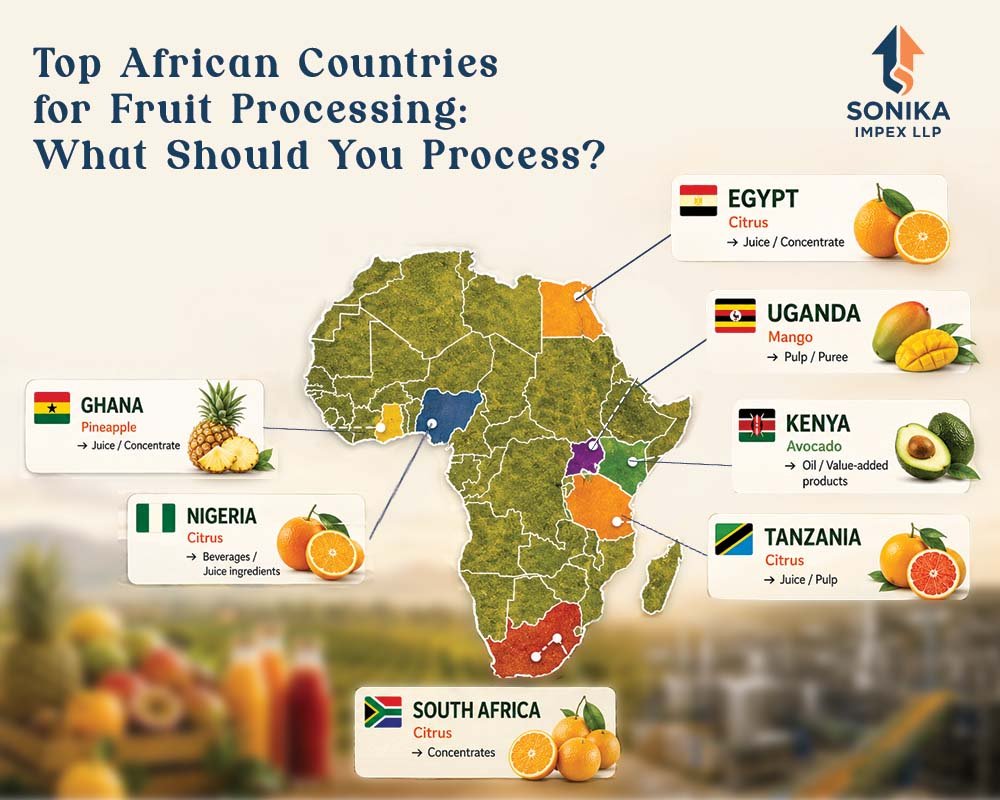
| Country | Key Fruits | Processing Opportunities | Why It Matters |
| Ghana | Pineapple, mango, citrus | Juice, pulp, puree, concentrate | Strong tropical-fruit base and access to West African markets |
| Uganda | Mango, pineapple, passion fruit, avocado | Pulp, puree, juice, concentrate | Diverse fruit production and value-addition potential |
| Kenya | Avocado, mango, passion fruit | Oil, puree, juice, dried fruit | Established horticultural export sector |
| Tanzania | Citrus, mango, pineapple, avocado | Juice, pulp, puree, dried fruit | Agricultural base and East African market access |
| Nigeria | Citrus, mango, pineapple | Juice, beverages, puree, concentrates | Large domestic consumer market |
| South Africa | Citrus, grapes, apples, pears | Juice, concentrates, purees | Mature agricultural and export infrastructure |
| Egypt | Citrus, grapes, dates | Juice, concentrate, puree, dried fruit | Major producer with strong export orientation |
The processing opportunities shown are indicative and should be validated against raw-material availability, market demand and project economics.
Ghana: Pineapple and Tropical Fruit Processing
Ghana is one of the more interesting markets for investors evaluating pineapple processing in Africa as part of the broader Fruit Processing in Africa industry.
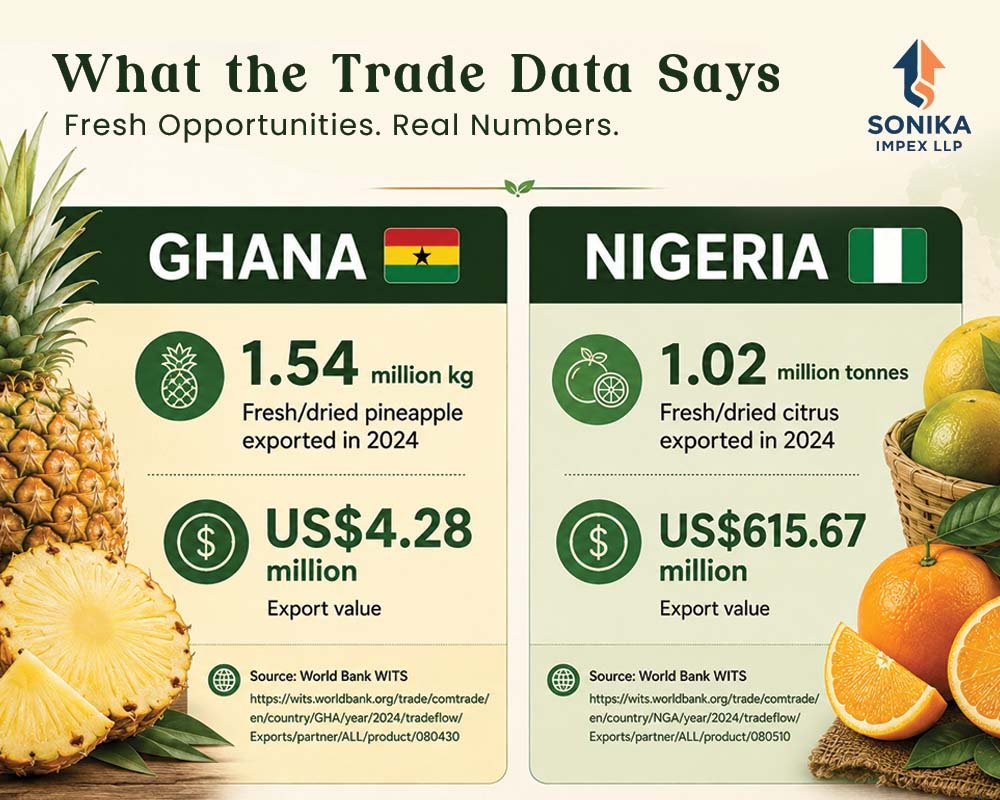
The country already participates in the international pineapple trade. World Bank WITS data records Ghana exporting approximately 1.54 million kg of fresh or dried pineapple worth US$4.28 million in 2024. Belgium, Germany, the United Kingdom, the United States and the Netherlands were among its reported destinations.
But fresh-fruit exports represent only one part of the value chain.
Pineapple can be converted into juice, concentrate, pulp and other processed products, creating opportunities within Fruit Processing in Africa while allowing processors to serve domestic consumers as well as regional and international buyers.
An interesting market signal is that Ghana also imported pineapple juice from markets including Burkina Faso and South Africa in 2024.
This raises a commercially relevant question:
Can more of the value generated from Ghana’s own fruit production be captured through domestic processing?
For investors, the opportunity extends beyond installing a processing line. Reliable fruit sourcing, collection infrastructure, seasonal supply planning, product selection and access to regional markets all need to be considered when developing a viable fruit processing business in Africa.plant.
Uganda: From Fresh Mangoes to Pulp and Puree
Uganda offers a different proposition.
Its diverse tropical-fruit base includes mango, pineapple and passion fruit, alongside other commercially relevant fruits such as avocado.
This diversity creates the possibility of developing processing facilities around multiple raw materials rather than depending on a single fruit.
For fruits with short harvest periods, processing can also help address seasonality. Instead of selling the entire crop into the fresh market during a limited harvesting window, suitable fruit can be converted into pulp, puree, juice or concentrate for use over a longer period.
For Uganda, therefore, the opportunity is not simply about building a juice factory.
It is about connecting:
Fruit production → collection → processing → storage → domestic consumption → regional markets
Mango pulp, passion-fruit concentrate and pineapple-based products are examples of areas that can be evaluated during a feasibility study.
The right product, however, depends on the volume and quality of fruit available within an economically viable sourcing radius.
Nigeria: Where the Domestic Market Changes the Equation
Nigeria presents a different type of opportunity.
Its fruit-processing potential is supported not only by agricultural production but also by the scale of its domestic consumer and food-and-beverage market.
Citrus, mangoes, pineapples and other fruits can be used in juice, beverages, purees and concentrates.
World Bank WITS data shows that Nigeria imported approximately 3.44 million kg of single citrus fruit juice, excluding orange and grapefruit juice, worth about US$15.7 million in 2024.
This can be used to show that Nigeria also imported approximately 2.28 million kg of other citrus fruit in 2024, worth US$1.12 million.
Imports do not automatically represent an opportunity for local substitution. They can reflect differences in product specifications, pricing, availability and supply relationships.
Nevertheless, the figures demonstrate that there is an established market for processed fruit ingredients.
For investors, the key question becomes:
Can locally available fruit be processed competitively enough to serve Nigeria’s large food and beverage market?
That makes Nigeria particularly interesting for projects where domestic consumption, rather than exports alone, forms the foundation of the business case.
Kenya: Moving Beyond Fresh Avocado Exports
Kenya demonstrates how processing can complement an already established horticultural export industry.
The country has developed significant commercial production and export channels for horticultural products, including avocado and mango.
However, fresh exports are highly dependent on quality, maturity, market specifications, timing and international demand.
In 2024, Kenya’s Agriculture and Food Authority implemented measures relating to the avocado export season, including maturity and traceability requirements for exporters, importers and processors.
Kenya’s export authorities have also highlighted the relatively small quantities of processed mango exported compared with fresh mango.
This creates an opportunity to consider processing as an additional route for fruit that may not enter premium fresh-export channels.
Potential products include:
- Avocado oil
- Avocado puree
- Mango puree
- Dried mango
- Passion-fruit products
- Other value-added fruit ingredients
The commercial case ultimately depends on product specifications, market demand, processing yields and raw-material economics.
Tanzania: Citrus and Tropical Fruit Processing
Tanzania combines a substantial agricultural base with access to the wider East African market.
Citrus, mangoes, pineapples and avocado provide potential raw materials for juice, pulp, puree and dried-fruit production.
The opportunity becomes particularly interesting when processing is viewed as part of a regional supply chain rather than simply a factory located near a farm.
A well-planned project could potentially connect:
Farmers → Collection centres → Processing plant → Domestic market → Regional markets
For investors, the critical consideration is therefore not simply how much fruit Tanzania produces.
It is:
Where is commercially viable fruit concentrated, for how many months of the year, and which processed products have sufficient demand to justify industrial-scale production?
These questions should form part of the feasibility and plant-design process.
South Africa and Egypt: Established Processing and Export Ecosystems
South Africa and Egypt represent more mature fruit-production and export environments.
South Africa has major commercial fruit industries covering citrus, grapes, apples and pears, while Egypt is particularly significant in citrus, grapes and dates.
The OECD-FAO Agricultural Outlook identifies South Africa and Egypt among Africa’s leading fruit producers by production value.
For these markets, the opportunity may therefore be less about introducing fruit processing for the first time and more about improving value addition and processing efficiency.
Potential areas include:
- Higher-value processed products
- Improved processing yields
- Greater automation
- Better resource utilisation
- Export-oriented processing
- By-product utilisation
- Modern packaging systems
The experience of these more established markets can also provide useful benchmarks for developing processing industries elsewhere in Africa.
Different Countries, Different Processing Models
Africa’s fruit-processing opportunity is not defined by one country, one fruit or one type of product. From Ghana’s pineapple industry and Uganda’s tropical fruit base to Kenya’s horticultural exports and Nigeria’s large consumer market, each country presents a different combination of raw materials, markets and processing potential.
What matters is how these factors come together.
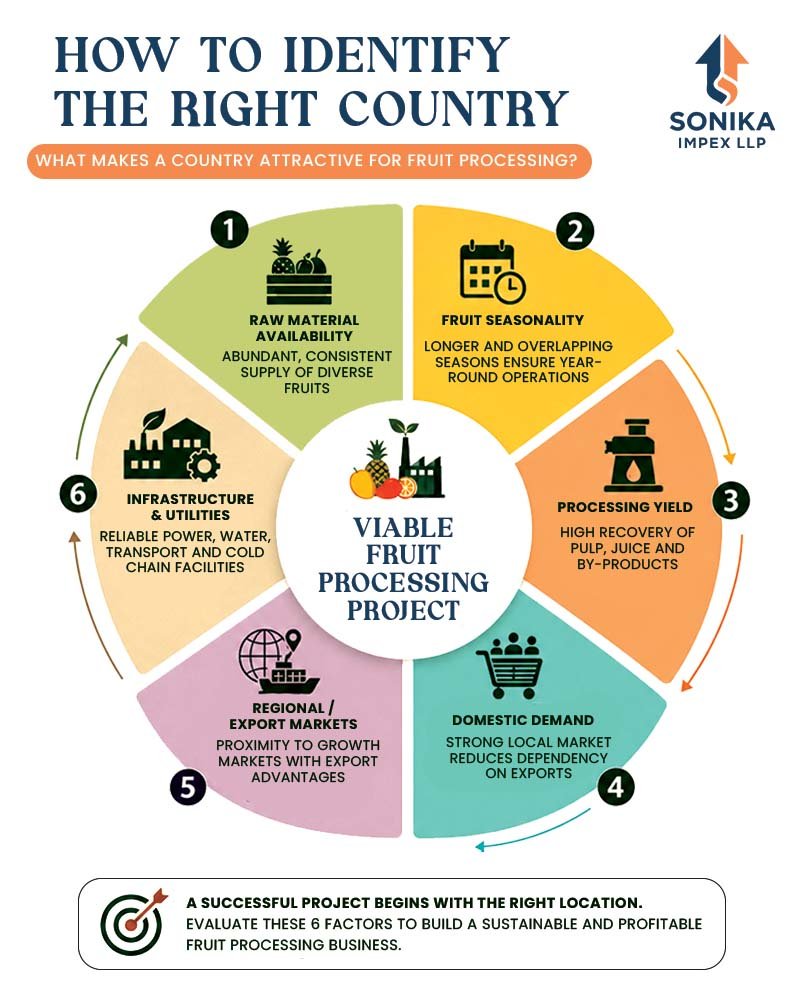
A successful fruit-processing project begins with understanding the availability and seasonality of raw materials, identifying the right processed product, assessing domestic and regional demand, and then designing a processing facility around the required capacity, technology and market.
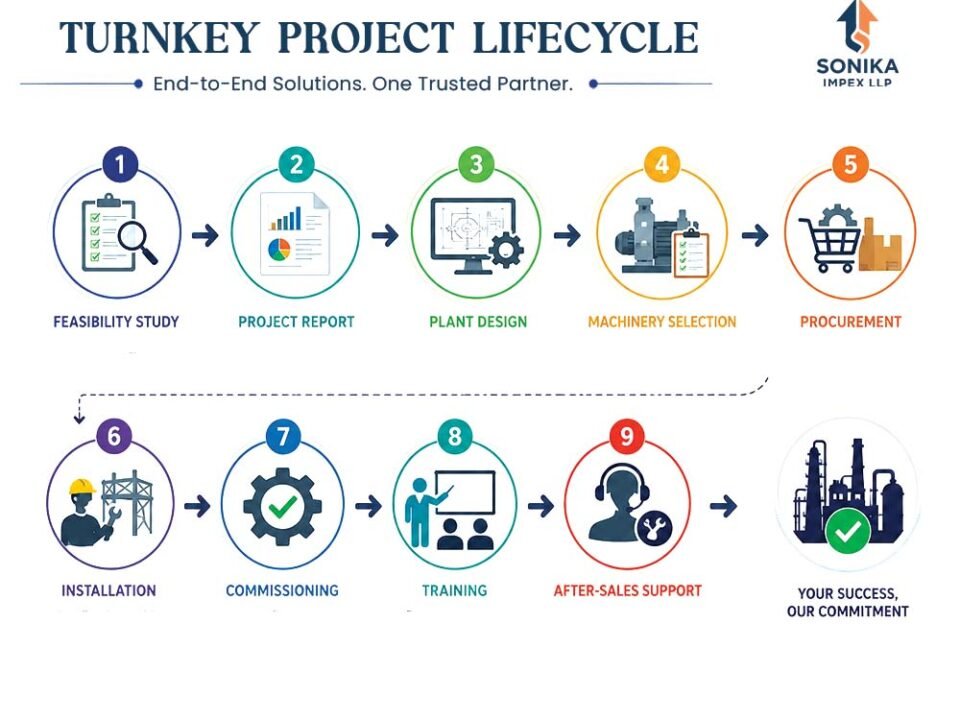
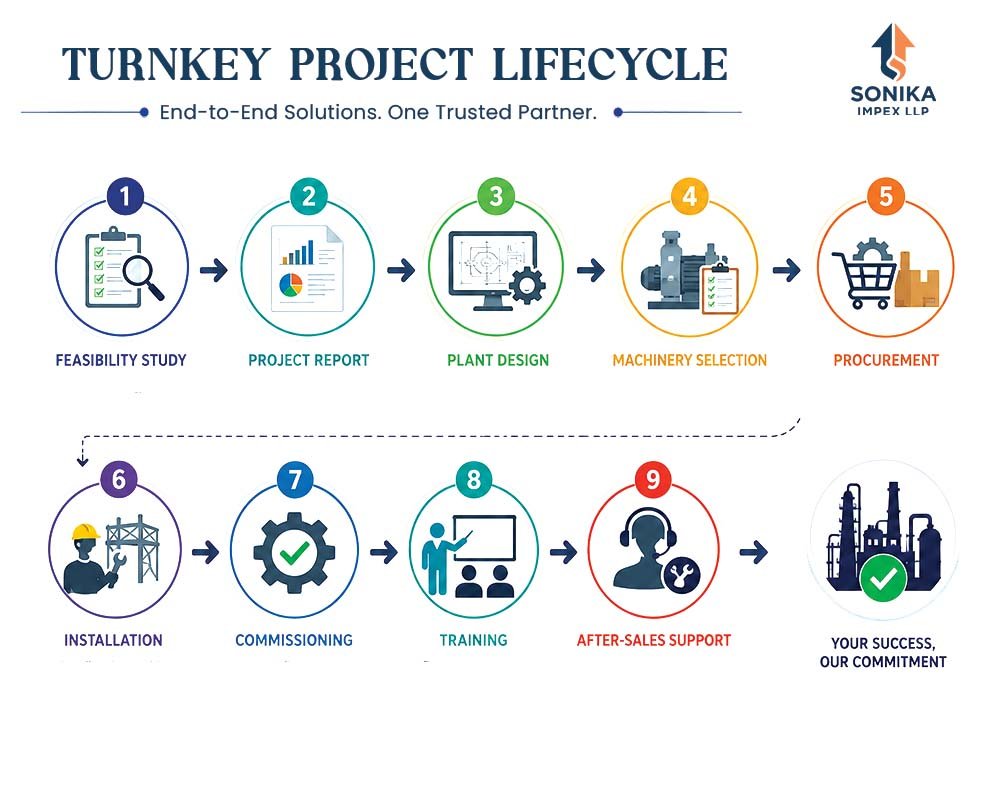
This is also why choosing the right machinery is only one part of the equation. A commercially viable project requires an integrated approach ; from fruit sourcing and processing technology to plant layout, utilities, packaging, installation, commissioning and operational support.
For businesses looking to establish or expand fruit-processing capacity in Africa, the opportunity is therefore not simply to process more fruit. It is to capture more value from the fruit that is already being produced and build stronger connections between farmers, processors and markets.
With experience in supplying machinery and developing turnkey industrial projects, Sonika Impex works with businesses looking to establish processing capabilities by bringing together equipment, project requirements and implementation support under one approach.
The African fruit-processing industry is still evolving and for companies prepared to invest in the right products, technology and markets, the next opportunity may be not just in producing fruit, but in processing it closer to where it is grown and creating greater value within Africa itself.
FAQ Section
Frequently Asked Questions About Fruit Processing in Africa
Which African country has the greatest fruit processing potential?
There is no single country that offers the greatest fruit-processing opportunity across every product category. Ghana, Uganda, Kenya, Tanzania, Nigeria, South Africa and Egypt each have different advantages based on fruit availability, domestic demand, processing infrastructure and access to regional or international markets.
For example, Ghana is particularly relevant for pineapple and tropical-fruit processing, Uganda for mango, pineapple and passion fruit, Kenya for avocado and mango, while Nigeria offers a particularly large domestic market for fruit-based beverages and ingredients.
The right country ultimately depends on the fruit, product and target market being considered.
Is fruit processing profitable in Africa?
Fruit processing can be commercially attractive, but profitability depends on factors such as raw-material availability, fruit prices, plant utilisation, processing yield, energy costs, packaging, labour, financing and market prices.
A feasibility study is therefore essential before investing in a processing plant. The objective should be to identify the right fruit, product, plant capacity and target market rather than simply installing machinery based on available raw materials.
What machinery is required for a fruit processing plant?
Machinery depends on the fruit and final product. A typical fruit-processing line may include fruit washers, sorting equipment, preparation machines, pulpers or extractors, filtration systems, blending tanks, pasteurisers, homogenisers, filling machines and packaging equipment.
Additional machinery such as evaporators, aseptic filling systems, freezing equipment or cold-storage systems may be required depending on whether the plant produces concentrate, shelf-stable puree, frozen fruit or other products.
The processing line should therefore be designed around the product specification, capacity and market requirement.
What products can be manufactured from fruit?
Fruit can be converted into a wide range of products, including:
- Juice
- Nectar
- Pulp
- Puree
- Concentrate
- Jam
- Dried fruit
- Frozen fruit
- Fruit-based beverages
- Food and beverage ingredients
The right product depends on the fruit available, processing technology, investment level and target market.
What are the major challenges facing fruit processing in Africa?
Major challenges include seasonal fruit availability, fragmented supply chains, inadequate cold-chain infrastructure, transportation, energy costs, inconsistent raw-material quality and limited processing infrastructure.
The OECD-FAO Agricultural Outlook 2025–2034 highlights transportation infrastructure and cold-chain development as important factors in the development of agricultural value chains.
This is why successful fruit-processing projects need to consider raw-material sourcing, collection, storage, processing, utilities, packaging and market access as one integrated system.