

Home › Fruit Processing Machinery › Colloid mill
Colloid Mill For Fruit Pastes, Sauces, Ketchup And Jam
What A Colloid Mill Does
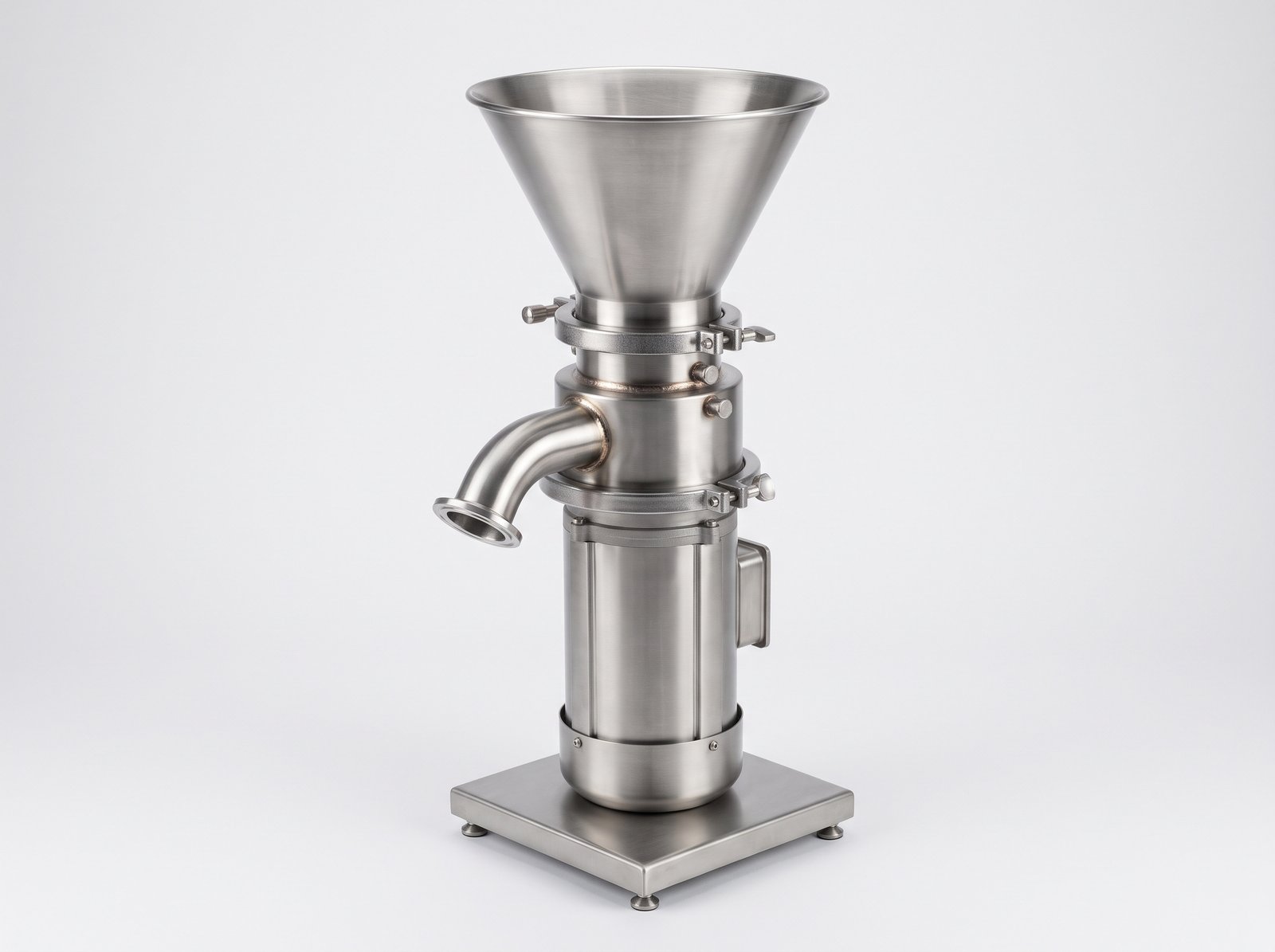
A colloid mill takes a coarse paste or a thick sauce and shears it between a fast-turning rotor and a fixed stator until the product is smooth and even. It breaks down the fibre and small particles a fruit pulper and finisher leaves behind, and it disperses spices, starch and other ingredients through the batch so they do not settle or clump. On a fruit processing line it is used for ketchup, sauces, chutneys, fruit spreads and some jams, after cooking and before filling.
Without it, or with the gap set wrongly, the product feels grainy on the tongue, separates in the bottle with a watery layer on top, and shows spice specks unevenly through the jar. A mill set too tight heats the product by friction and slows the line. A mill set too loose does little at all.
Colloid Mill Capacity
Colloid mills are offered at 50–100, 200–300, 500–750 and 1,000–1,500 kg/hour, from a small batch mill to a continuous mill. A mill takes product from the cooking kettles and serves ketchup, sauce and jam lines. The buyer chooses a mill that empties one kettle batch in good time for the next, so the kettles never wait on the mill. The mill is also matched to the filler that takes the finished product.
Where A Colloid Mill Sits In The Line
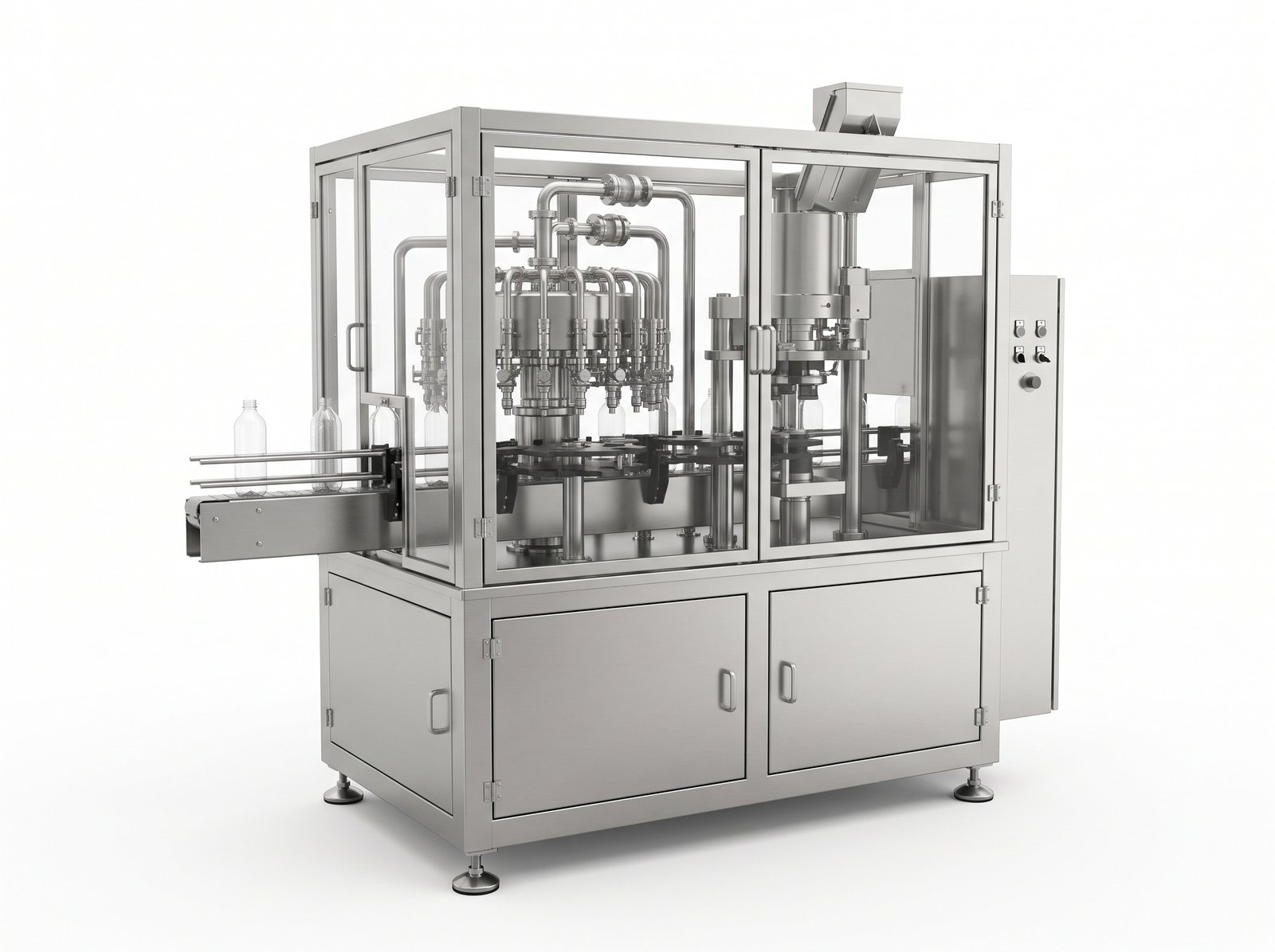
The mill sits after the steam-jacketed and vacuum cooking kettles and before the holding tank, the plate and tubular pasteuriser or the filler. Cooked ketchup, sauce or fruit preparation arrives from the kettle by transfer pump or gravity into the mill’s hopper. Smooth product leaves the outlet to a holding tank and then to the hot-fill bottle filling and capping machine or the pouch and jar filling machine.
On lines that also have a homogeniser, the colloid mill handles the thicker, more fibrous products. The homogeniser handles the thinner ones. The colloid mill and the homogeniser work side by side on the same line.
Colloid mill
This Machine

How It Works
1
The Rotor And Stator Inside A Colloid Mill
The mill has a conical rotor that turns at high speed inside a matching conical stator. The gap between them is very small and can be adjusted. The rotor is driven directly by an electric motor on the same shaft, mounted vertically or horizontally on a frame.
2
Shearing In The Colloid Mill Gap
Product fed from the hopper is drawn into the gap, where the speed difference between the turning rotor and the still stator tears particles and fibres apart. The same action spreads droplets and powders evenly through the liquid. The finer the gap, the finer the result. The ground product is thrown out of the gap into the outlet casing and leaves through the discharge.
3
Setting The Gap On A Colloid Mill
The gap is set with an adjusting ring or handle, with a scale so the operator can return to the same setting for each product. Each product the line makes has its own setting, so a change from ketchup to a chutney is a matter of turning back to a known mark.
4
Recirculation And Temperature Control In The Colloid Mill
Recirculation from the outlet back to the hopper lets a batch pass through more than once when a very smooth finish is wanted. Some mills have a cooling or heating jacket on the casing to control the temperature of the product as it is ground.
5
Construction And Cleaning Of The Colloid Mill
All parts that touch the product, the hopper, rotor, stator and casing, are stainless steel, and the shaft is sealed so product cannot reach the motor. The mill is stripped and washed after each product, so it is built to come apart quickly without special tools.
Types And Options
Vertical Colloid Mill
The motor sits under the grinding head and product drops in from a hopper above. It is the common type for ketchup, sauces and pastes on batch lines.
Horizontal Colloid Mill
The grinding head is on its side and product is fed by pump. It suits continuous lines and thinner products.
Colloid Mill Options
Each option is chosen to suit the product and the line around the mill.
- Jacketed grinding casing for cooling or heating.
- Recirculation back to the hopper for a second pass.
- Hopper size to suit the kettle batch.
- Stainless steel stand and motor cover for wash-down.
- Different rotor and stator surfaces for coarse or fine grinding.
What Decides The Choice Of A Colloid Mill
Six things settle which mill, and which settings, suit a line.
- The product: ketchup and sauces with spices need dispersion. Chutneys and jams with fruit pieces need a coarser setting or bypass.
- The texture the market expects: a very smooth sauce may need two passes or a finer rotor.
- Batch size and line rate: the mill must keep up with the kettle discharge so the filler is not left waiting.
- What comes before and after: a pulper with a fine finisher screen reduces the work the mill does. A homogeniser after it handles thinner products.
- Heat: products that thicken when warm, or lose flavour, call for a jacketed casing.
- Power and cleaning: the motor runs on site power, and the mill is washed after each product.
What A Colloid Mill Is Supplied With
- The mill, with stainless steel hopper, rotor, stator and casing.
- Directly coupled electric motor and shaft seal.
- Gap adjustment with scale.
- Stand or frame, with recirculation to the hopper where ordered.
- Starter or control panel.
- Manuals and an initial parts kit, including seals.
- Installation, commissioning and operator training at the buyer’s site.
Colloid Mill On Its Own Or In A Line
A colloid mill is supplied on its own to improve texture on an existing sauce or ketchup line. It is also supplied as part of the tomato ketchup plant, the tomato puree, paste and sauce plant and the jam and fruit preserves plant. In a complete plant the mill is sized together with the kettles before it and the filler after it.
Colloid Mill Inspection And Documentation
SGS or Bureau Veritas can inspect the mill before shipment as the buyer requires: the rotor and stator surfaces, the gap adjustment and its scale, the shaft seal and the contact-part steel. Manuals, the packing list and an initial parts kit of seals travel with the mill.
Frequently Asked Questions
What Is The Difference Between A Colloid Mill And A Homogeniser?
A colloid mill grinds thick, fibrous products in a rotor-stator gap. A homogeniser forces thinner liquids through a valve at high pressure. Ketchup and sauces can go through a colloid mill, a homogeniser or both. Juices and thin purees go through a homogeniser.
Can The Same Colloid Mill Handle Different Products?
Yes. The gap is set for each product, and the mill is washed between them.
Does A Colloid Mill Heat The Product?
Grinding adds some heat. A jacketed casing controls it where the product is sensitive.
Will A Colloid Mill Break Fruit Pieces In Jam?
Yes, at a fine setting. For jam with pieces, the mill is set coarse or the pieces are added after milling.
Related Machines

Cooks the ketchup, sauce or fruit preparation that the mill then grinds smooth.

Handles the thinner products on lines that also have a colloid mill. The mill takes the thicker, more fibrous ones.

Leaves the pulp whose remaining fibre and small particles the mill breaks down.
Next Step For Your Colloid Mill
Tell us the product, the texture you want and the batch size of your kettles, and we will send a customer-specific proposal. How we work sets out each stage, from the needs assessment to erection and commissioning. Write to archit@sonikaimpex.com or sunil@sonikaimpex.com, or call +91 99027 67900.