Choosing a Turnkey Plant Manufacturer in India: The Questions to Settle Before You Sign
November 11, 2026
Industrial Steam Boiler: What the Quote Should Contain, and Whether to Buy IBR or Non-IBR
November 13, 2026
Turnkey Fruit Processing Plant Setup Cost: Why Juice, Concentrate, Pulp and Packaged Fruit Lines Price So Differently
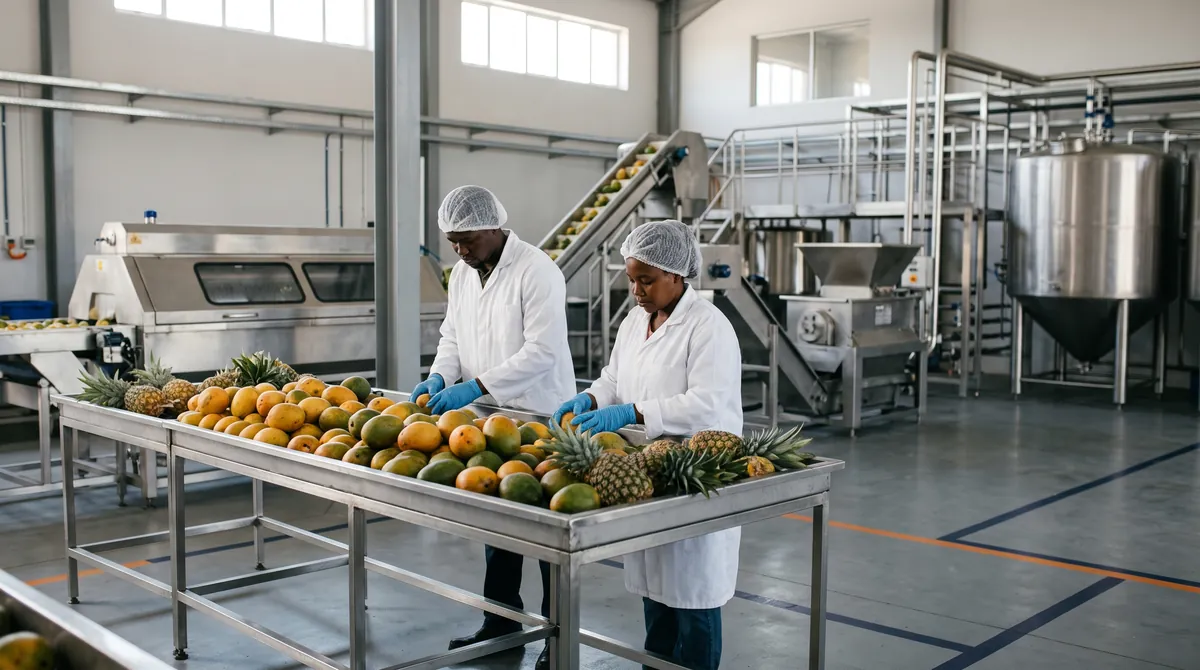
Before anyone can put a figure on a fruit processing plant cost, you have to decide what the plant will make. Juice, bulk pulp, concentrate, canned pieces, dried slices and fresh-cut packs share a washer and a sorting table, and very little after that. Each sets its own machines, steam, cold rooms and packing, so the product shapes the plant before any machine is sized.
This article takes each product line in turn, then the utilities, stores and season around it, and ends with the decisions to settle for your own project. It is written for first-plant buyers, processors adding a line, and the consultants and banks reviewing their projects.
In short:
- The product decides the line, utilities, packing and storage.
- Every line shares reception, washing and sorting.
- Juice and pulp part ways at the filler.
- Concentrate adds an evaporator, a boiler, its fuel and a frozen store.
- Canned, dried and fresh-cut lines keep fruit by heat, dry air or cold.
Contents
- Choose the product first: it decides the plant
- Reception, washing and sorting: the front end every fruit line shares
- Juice and pulp lines: extraction, finishing, pasteurising and filling
- Concentrate lines: evaporation and the steam it draws
- Packaged fruit: canned, dried and fresh-cut lines
- What the utilities and stores add to the fruit processing plant cost
- Running a fruit plant beyond one season
- What this means in Ghana, Cote d’Ivoire, Uganda and Rwanda
- Decisions to settle for your own project
- How Sonika Impex LLP can help
- Frequently asked questions
- Final thoughts
- Sources
Choose the product first: it decides the plant
The Codex Alimentarius Commission sets minimum Brix levels for reconstituted juice and purée, and minimum juice or purée contents for nectars, in CXS 247-2005 [1]. Each of those definitions carries its own process. A nectar line needs blending and sugar handling, and juice from concentrate needs reconstitution. Pulp sold to another processor needs sterile bulk packing.
So the first decision is a written one: the product, the pack, and the buyer who will take it. Every later choice in this article follows from it. Bottled juice and bulk pulp can start from the same fruit and end as two different projects.
Reception, washing and sorting: the front end every fruit line shares
FAO’s fruit juice processing manual says removing unsound fruit matters more in juice processing than in whole fruit processing, and that the human eye, hand and mind still commonly make the final sorting decision [2]. So the sorting table needs people, light and space in the layout.
Water is the other front-end decision. The same FAO manual calls water quality an expensive but essential feature of any quality juice plant, with chlorination and recycling usually necessary [2]. Plan the treated supply, recirculation and drainage as part of your project, and settle who supplies each.
Size reception, washing and sorting for the peak day. Size the line behind them for the steady rate.
Juice and pulp lines: extraction, finishing, pasteurising and filling
Juice and pulp lines share most machines and part ways at the filler. The steps below run in the order the fruit meets them, from FAO’s tropical fruit chapter [3] and its juice manufacture chapter [2].
- Preparation. Fruit is peeled, cut or destoned; mango’s leathery peel resists mechanical peeling [3].
- Extraction. A pulper separates pulp from skin and seeds; for mango, a paddle pulper with brushes [3].
- Finishing. A finer screen removes fibre and seed: about 0.5 to 1 mm for pineapple, and 0.3 to 0.8 mm for passion fruit, per the tropical fruit chapter [3].
- Deaeration. Oxygen promotes browning, so heated juice is flashed into a vacuum chamber, as the juice manufacture chapter describes [2].
- Pasteurising. Mango puree is acidified and hot filled, then cooled rapidly, as FAO’s tropical fruit chapter describes [3].
- Filling. Juice goes hot into bottles or pouches. Pulp is cooled and filled aseptically into sterile bulk containers.
- Storage and dispatch.
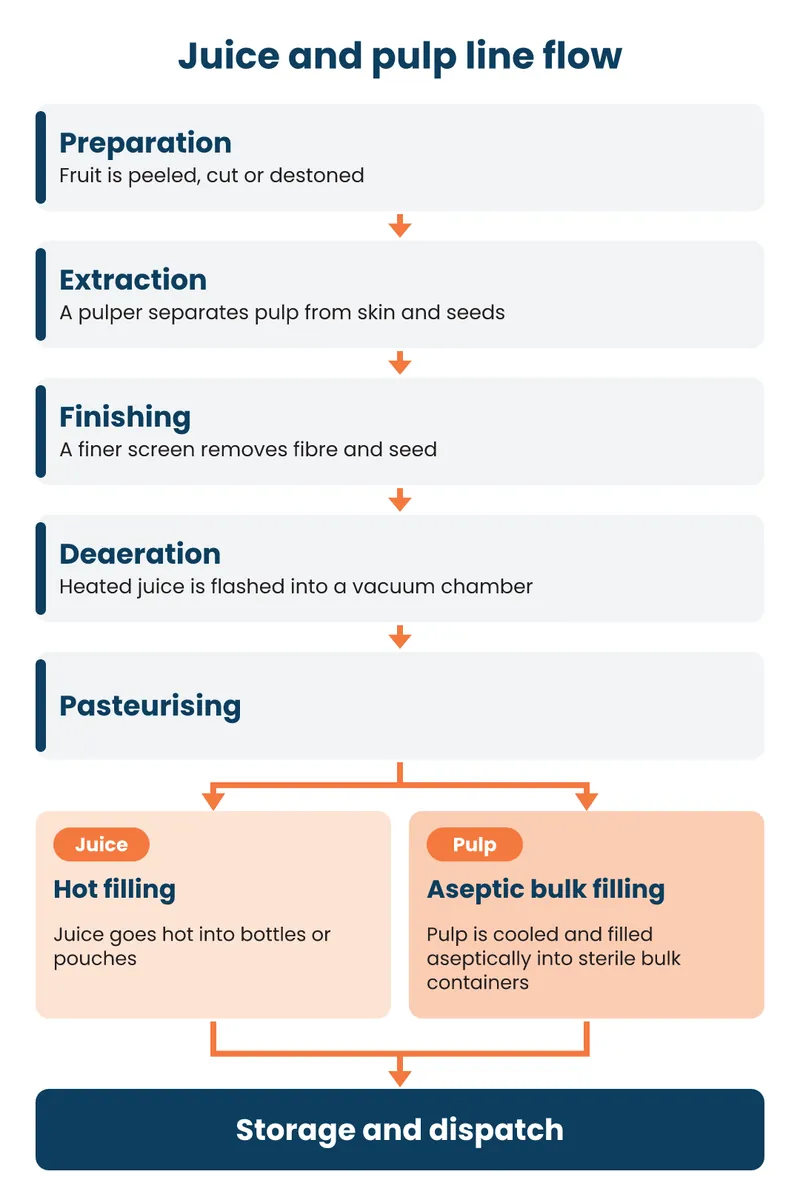
Flow: preparation, extraction, finishing, deaeration, pasteurising, then hot filling for juice or aseptic bulk filling for pulp, then storage and dispatch.
FAO’s chapter on juice preservation explains that aseptic processing needs rapid heating and cooling, with a sterile system after the pasteuriser, cooler and filler included [4]. In return, the same chapter says, many hundreds to thousands of litres can be processed, transported and held [4]. What aseptic pulp buys you is stock that a filling line, or another processor, can draw on later.
Concentrate lines: evaporation and the steam it draws
A concentrate line adds an evaporator, which boils water off under vacuum to the target Brix. FAO’s tropical fruit chapter notes that pineapple juice can be concentrated [3]. That heat arrives as steam, so the line brings a boiler, its fuel, treated feed water and an operator.
The number of effects decides how hard the boiler works, because vapour from one effect heats the next. A 2024 simulation study compared a single-effect evaporator with a forward-feed triple-effect evaporator on the same feed and Brix duty [5].
| Design | Vessels | Steam drawn in the study | Steam economy in the study | Heat transfer (UA) |
|---|---|---|---|---|
| Single-effect | One, simpler | Highest | Lowest | Lower [5] |
| Forward-feed triple-effect | Three in series | Far lower | Highest | Highest modelled [5] |
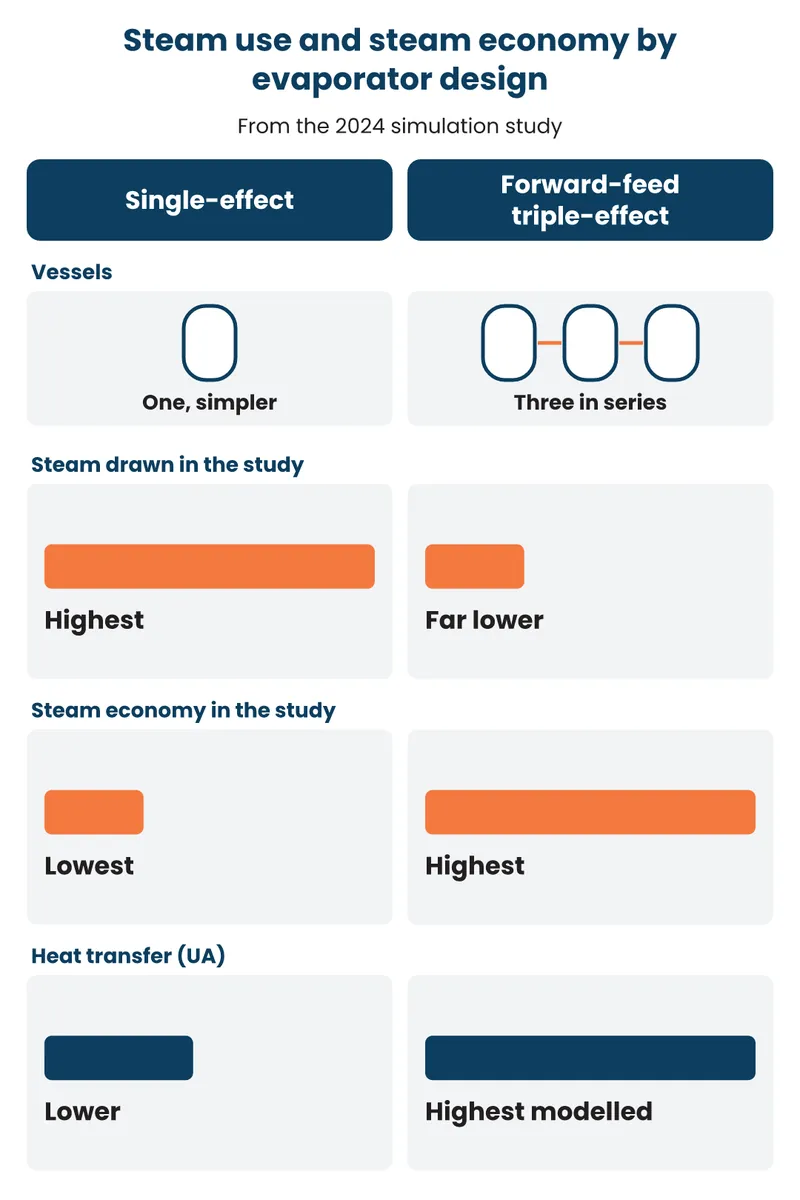
Caption: Steam use and steam economy by evaporator design, from the 2024 simulation [5]. Source: 2024 evaporator simulation study [5].
In that study, the triple-effect design cut steam use at the price of the most heat transfer capacity, reported as UA [5]. Your own figures depend on your fruit, your Brix and your evaporator. The boiler and its fuel follow from that steam use for as long as the line runs, so budget them with the evaporator.
Concentrate is then held frozen. FAO’s chapter on juice preservation notes that holding concentrate frozen is widely practised [4]. Ask for the evaporator’s steam use on your fruit at your target Brix, and size the boiler and frozen store from it.
Packaged fruit: canned, dried and fresh-cut lines
A canning line seals fruit in cans or jars, then heats them. FAO’s small-scale processing manual sterilises jars of pineapple in syrup in boiling water [6]. Low-acid product is a separate case: FAO’s juice preservation chapter calls for a higher process temperature, under pressure, for it [4]. So canning lines acidify where the fruit allows, and the retort and its steam sit at the centre.
A drying line removes water with warm air. The FAO small-scale manual dries mango pulp to a leather-like consistency at about 15% moisture [6]. The utility is heat and airflow, and the product needs sealed bags and a dry store.
A fresh-cut line packs sliced fruit for quick sale, and its utility is cold, from chilled rooms to refrigerated transport. It needs a buyer who takes the product within days, so confirm that buyer first.
What the utilities and stores add to the fruit processing plant cost
The table sets out what surrounds the machines for each product. The last column is what you decide and confirm for your own project, because each item adds to the fruit processing plant cost alongside the machines.
| Product | Key machines | Utilities | Packing | Storage | Decide and confirm |
|---|---|---|---|---|---|
| Juice | Extractor, pasteuriser, filler | Treated water, steam | Bottles, caps | Dry store | Water source and treatment |
| Bulk pulp | Pulper, steriliser, aseptic filler | Steam, chilled water | Sterile bulk containers | Bulk store | Container stock |
| Concentrate | Pulp line, evaporator | Heavy steam | Sterile bulk containers | Frozen store | Boiler, fuel, frozen store |
| Canned fruit | Slicer, seamer, retort | Steam, treated water | Cans or jars | Warehouse | Retort steam supply |
| Dried fruit | Slicer, dryer | Heat, airflow | Sealed bags | Dry store | Dryer heat source |
| Fresh-cut | Peeler, slicer, wash tank | Refrigeration | Trays, film | Cold store | Chilled transport |
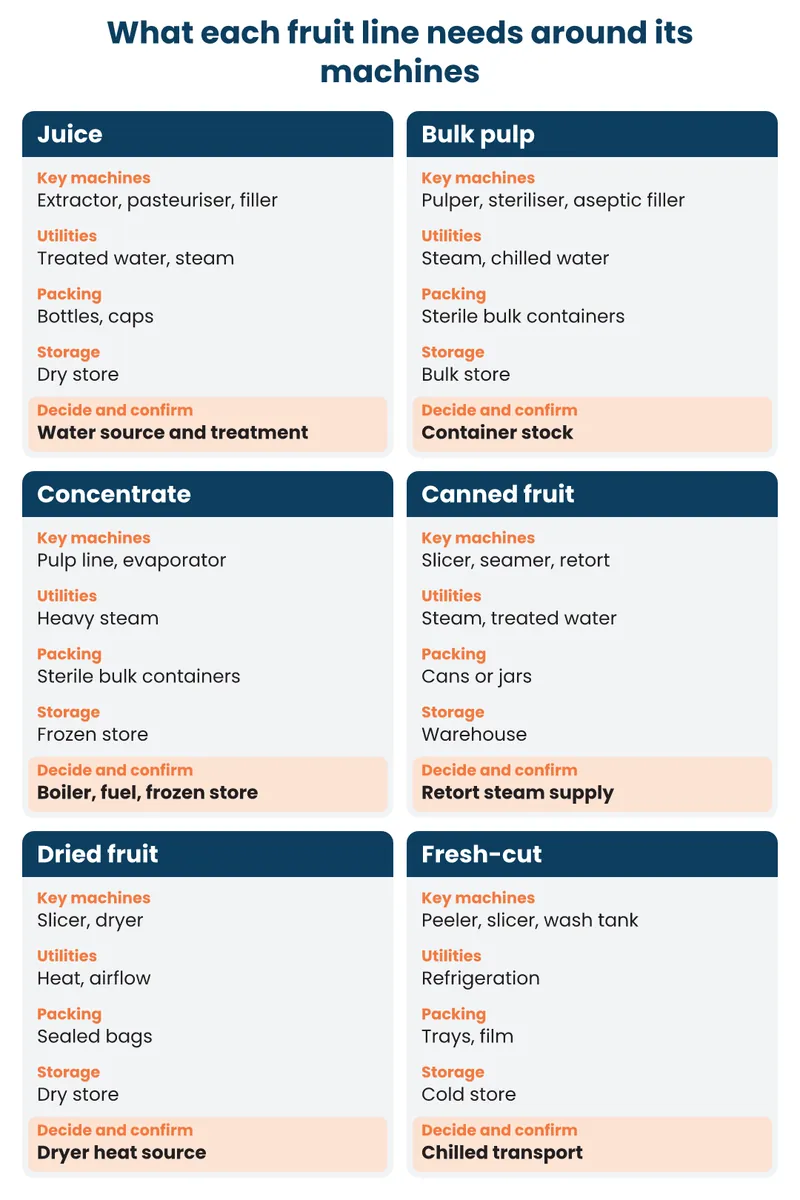
Caption: What each fruit line needs around its machines. Source: Sonika Impex team summary of the FAO manuals [2] [4] [6].
Steam is heaviest on the concentrate line, where the evaporator draws it, so the boiler house and its fuel weigh most there. A juice line leans on treated water instead. A fresh-cut line leans on cold, from the packing room to the buyer’s door.
Running a fruit plant beyond one season
A plant that runs through one harvest carries its capital cost on a few months of output, and the bank will see that in the cash flow. In Ghana, the 2024 main mango season ran from May to July, the Ghana News Agency reported in June 2024 [7]. Outside those months, a single-fruit line stands idle.
One way to spread the year is a multi-fruit line, with changeable screens for mango, pineapple and passion fruit. The other is stock: bulk pulp and frozen concentrate let a filling line run after the fresh fruit has gone. Stock ties up cash until it sells, so plan that working capital with the machines.
What this means in Ghana, Cote d’Ivoire, Uganda and Rwanda
Ghana
At a June 2024 launch, the country’s tree crops regulator put Ghana’s mango at about 200,000 hectares producing 300,000 to 400,000 tonnes a year, the Ghana News Agency reported in June 2024 [7]. The national total says nothing about farms within reach of your site, so secure supply in writing before sizing reception and the bulk store.
Ghana typically uses ISO, Codex or IEC standards, according to a US government trade guide [8]. The Ghana Standards Authority publishes standards, and the Food and Drugs Authority enforces them for food, the same guide says [8]. Confirm with the Ghana Standards Authority which juice standard your product will be tested against.
Cote d’Ivoire
We found no current national production figure or juice standard for Cote d’Ivoire that we could cite. Ask the national standards body which juice and pulp standards apply, and get intake volumes and months in writing from your growers.
Uganda
Uganda adopted the East African Standard for fruit juices, puree, pulp and nectars as US EAS 948:2023 on 6 August 2024, as technical barriers to trade notification G/TBT/N/UGA/1695/Add.2 records [9]. Confirm the edition in force with the Uganda National Bureau of Standards, because the product will be tested against it.
Rwanda
Rwanda exported 97,165 tonnes of fruit and vegetables in 2024, and showed passion fruit among its produce in Berlin in February 2025, its national agricultural export board reported [10]. A passion fruit pulp line buys fruit that also has a fresh export outlet, so confirm volumes and prices with growers first.
EAS 948:2022 was adopted as an East African Standard on 25 August 2023, as an earlier notification, G/TBT/N/RWA/721/Add.1, records [11]. Confirm the version in force in Rwanda with the Rwanda Standards Board.
Decisions to settle for your own project
Each answer changes the plant, so settle them before the scope is fixed. The needs assessment and the budget start from them.
- Which product, in which pack, for which buyer?
- What is the peak daily fruit intake, and how long does the peak last?
- Which fruits will the line run, and which screens and spares does each one need?
- How much steam, chilled water and treated water will the line draw, cleaning included?
- How will the product be held: hot-filled packs, sterile bulk containers or a frozen store?
- Which standard will the product be tested against, and in which market?
- Can commissioning fall in the fruit season, so the line is proven on real product?
- What can wait? A pulp line can come now and an evaporator later, if the layout and boiler house leave room.
How Sonika Impex LLP can help
For a fruit processing project, Sonika Impex LLP provides:
- A needs assessment: what the plant needs now and later, with a plain word when something is not needed yet
- Turnkey fruit and vegetable processing plants from 150 kg/hour to 10 TPH of fresh fruit, standalone machinery and working capital materials, from a single point of service
- Steam boilers from 80–100 kg/hour to 8 TPH, available IBR certified, and packaging machinery
- Pre-shipment inspection and packing, with third-party inspection by SGS or Bureau Veritas as required
- Export, FOB by preference or CIF
- Erection, commissioning, training for project and maintenance staff at your site, and after-sales support
- Introductions to banks, financial institutions and other institutions that can help the project
Send us:
- What you want to make, in which pack, and how much
- Which fruits you can buy, in which months
- Peak and average daily fruit intake
- The site, its power and its water
- Any equipment already installed
+91 99027 67900 · sonikaimpex.com
Frequently asked questions
Do I need a laboratory at the plant?
You need Brix, pH and acidity checks on every batch, plus basic hygiene tests on surfaces and water. Keep a retained sample from each batch so a complaint can be traced to its day. More complex tests, such as microbiology for an export buyer, can go to an outside accredited laboratory.
What Brix does fruit arrive at?
As a planning basis, mango arrives at about 14 to 16 Brix, pineapple at 12 to 14 and orange at 9 to 11. Your own fruit will vary with variety, ripeness and season, so test it across a full season before the line is designed. A refractometer at reception reads Brix quickly and lets you grade fruit before it enters the line.
How much water will a fruit plant use?
It depends on the fruit, the washing system and the cleaning routine, and we found no single figure that holds across plants. [FAO’s juice manual](https://www.fao.org/4/Y2515E/y2515e07.htm) notes that efficient equipment reduces wash water use, and that a screen shaker with air jets and dry brushes can cut it further where the fruit tolerates mechanical handling [2]. Ask for consumption at full output, cleaning included, and size the water treatment to it.
What does cleaning add to a fruit line?
Fruit sugars and pulp foul pipes, heat exchangers and fillers, so every product run ends with cleaning. A clean-in-place system needs its own tanks, pumps, detergent storage, hot water and steam. CIP sets range from a manual single-tank set to two- or three-tank automatic sets. Settle which one your plant needs, and what it draws from the boiler and the water supply in each cycle.
What happens to wash water and peel?
A fruit plant discharges wash water, cleaning solutions and solid waste such as peel, seeds and rejected fruit. Each needs a route: an effluent treatment step for the water, and a collection point and buyer or disposal plan for the solids. Confirm the discharge rules with the environmental regulator before the site layout is fixed.
Can the plant recover anything from pineapple peel?
[FAO’s tropical fruit chapter](https://www.fao.org/4/Y2515E/y2515e17.htm) describes juice recovered from flesh scooped from the shell and ends, processed together with peeled off-size fruit and core [3]. The [same chapter](https://www.fao.org/4/Y2515E/y2515e17.htm) warns that too much shell material gives dark specks and a harsh flavour [3]. So recovery needs controlled scooping, and the rest of the peel still needs its own route.
What power supply does a fruit plant need?
Ask for the connected load of every motor, heater and refrigeration compressor, and the starting load of the largest. A frozen store runs day and night, out of season too, so it sets a base load the supply must carry all year. A standby generator for the cold store protects stock during outages.
Which packing materials should be ordered with the plant?
Order enough bottles, caps, sterile bulk bags, cans or pouches for trial runs and the first weeks of production. Pack sizes seen on fruit lines include PET bottles of 300 and 500 ml, glass of 350 and 500 ml, cans of 450 ml, 850 g and 1 kg, and pouches of 250 to 1,000 ml. Packing that matches the filler exactly avoids stoppages at commissioning, so buy to the specification each filler accepts.
Which stainless steel should the contact parts be made of?
Food machines are built in stainless steel. SS 304 (AISI 304) suits general contact parts and frames. SS 316 or 316L (AISI 316 / 316L) suits acid, pulpy or hot product. A fruit line handles acid, pulpy and hot product at several stages, so settle the grade machine by machine for your own product.
What steam pressure and compressed air does a fruit plant run on?
As a design basis, steam reaches the plant at 3 to 4 bar, and the evaporator takes it at 9 bar. Compressed air runs at 6 to 7 bar. Confirm both for your own line, because the boiler and the compressor are sized from them.
Final thoughts
This article opened on the decision that comes before any figure: what the plant will make. The fruit processing plant cost then follows from three answers you can give before the first drawing. They are the product and its buyer, the tonnes your front end must clear on the peak day, and how you will hold the product. Settle those for your own project, and every figure you are shown will describe the plant you mean to build.
For the full picture, read our guide: [What an industrial machinery quote leaves out: the costs between the price and a running plant](/what-an-industrial-machinery-quote-leaves-out).
Sources
- Codex Alimentarius Commission, FAO/WHO | Ad Hoc Intergovernmental Task Force on Fruit and Vegetable Juices: General Standard for Fruit Juices and Nectars, CXS 247-2005, standard in force | https://codex.fao.org/codex-committees/ad-hoc-intergovernmental-task-forces/TFFJ (accessed 2026-10-19)
- FAO | Principles and practices of small- and medium-scale fruit juice processing, Chapter 6: General juice manufacture principles, FAO Agricultural Services Bulletin 146, 2001 | https://www.fao.org/4/Y2515E/y2515e07.htm (accessed 2026-10-19)
- FAO | Principles and practices of small- and medium-scale fruit juice processing, Chapter 15: Tropical fruits, 2001 | https://www.fao.org/4/Y2515E/y2515e17.htm (accessed 2026-10-19)
- FAO | Principles and practices of small- and medium-scale fruit juice processing, Chapter 8: Juice stabilization and preservation, 2001 | https://www.fao.org/4/Y2515E/y2515e09.htm (accessed 2026-10-19)
- Chemical Product and Process Modeling, De Gruyter | Simulation of single-effect and triple-effect evaporator for fruit juice concentration using Aspen HYSYS, 2024 | https://www.degruyterbrill.com/document/doi/10.1515/cppm-2023-0093/pdf (accessed 2026-10-19)
- FAO Regional Office for Latin America and the Caribbean | Technical manual on small-scale processing of fruits and vegetables: Processes, 1997 | https://www.fao.org/4/x0209e/x0209e07.htm (accessed 2026-10-19)
- Ghana News Agency | Ministry of Food and Agriculture announces maiden minimum producer price of mango per kg, published 28 June 2024 | https://gna.org.gh/2024/06/ministry-of-food-and-agriculture-announces-maiden-minimum-producer-price-of-mango-per-kg/ (accessed 2026-10-19)
- International Trade Administration, US Department of Commerce | Ghana Country Commercial Guide: Standards for Trade, published 6 August 2025 | https://www.trade.gov/country-commercial-guides/ghana-standards-trade (accessed 2026-10-19)
- WTO TBT notification G/TBT/N/UGA/1695/Add.2, relayed by the National Standardization Agency of Indonesia | DEAS 948:2022 Fruit juices, puree, pulp and nectars: adoption as US EAS 948:2023 on 6 August 2024 | https://tbt.bsn.go.id/notification_detail/54527 (accessed 2026-10-19)
- National Agricultural Export Development Board, Rwanda | Rwanda showcases fresh produce at Fruit Logistica 2025 trade show, February 2025 | https://www.naeb.gov.rw/publications/news/rwanda-showcases-fresh-produce-at-fruit-logistica-2025-trade-show (accessed 2026-10-19)
- WTO TBT notification G/TBT/N/RWA/721/Add.1, relayed by the National Standardization Agency of Indonesia | DEAS 948:2022 Fruit juices, puree, pulp and nectars: adoption as EAS 948:2022 on 25 August 2023 | https://tbt.bsn.go.id/notification_detail/51177 (accessed 2026-10-19)