Milk arrives on the morning’s terms, not the plant’s
November 22, 2026
Wheat and Maize Milling Machines: Where the Tonnage Goes Between the Truck and the Rolls
November 24, 2026
What Sets the Output of a Poultry Feed Manufacturing Plant: The Ingredient Store Behind the Mixer
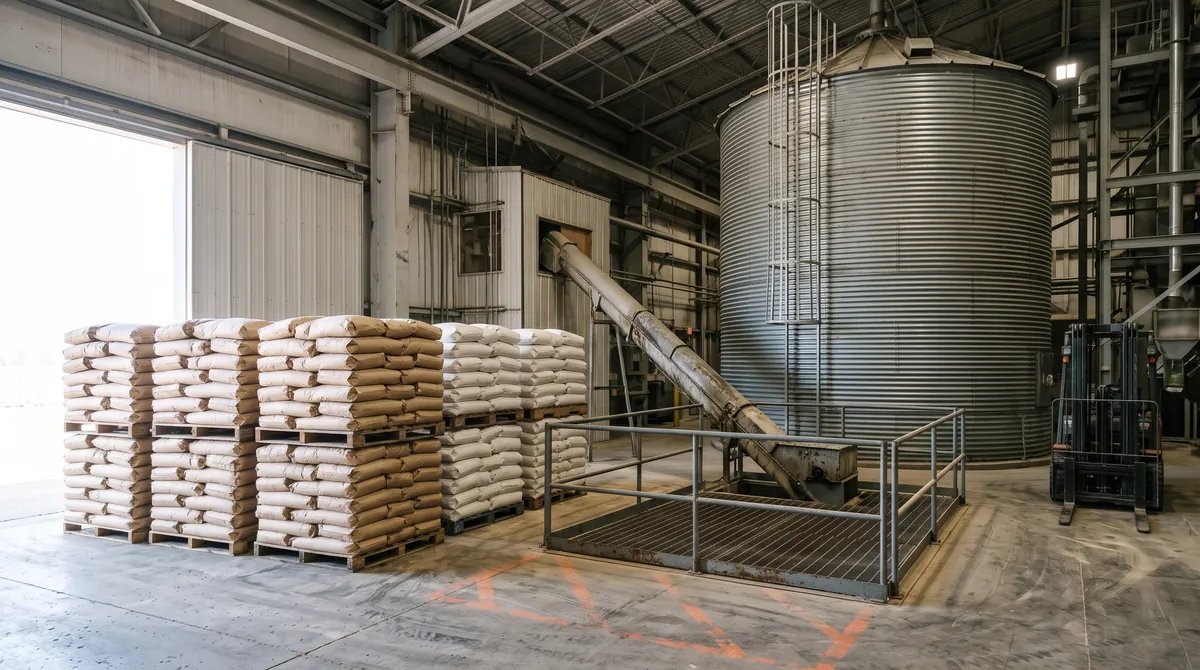
In July 2026, The New Times reported Rwanda’s agriculture ministry putting the country’s feed manufacturers at about 53 percent of their installed capacity [3]. In September 2026, the Daily Monitor reported Uganda’s oilseed processors short of soybeans, a raw material that also goes into animal feed [6]. It is tempting to judge a poultry feed manufacturing plant by its mixer and pellet press. Its real output is set earlier, by how much maize and protein it can hold, and keep in condition, until the press needs them.
This piece is for owners planning or expanding a feed mill plant, and follows the material from intake to the farm order.
In short:
- A feed mill runs only as long as its smallest ingredient stock lasts.
- Each ingredient has its own supply gap, and each gap sets its own store.
- Stored ingredients must stay dry and be used in order, because feed standards cap moisture and aflatoxin.
- Bins inside the mill let each stage run steadily while the next one pauses.
- The bagged feed store is sized to farm collections, and the processing rate is fixed last.
Contents
- Every ingredient arrives on its own calendar
- Holding weeks of protein and maize, one ingredient at a time
- Keeping maize, soya and premix fit to use
- The bins inside the mill: batching, mash and pellet buffers
- Bagged feed and the farms’ ordering cycle
- Sizing a poultry feed manufacturing plant from the stores outward
- What this means in Ghana, Cote d’Ivoire, Uganda and Rwanda
- What to ask before investing in a feed mill plant
- How Sonika Impex LLP can help
- Frequently asked questions
- Final thoughts
Every ingredient arrives on its own calendar
In Rwanda, maize makes up about half of feed formulations and soybean roughly 30 percent, according to the same New Times report [3]. Those shares decide how many tonnes of each the stores must hold.
In Uganda, FAO’s GIEWS country brief of May 2026 said first season crops planted in February and March 2026 would be harvested in June and July [1]. In southern Ghana, FAO’s GIEWS brief for Ghana expected the 2025 main season maize harvest to conclude in September [4].
FAO’s GIEWS brief for Rwanda recorded a seasonal rise of 42 percent in maize prices between March and October 2025, supported in part by poultry sector demand [2]. A mill holding maize bought at harvest had already fixed most of that cost. A mill buying week by week paid the rise.
Protein follows a different calendar again. Ghana was forecast to import 60,000 tonnes of soybean meal in the 2024/25 marketing year, according to the USDA Foreign Agricultural Service [5]. Cote d’Ivoire imported soybean meal worth 97.3 million euros in 2024, according to France’s Direction générale du Trésor [7].
Here’s the catch. The ingredient you hold least of is the one that stops the plant. That is the Rwanda capacity figure seen from inside a mill.
Holding weeks of protein and maize, one ingredient at a time
Each ingredient needs a store sized to its own gap: how long the plant must run from stock before the next lot can be relied on. For maize bought at harvest, the gap runs from one harvest window to the next. For protein meal, it runs from one consignment to the next, plus any delay at port or on the road. For premix, the stock covers the time to reorder with room to spare.
An FAO paper on feed milling notes that protein supply is often scarce and discontinuous, so storage in well-run feed mills is commonly sized to several weeks of production [8]. Yet the Codex code of practice on good animal feeding says feed ingredients should be used as soon as possible [9]. Those two pull against each other, so the holding period is set per ingredient.
The trick is to size each store separately. A plant with ample maize space and too little protein space stops with a full maize bin.
Size the store for each ingredient against that ingredient’s own supply gap, and fix daily output only after every gap is covered.
Keeping maize, soya and premix fit to use
A store that lets material deteriorate leaves the plant just as short, and the loss is harder to see.
Moisture comes first. The Codex code of practice says dry feeds should be kept dry to limit fungal and bacterial growth [9]. The draft East African maize grain standard, published for review by the Rwanda Standards Board, caps moisture at 13.5 percent [10], and the draft East African standard for compounded poultry feed caps it at 13 percent [11]. The same draft maize standard limits total aflatoxin to 10 µg/kg and aflatoxin B1 to 5 µg/kg [10]. So an intake moisture check, and the right to dry or refuse a wet lot, belongs at the front of the plant.
An FAO manual on good practices for the feed sector lists relative humidity, temperature and oxygen as the outside drivers of fungal growth and mycotoxin production [12]. So specify ventilation, dry floors and shade for your climate.
Aflatoxin needs its own attention, because it survives the mill. The same FAO manual notes that most mycotoxins survive feed processing and that by-product feeds often concentrate them [12]. The draft East African poultry feed standard sets aflatoxin B1 limits of 10 µg/kg for starter and grower feeds and 20 µg/kg for layer, breeder and broiler finisher feeds [11].
The Codex code expects ingredients to be inspected, sampled and analysed for undesirable substances, with records of each receipt and batch produced [9]. In practice: first in, first out, a sample from every lot, and lot records for each batch.
The bins inside the mill: batching, mash and pellet buffers
The bins between the stages decide whether the mixer and press work at their rated pace. A pelleted poultry feed line runs in this order:
- Intake and cleaning. Ingredients are screened before binning.
- Ingredient bins. Major and minor ingredients are held separately.
- Grinding. Maize and coarse ingredients are ground.
- Batching. Each ingredient is weighed, with premix in its own bin.
- Mixing. The batch is mixed until uniform.
- Mash surge bin. Mash waits and is metered steadily to the press.
- Conditioning. Steam is added.
- Pelleting. The mash is pressed into pellets.
- Cooling. Pellets are cooled and dried.
- Crumbling and screening. Pellets may be crumbled, then screened, with fines returned.
- Bagging. Feed goes to a bagging bin or a bulk truck.
As one flow: intake, bins, grinding, batching, mixing, mash bin, conditioning, pelleting, cooling, screening, bagging.
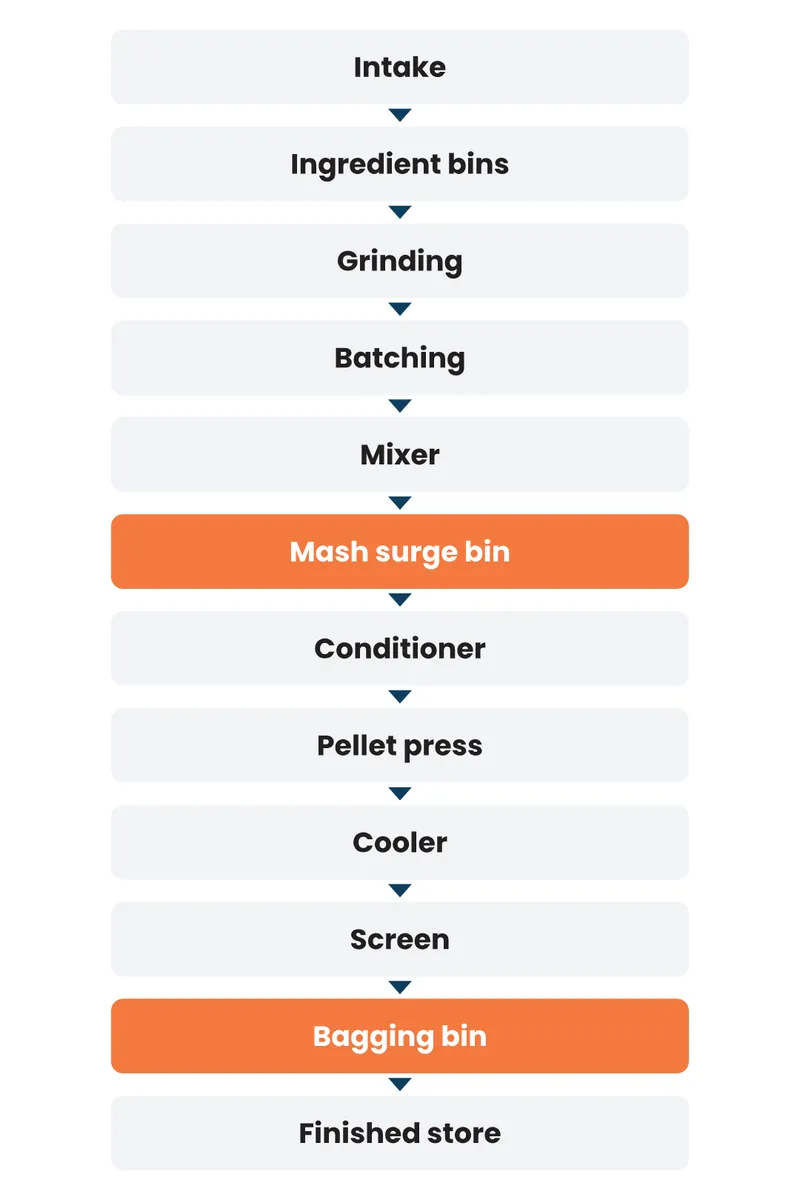
The mixer works in batches and the press continuously, so without a mash bin the press stops between batches. Without a bagging bin, the cooler stops at every bag change.
Bagged feed and the farms’ ordering cycle
Bagged feed waits for farms that order to their own rhythm, set by flock placements, cash flow and storage.
A small finished store assumes feed leaves the day it is made. A missed truck or a public holiday fills it, and the mill must stop or stack bags where they will be damaged.
Finished feed also has a shelf life. The draft East African poultry feed standard requires each bag to carry storage instructions and an expiry date [11]. So size the finished store from the dispatch pattern: how often farms collect, how much they take, and what happens in a bad week, all within the shelf life on the label.
Sizing a poultry feed manufacturing plant from the stores outward
Work outward from the stores, and fix the processing rate last.
- List the ration. Note each ingredient’s share in every feed.
- Map each supply pattern. Note the longest gap between reliable lots.
- Size each raw material store. Match holding time to the supply gap, using each lot as soon as possible.
- Specify condition control. Add moisture testing, drying, ventilation, sampling and lot records.
- Size the bins inside the mill. Match mash and bagging bins to press, cooler and bagger stops.
- Size the finished store. Match it to collections and a bad week, within the expiry date on the bag.
- Fix the processing rate. Choose the press for the output the stores can sustain all year.
The table lists every store in the plant, so a proposal that leaves any row blank has left part of the plant unplanned.
| Store | Sized against | Condition it must keep |
|---|---|---|
| Maize store | Gap between harvests | Dry, ventilated, rotated |
| Protein meal store | Gap between consignments | Cool, dry, rotated |
| Premix store | Reorder time | Dry, sealed, by lot |
| Ingredient bins | Batching rhythm | Monitored for heating |
| Mash surge bin | Gap between batches | Even flow |
| Bagging bin | Bag changes | Screened |
| Finished feed store | Farm collections | Cool, dry, separate |
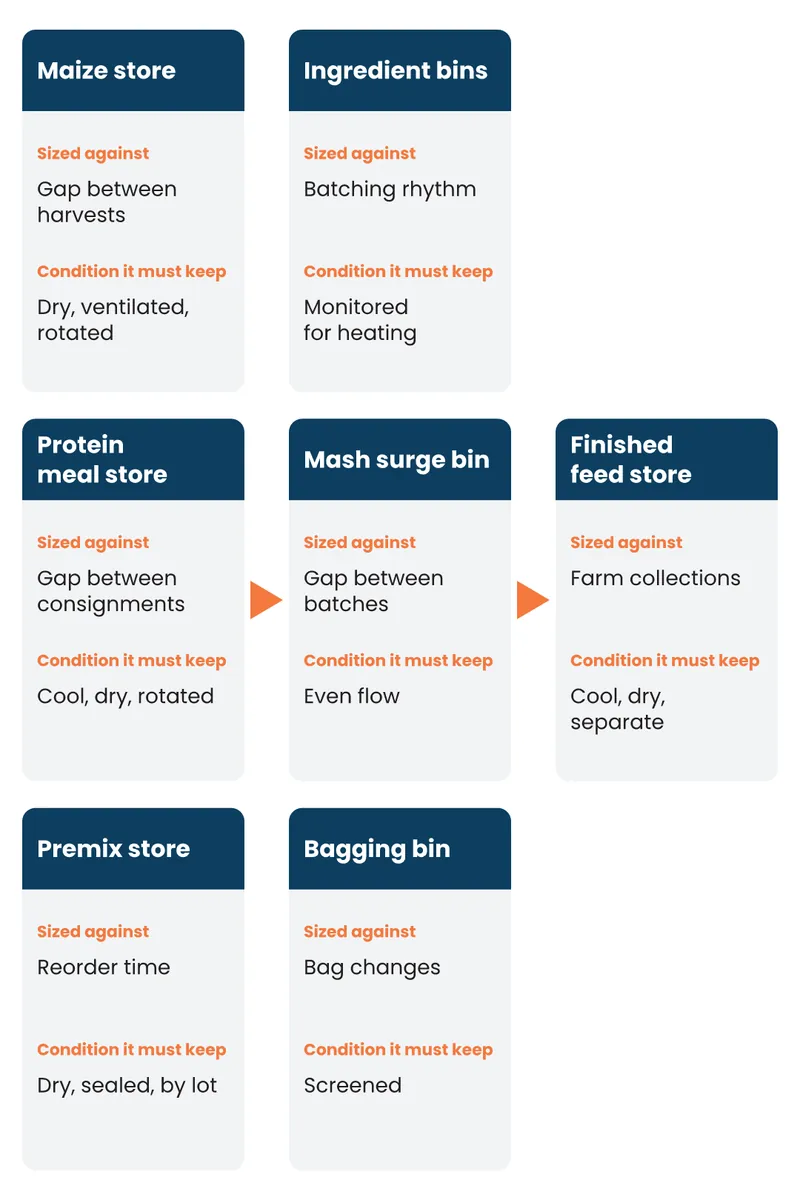
Caption: Every store in a feed mill, what sets its size and the condition it must keep. Source: this article’s sizing method; storage conditions from the Codex code [9].
What this means in Ghana, Cote d’Ivoire, Uganda and Rwanda
Ghana
The north sows cereals between May and July, according to FAO’s GIEWS brief for Ghana [4], so a mill buying from both regions plans its maize store around more than one intake window. The Ghana Standards Authority can confiscate goods that do not comply with standards, according to a US government trade guide [14], so confirm feed aflatoxin limits with it before setting intake limits.
Cote d’Ivoire
In the south and centre, the 2024 main maize harvest ended in September, and the second season harvest ran into early 2025, according to FAO’s GIEWS brief for Cote d’Ivoire [15]. With soybean meal imported, as France’s Direction générale du Trésor records [7], the protein store follows consignments through Abidjan.
Uganda
Uganda’s Animal Feeds Act, 2024 requires approved premises and an annual licence to produce or store feed, access to an approved quality control laboratory, a nutritionist’s certificate of analysis for each batch, and a permit for feed imports [13]. The stores are part of the licensed premises, and lot records support each batch certificate.
Rwanda
Rwanda produces about 508,492 tonnes of maize and 29,059 tonnes of soybeans a year, and soybean output falls short of demand, according to The New Times [3]. So the protein store carries the larger risk. The Rwanda Standards Board lists RS 98, a code of practice covering feed storage, among the sector’s standards [16]. The Rwanda Food and Drugs Authority keeps a register of licensed animal feed premises [17]; confirm with it which licence a feed mill needs. Add inland transit from Mombasa or Dar-es-Salaam to every consignment gap.
What to ask before investing in a feed mill plant
The common mistakes are choosing the press first, using one warehouse figure for all ingredients, and leaving out drying. Each leaves the press waiting. Before comparing quotes for animal feed plant machinery, ask of every proposal:
- How many days can the plant run on each major ingredient held on site?
- How is wet maize handled at intake, and who decides whether a lot is accepted?
- What sizes are the mash and bagging bins, and which stoppages do they cover?
- How many days of bagged feed can be stored before the press must stop?
- Is the daily output on the quote the output the stores can sustain all year?
How Sonika Impex LLP can help
Sonika Impex LLP can supply:
- A needs assessment of what you need now and later, with a plan for both, saying plainly when something is not needed yet.
- Feed mill plants from 500 kg/hour to 30 TPH, as a turnkey plant or standalone machines.
- Feed mill steam boilers from 500–750 kg/hour to 2,500 kg/hour of steam, IBR certified where required, and packaging machinery for bagging.
- Pre-shipment inspection, by SGS or Bureau Veritas as required.
- FOB terms by preference, or CIF to Tema, Abidjan, Mombasa or Dar-es-Salaam, with payment by TT or Letter of Credit.
- Erection, commissioning, training for project and maintenance staff at your site, and after-sales support.
- Introductions to banks, financial institutions and other institutions that can help the project.
Send us:
- The feeds you plan to make, the ration for each, and your intended daily output.
- Where each ingredient comes from and how often it arrives across the year.
- Your site plan, power supply and water source.
- Any machinery, bins, boiler or stores already installed.
- How your farm customers order and collect.
+91 99027 67900 · sonikaimpex.com
Frequently asked questions
Can a feed mill run on maize bought weekly from traders?
It can, and the mill then carries the market price and quality of each week. Buying at harvest and holding stock costs storage and drying. Buying weekly ties every batch to that week’s price and quality. The right balance depends on your working capital and the storage you can keep in condition.
Should soya meal be stored in bulk or in bags?
Both work. Bagged meal is easier to rotate and to sample by lot, and suits smaller plants. Bulk storage needs bins with temperature monitoring and good discharge, and suits plants with steady, large consignments.
Does a mash-only plant need the same bins as a pellet plant?
A mash plant skips conditioning, pelleting and cooling, so the surge bin ahead of a press drops out. Ingredient bins, a premix bin and a bagging bin stay. If you may add a press later, leave room in the layout for the bins a pellet line will need.
How should a lot be sampled for aflatoxin?
Aflatoxin sits unevenly in a lot, concentrated in pockets, so one scoop from the top of a truck can miss it. Draw many small portions from across the lot, combine them and test the combined sample. A rapid test kit lets the intake team screen a lot before unloading, and a laboratory result confirms it. Keep part of each accepted sample until the feed made from that lot has been used.
Can the finished feed store be shared with raw materials?
It can share a building, provided finished feed is kept physically separate from incoming ingredients, as the [Codex code](https://www.fao.org/fileadmin/user_upload/livestockgov/documents/CXP_054e-1.pdf) expects [9]. Mixing them raises the risk of contamination and makes rotation harder. Separate bays with clear marking are the minimum.
What drives poultry feed manufacturing plant cost beyond the machines?
Storage, drying, handling equipment, civil works, power connection and working capital for ingredient stock are each a cost of their own. Ingredient stock matters most here, because the plant has to buy ahead of production. Check whether each one is named in the proposal, and budget for any that is not before fixing the machinery size.
Is it better to start small and expand?
Often, yes, provided the layout, power and storage are planned for the final size. Machines can then be added in stages without rebuilding the site. A needs assessment should show both the first stage and the full plant on one plan.
Who should be trained first?
The people who run intake and quality checks, and the people who operate and maintain the press and boiler. Intake decisions protect the stored material, and press operators decide how steadily the line runs. Both groups should be in place before commissioning.
Final thoughts
The opening asked why installed feed presses stand idle. The usual question is how large a press to buy. The better one is how many days of each ingredient you can hold, in condition, through its longest supply gap. Answer that for maize, protein and premix, and the plant’s output becomes a figure you can put in a repayment plan.
For the full picture, read our guide: [Rice Mill Plant Storage Sizing: Why the Smallest Store Sets the Output of Any Processing Plant](/rice-mill-plant-storage-sizing-smallest-store-sets-output/)
Sources
- FAO GIEWS | GIEWS Country Brief: Uganda, reference date 8 May 2026 | https://www.fao.org/giews/countrybrief/country/UGA/pdf/UGA.pdf (accessed 2026-10-19)
- FAO GIEWS | GIEWS Country Brief: Rwanda, reference date 12 November 2025 | https://cb.apps.fao.org/country/RWA/pdf/RWA.pdf (accessed 2026-10-19)
- The New Times, via AllAfrica | Rwanda: Govt Eyes Investment to Tackle Animal Feed Shortage, 1 July 2026 | https://allafrica.com/stories/202607010179.html (accessed 2026-10-19)
- FAO GIEWS | GIEWS Country Brief: Ghana, reference date 19 August 2025 | https://www.fao.org/giews/countrybrief/country/GHA/pdf/GHA.pdf (accessed 2026-10-19)
- USDA Foreign Agricultural Service | Ghana: Ghana Oilseeds Voluntary 2024, GAIN report GH2024-0006, 2024 | https://www.fas.usda.gov/data/ghana-ghana-oilseeds-voluntary-2024 (accessed 2026-10-19)
- Daily Monitor | Uganda’s oilseed processors face growing raw material shortage, 25 September 2026 | https://www.monitor.co.ug/uganda/news/national/uganda-s-oilseed-processors-face-growing-raw-material-shortage-5608506 (accessed 2026-10-19)
- Direction générale du Trésor, France | Côte d’Ivoire: Panorama des échanges agricoles et agroalimentaires, 1 February 2025 | https://www.tresor.economie.gouv.fr/Articles/2025/02/01/cote-d-ivoire-panorama-des-echanges-agricoles-et-agroalimentaires (accessed 2026-10-19)
- FAO | J. Delort-Laval, The feed milling industry in developing countries, in Proceedings of the FAO Expert Consultation on the substitution of imported concentrate feeds in animal production systems in developing countries, 1987 | https://www.fao.org/4/x6930e/X6930E15.htm (accessed 2026-10-19)
- FAO/WHO Codex Alimentarius | Code of Practice on Good Animal Feeding, CAC/RCP 54-2004, adopted 2004, amended 2008 | https://www.fao.org/fileadmin/user_upload/livestockgov/documents/CXP_054e-1.pdf (accessed 2026-10-19)
- East African Community, published for review by Rwanda Standards Board | DEAS 2:2024 Maize grains: Specification, draft, 2024 | https://rsb.gov.rw/fileadmin/user_upload/DEAS_2_2024.pdf (accessed 2026-10-19)
- East African Community, published for review by Rwanda Standards Board | DEAS 90:2023 Compounded poultry feed: Specification, draft second edition, 2023 | https://www.rsb.gov.rw/fileadmin/Standard_Publications/Standards_for_public_review/DEAS_90_2023.pdf (accessed 2026-10-19)
- FAO and IFIF | Good practices for the feed sector, FAO Animal Production and Health Manual No. 24, 2020 | https://openknowledge.fao.org/server/api/core/bitstreams/38b56761-c230-4ffb-83b5-d0a34c939a16/content (accessed 2026-10-19)
- Ministry of Agriculture, Animal Industry and Fisheries, Uganda | The Animal Feeds Act, 2024, Act 6 of 2024, 28 June 2024 | https://agriculture.go.ug/wp-content/uploads/2024/09/Animal-Feeds-Act-2023.pdf (accessed 2026-10-19)
- International Trade Administration, US Department of Commerce | Ghana Country Commercial Guide: Standards for Trade, 2025 | https://www.trade.gov/country-commercial-guides/ghana-standards-trade (accessed 2026-10-19)
- FAO GIEWS | GIEWS Country Brief: Cote d’Ivoire, reference date 9 December 2024 | https://www.fao.org/giews/countrybrief/country/CIV/pdf/CIV.pdf (accessed 2026-10-19)
- Rwanda Standards Board | Zamukana Ubuziranenge programme: applicable standards in the animal feed sector, undated web page | https://www.rsb.gov.rw/services/about-zamukana-ubuziranenge-zu-program/technical-assistance-in-the-implementation-of-standards/agro-processing/animal-feeds (accessed 2026-10-19)
- Rwanda Food and Drugs Authority | List of wholesalers and retailers of animal feeds with premises license, June 2026 | https://rwandafda.gov.rw/wp-content/uploads/2026/07/14.-LIST-OF-ANIMAL-FEED-WHOLESALERS-WITH-PREMISES-LICENSE-JUNE-2026.pdf (accessed 2026-10-19)