What Sets the Output of a Poultry Feed Manufacturing Plant: The Ingredient Store Behind the Mixer
November 23, 2026
Wheat and Maize Milling Machines: Where the Tonnage Goes Between the Truck and the Rolls
You are planning wheat and maize milling machines for a new mill or an expansion, and the rolls and sifters are the visible part of that plan. The intake, the raw grain store and the tempering bins in front of them decide how much of the grain you buy ever reaches the first break.
In June 2026, the Daily Monitor reported that farmers in Uganda’s Busoga sub-region lose up to 40 percent of their grain harvest through poor handling and storage, with aflatoxin contamination widespread [1]. The same risks travel into mill yards and stores with every truck, and how much of them a mill carries is settled when it is planned. This article follows grain from weighbridge to first break, for the manager who answers for the gap between grain bought and grain milled.
In short:
- Shrink, insects, mould and aflatoxin rejects take tonnage in the yard and the stores, before any grain reaches the rolls.
- Size intake to how trucks arrive. The mill rate is a separate number.
- Size the raw store to the longest gap between buying windows, and keep it dry and aerated.
- Tempering bins must hold the full conditioning time, or the operator shortens the temper or slows the mill.
- A monthly mass balance from weighbridge to first break puts a figure on the missing tonnage.
Contents
- Tonnage is lost before grain reaches wheat and maize milling machines
- Intake and cleaning are sized to the trucks
- The raw store carries the mill between harvests
- Tempering bins are sized to the conditioning time
- A mass balance puts a number on the loss
- What this means in Ghana, Cote d’Ivoire, Uganda and Rwanda
- What should I settle about the stores before I order the mill?
- How Sonika Impex LLP can help
- Frequently asked questions
- Final thoughts
Tonnage is lost before grain reaches wheat and maize milling machines
Loss begins before the mill gate, and the causes the Busoga report names do not stop at it [1]. Poor handling, poor storage and aflatoxin keep working once grain sits in a mill’s own yard and bins.
What arrives at the gate faces four kinds of loss in the mill’s store. The table sets them against the 2024 draft East African maize grain standard, DEAS 2, held by the Rwanda Standards Board [2]. Buyers test against those limits.
| Loss | What happens in store | Reference limit | What the store controls |
|---|---|---|---|
| Moisture shrink | Grain dries further; weight falls | Moisture 13.5% maximum [2] | Moisture tests; buying on stated moisture |
| Insect damage | Weevils and borers eat and foul grain | Pest-damaged grain 1.0% to 5.0% by grade [2] | Sealed bins, fumigation, first in, first out |
| Mould | Damp grain heats in pockets | Same moisture ceiling [2] | Drying, aeration, temperature checks |
| Aflatoxin reject | Grain over the limit is lost to food use | Total aflatoxins 10 µg/kg; B1 5 µg/kg [2] | Intake testing, separate lots, dry storage |
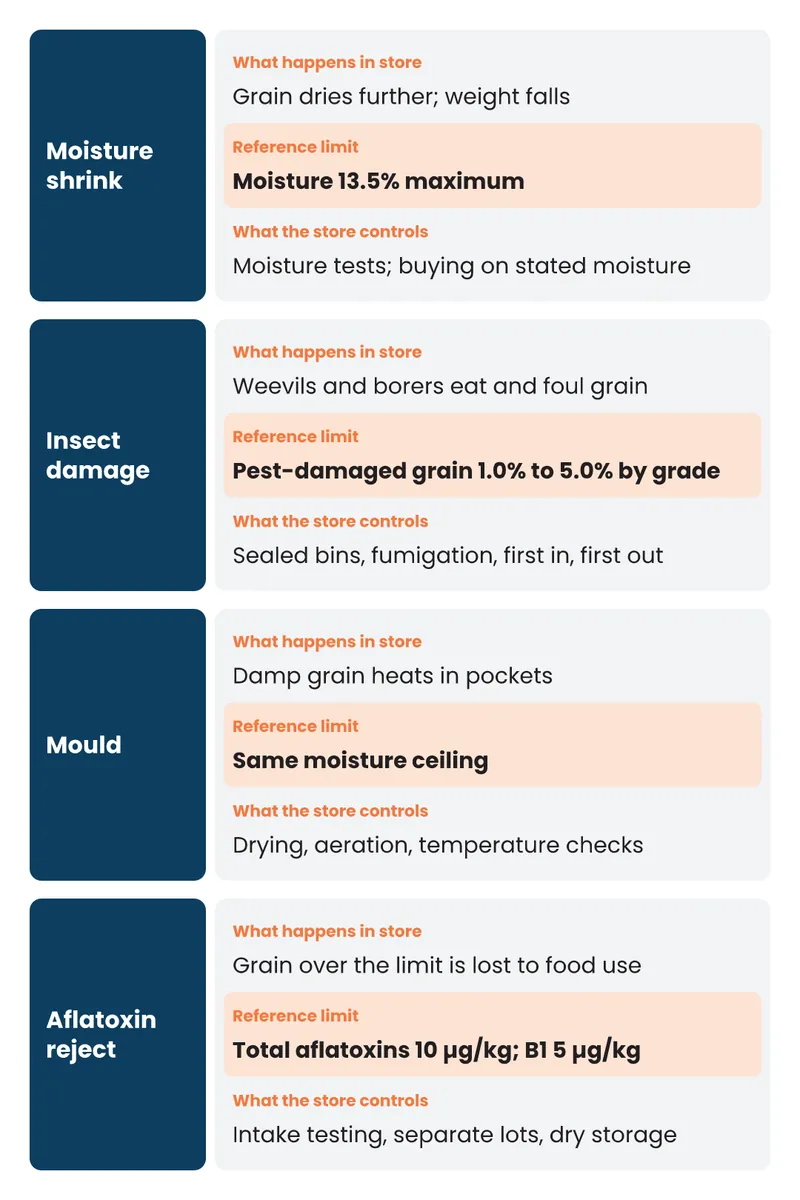
Caption: Four ways a maize store loses tonnage, and the limit each is tested against. Source: East African Community draft maize grain standard, via the Rwanda Standards Board [2].
The last row is the expensive one. In October 2023, the trade publication Milling Middle East and Africa reported that 1,700 tonnes of Ugandan maize were to be destroyed after failing the East African aflatoxin B1 limit, with millers blaming open storage in high heat [3].
Intake and cleaning are sized to the trucks
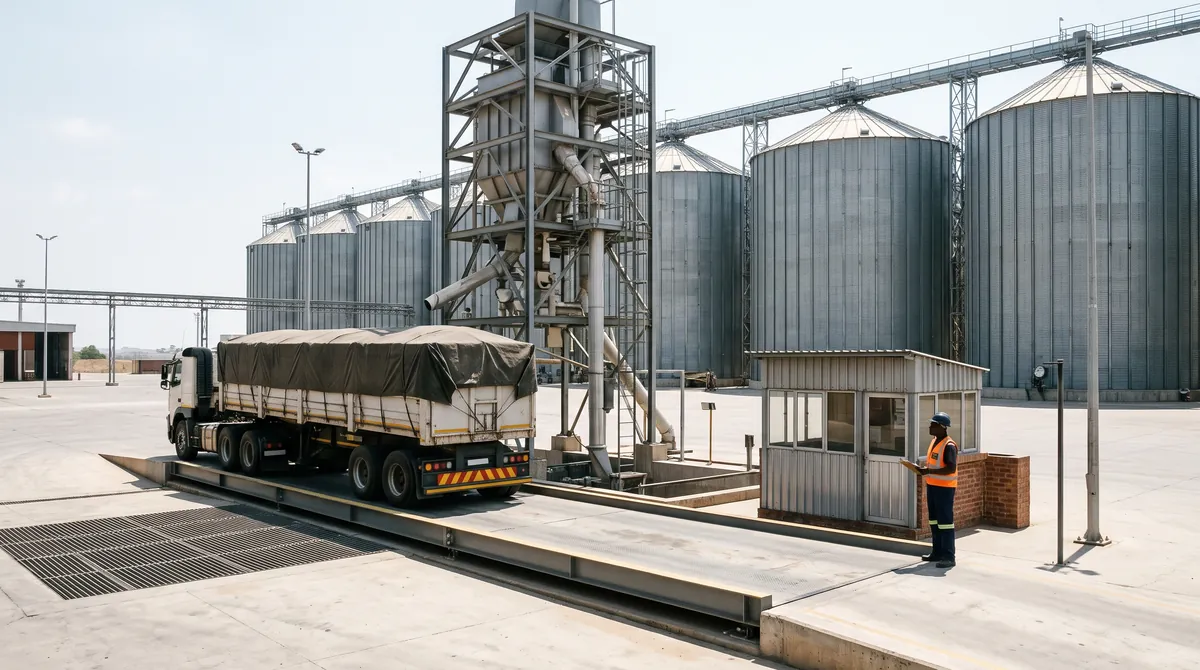
A mill runs at a steady rate, often around the clock. Trucks arrive in daylight, in bunches, most of all in harvest weeks. If the pit and pre-cleaner cannot take a load while the truck stands on site, trucks queue. Grain then waits in bags in the yard.
Size intake to the busiest day of deliveries, and the mill to the year.
As one example from the team’s offers, a 120 TPD roller flour mill runs 5 TPH milling, 6 TPH cleaning and 12 TPH intake. The intake takes grain much faster than the mill uses it, so trucks are emptied and sent away while the mill keeps its pace.
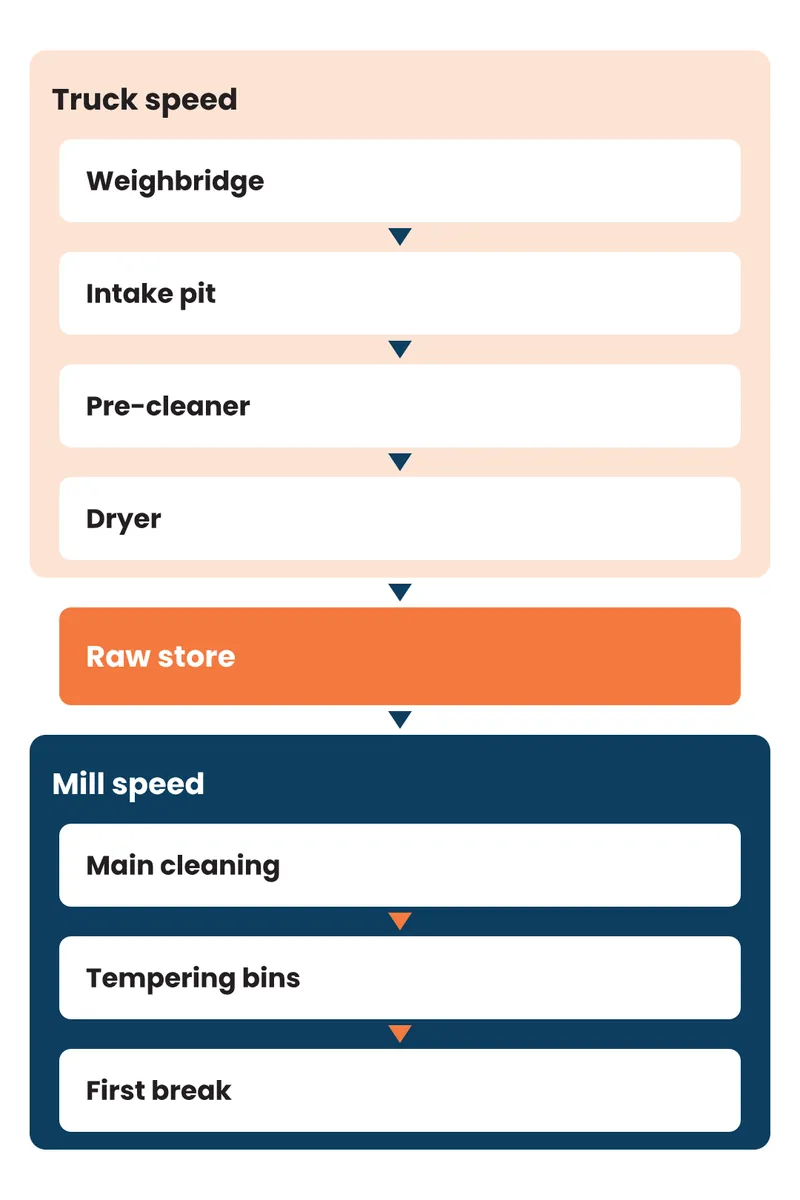
Pre-cleaning before storage matters, because cobs, dust and broken kernels are where insects breed. The draft East African standard allows foreign matter of 0.5 to 1.5 percent by grade [2]. Every tonne removed before the bin is a tonne the store need not protect. The route from truck to rolls has eight stages:
- Weighbridge and sampling, including an aflatoxin test for maize.
- Intake pit and elevator.
- Pre-cleaning.
- Drying, where needed.
- Raw grain store, with aeration.
- Main cleaning at mill rate, in two passes for wheat.
- Tempering or conditioning bins.
- First break rolls, or the degerminator.
As one flow, grain is weighed, received, pre-cleaned, dried and stored, then cleaned, conditioned and milled. Stages up to the raw store run at truck speed. Stages after it run at mill speed, so the raw store is the joint between them.
The raw store carries the mill between harvests
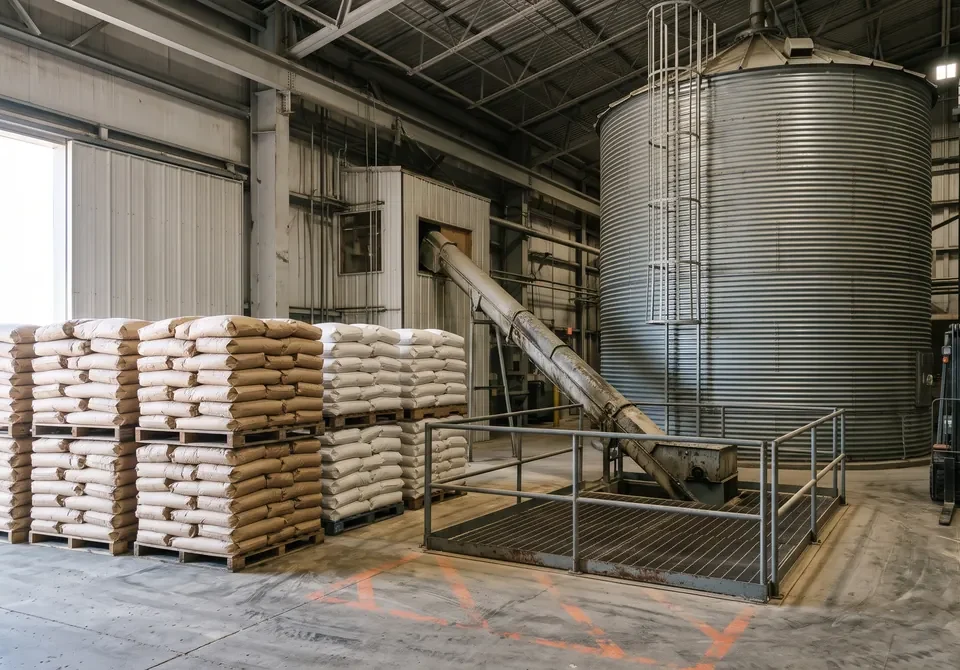
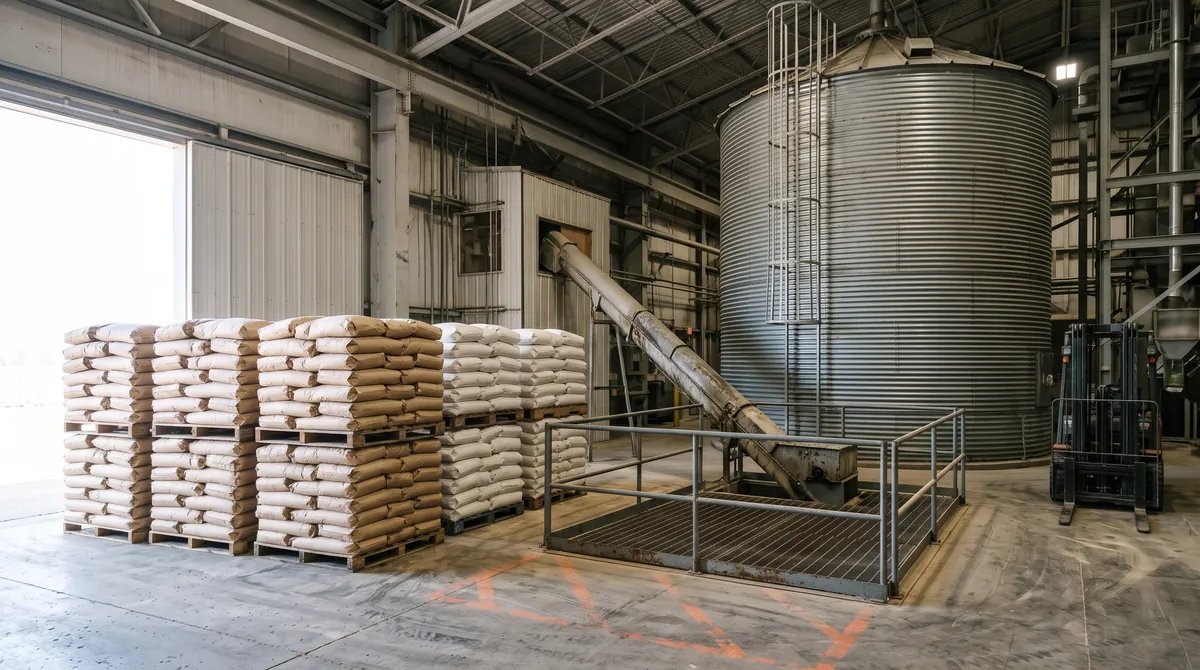
The raw store keeps the mill fed through the longest gap between buying windows. Its size is the mill’s daily grain need multiplied by the days it must carry, plus a margin for late deliveries. The harvest calendar in your buying area sets those days.
The team’s silos are designed for maize at 750 kg per cubic metre and 12 percent moisture, with four aeration fans per silo. Divide the tonnes you must hold by that density, and you have the volume the bins must give you.
The draft East African moisture limit is 13.5 percent [2]. The silo design basis is drier, at 12 percent. Grain bought at the trade limit may need drying before a long hold, because damp grain heats in pockets where mould and aflatoxin start.
Split the store into several bins wherever the budget allows. Several bins let you keep lots apart, empty one for cleaning, and run first in, first out. A failed lot then stays in one bin and the rest stays clean.
Tempering bins are sized to the conditioning time
Wheat is tempered so the bran toughens and the endosperm mellows, which lets bran come off in large flakes. A 2025 paper in the Asian Journal of Biological Sciences gives cold tempering times of between 6 and 24 hours [4]. A 2024 mill optimisation report on Australian wheat trials found the best results with tempering of between 30 and 48 hours [5]. These times come from particular wheats, so treat them as examples and confirm the time on your own wheat before the bins are sized.
Treat tempering time as a volume. The bins hold the hourly mill rate multiplied by the tempering hours. Add room for one bin to fill while another rests and another feeds the mill. The team’s conditioning bins run from 10 to 20 tonnes each, so the count of bins follows from the hours and the mill rate.
If the budget cut the bins, the operator must shorten the temper or slow the mill. A slower mill loses output every hour it runs. Short-tempered bran is brittle, so more of it powders into the flour and the rolls get the blame.
One more bin belongs ahead of the first break. It absorbs short stops in cleaning or tempering, so the rolls keep a steady feed. It has no motor, so it is easy to leave off a first layout.
A mass balance puts a number on the loss
These losses show up as a gap between what came in and what reached the rolls. A monthly mass balance measures that gap. Weigh everything in and out, count stock at the start and end of the month, correct for moisture, and read the remainder.
| Line | How to measure it | What a rising figure tells you |
|---|---|---|
| Grain received | Net weight and moisture, per truck | Check against invoices |
| Cleaning rejects | Screenings and dust, each shift | Dirty intake, or a harsh pre-cleaner |
| Moisture change | Dry matter in minus dry matter out | Shrink in store, or tempering water |
| Grain to first break | Weigher or flow scale ahead of the rolls | The figure the stores delivered |
| Stock change | Opening minus closing stock, all bins | Hidden build-up or draw-down |
| Unaccounted | The balance of all lines | Spillage, dust, pests, weighing error, theft |
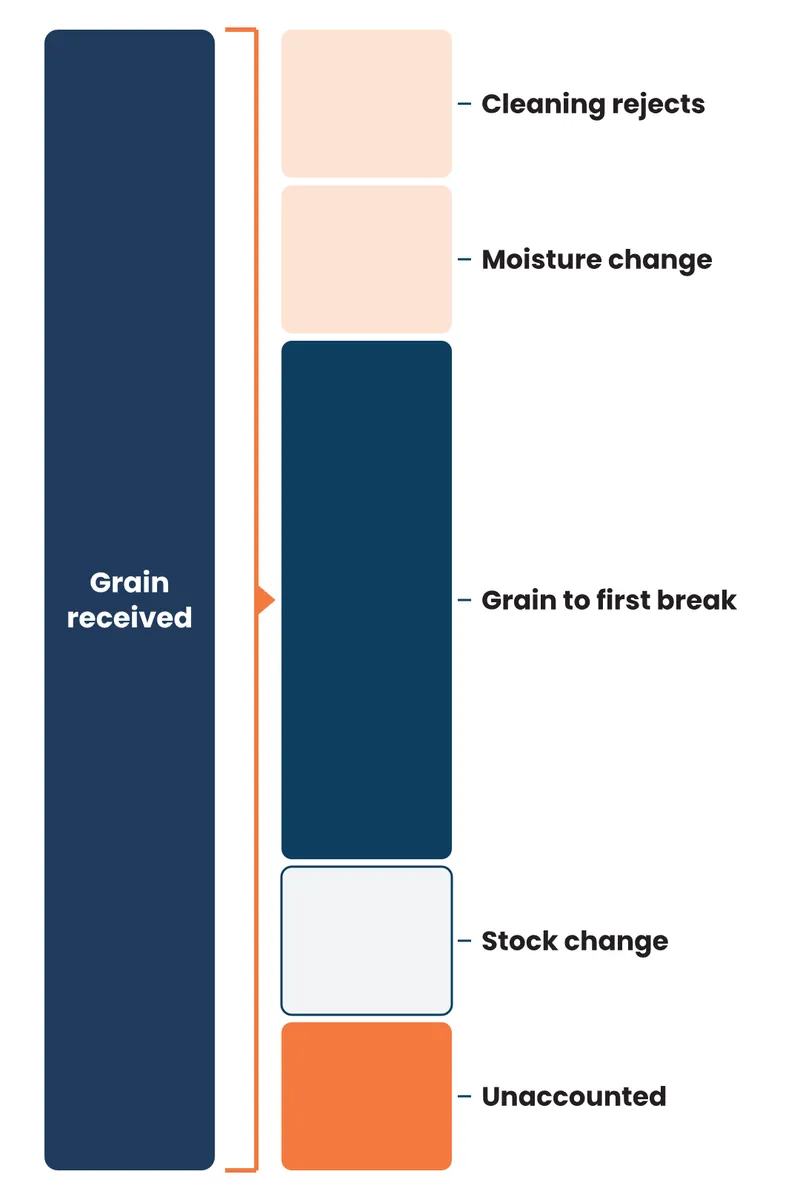
Caption: Grain received over the month, split by where it went before the rolls. Source: the plant’s own weighing and stock records; no figures shown.
The weigher ahead of the first break separates the stores from the milling section. Without it, store and milling losses merge into one number. Over a few months, unaccounted loss rising in harvest months points to the yard and intake. A rising moisture line in quiet months points to grain held too long or too warm.
What this means in Ghana, Cote d’Ivoire, Uganda and Rwanda
The harvest calendar sets how long the raw store must carry the mill, and each market has its own pattern.
Ghana
The FAO GIEWS brief for Ghana of 19 August 2025 reports two rainy seasons in the south, with the 2025 main season maize harvest ending in September [6]. The north has one season, with cereals sown between May and July [6]. A mill relying on northern grain fills its store from one season, so the store carries more of the year. Confirm maize grain limits with Ghana’s standards authority.
Cote d’Ivoire
The FAO GIEWS brief for Cote d’Ivoire of 9 December 2024 reports that the 2024 main season maize harvest in the south and centre ended in September [7]. The northern cereal harvest ended in December [7]. A mill buying in the north fills its store from one harvest. Confirm harvest timing for your buying area with the ministry of agriculture.
Uganda
The FAO GIEWS brief for Uganda of 8 May 2026 reports that in the bimodal areas, first season crops planted in February and March 2026 were due for harvest in June and July [8]. Aflatoxin is the sharpest storage risk here, as the Busoga report [1] and the destroyed consignment [3] show. Intake testing and separate bins carry the most weight.
Rwanda
The FAO GIEWS brief for Rwanda of 12 November 2025 reports that Season A accounts on average for about 80 percent of aggregate output [9]. The National Institute of Statistics of Rwanda puts maize production at 481,246 tonnes in Season A of the 2025 agricultural year, against 117,711 tonnes in Season B [10]. Most local maize arrives in one window, so the intake, the dryer and the raw store must be sized for it.
What should I settle about the stores before I order the mill?
Ask these of any proposal before you compare prices, because every loss above is settled at design.
- What intake rate do the pit and pre-cleaner handle, against my busiest delivery day?
- How many days of grain will the raw store hold, and what keeps it dry and insect-free?
- How many bins does the raw store have, so lots can be kept apart?
- What tempering time is the mill designed for, and what bin volume does that need?
- Is there a bin and a weigher ahead of the first break?
Three mistakes are worth naming. Intake sized to the mill’s hourly rate leaves trucks queuing. Cut tempering bins force a short temper or a slow mill. No weigher ahead of the rolls leaves store losses without a number.
How Sonika Impex LLP can help
Sonika Impex LLP provides:
- A needs assessment of what the mill needs now and later, saying plainly when something is not needed yet.
- Wheat flour mill plants from 3–5 to 200 TPD of wheat and maize flour mill plants from 500 kg/hour to 5 TPH of maize, turnkey or standalone, for new or expanding mills.
- Cleaning machines, intensive dampeners and conditioning and tempering bin sets for mills of 1, 2, 5 and 8 TPH.
- Pre-shipment inspection and packing, with third-party inspection by SGS or Bureau Veritas as required.
- Export FOB preferred, or CIF where you prefer, with discharge typically at Tema, Abidjan, Mombasa or Dar-es-Salaam.
- Erection, commissioning, staff training at your site, and after-sales support.
- Introductions to banks, financial institutions and other institutions that can help the project.
The team behind Sonika Impex LLP has implemented 200+ projects across close to five decades of export experience.
Send us:
- Grains, products and planned output.
- Grain available in each month of the year, and your busiest delivery day.
- Site layout, power and water.
- Equipment already installed: bins, cleaners, dryers, mills, packers.
+91 99027 67900 · sonikaimpex.com
Frequently asked questions
Should a mill buy grain on a stated moisture basis?
Yes, where the market allows it. Buying on a stated moisture basis means the price is adjusted for water above an agreed level, so you stop paying grain prices for water that will dry off in store. It also gives sellers a reason to dry properly before delivery. Agree the moisture meter, the sampling method and the adjustment table in writing.
Can one line make whole maize meal and degermed products?
It can, with compromises. Whole meal keeps the germ and needs little conditioning. Degermed products need conditioning and a degerminator, and a shared line needs extra bins and changeover time. You can start with one product and plan the space and bins for a second line added later.
How often should stored grain be checked?
Check it on a fixed schedule, and more often in warm, humid months. Temperature readings in bins or silos show heating before mould is visible, and sampling from several depths finds pockets of damp grain. Insect traps and sieved samples show infestation early, and the records explain the store line in your mass balance.
What should happen to the screenings from cleaning?
Weigh them every shift and store them apart from clean grain, so they never find their way back into the stream. Whether they can be sold depends on what they contain and on local feed rules. Test them before any sale, and record the tonnage so the mass balance carries it.
Are silos better than a bag warehouse for a first mill?
Each suits a different situation. Silos need less labour and handle bulk grain well, though they need bulk intake and good aeration. A bag warehouse is flexible and cheaper to start, and it needs more handling, stacking discipline and pest control. You can start with bags and add silos when volume and bulk deliveries justify them.
Who should own the mass balance inside the plant?
One named person, usually the plant manager or the quality lead, with the stores keeper and the miller feeding figures in. When ownership is shared, the unaccounted line has nobody to chase it. Review it monthly with the owner, and compare harvest months with the rest of the year.
Can storage be added in stages?
Yes, if the layout allows for it from day one. Leave space, foundations and conveyor connections for future bins, and size the intake for the plant you expect to grow into. Adding a bin later is simple. Moving an intake pit or rerouting conveyors in a running plant is slow and costly.
Does maize need conditioning before degermination?
Yes. Maize for degermed meal and grits is conditioned before the degerminator, so the germ and bran come away cleanly. The right moisture and time depend on the grain and the machine, so get them in writing from the supplier and test them on your own maize. Size the conditioning bins to that time, as you would for wheat.
How do I correct the mass balance for moisture?
Work on dry matter, because tempering adds water and store drying removes it. Dry matter is the weight multiplied by 100 minus the moisture percentage, divided by 100. Do this for intake and for the grain that reaches the first break. Without it, a mill that tempers hard can appear to deliver more grain to the rolls than it bought.
Does a wheat mill need the same raw store planning as a maize mill?
The principle is the same: the store must carry the mill through the gap between deliveries. The pattern of deliveries may differ, depending on whether wheat arrives in large shipments or in smaller local lots. Size the store to your actual supply pattern, and keep wheat and maize in separate bins with separate cleaning where both are milled.
Final thoughts
The opening asked what decides how much of the grain you buy reaches the first break. The answer is the yard, the raw store and the tempering bins, and the mill’s share of the loss is decided on the drawing board.
So the question to carry into the project is how much of what you buy will reach the rolls in condition. Plan the stores, weigh what passes through them, and the missing tonnage gets a name.
For the full picture, read our guide: [Rice Mill Plant Storage Sizing: Why the Smallest Store Sets the Output of Any Processing Plant](/rice-mill-plant-storage-sizing-smallest-store-sets-output/).
Sources
- Daily Monitor | Poor handling costs Busoga farmers 40 percent of grain (June 2026) | https://www.monitor.co.ug/uganda/news/national/poor-handling-costs-busoga-farmers-40-percent-of-grain-5505986 (accessed 2026-10-19)
- East African Community, via Rwanda Standards Board | DEAS 2:2024 Maize grains: Specification (draft, 2024) | https://rsb.gov.rw/fileadmin/user_upload/DEAS_2_2024.pdf (accessed 2026-10-19)
- Milling Middle East and Africa | Uganda to destroy 1,700 tonnes of maize consignment after failing EAC aflatoxin test (October 2023) | https://millingmea.com/?p=2015421 (accessed 2026-10-19)
- Asian Journal of Biological Sciences | Impact of Wheat Tempering Conditions on Flour Particle Size and Thermo-Mechanical Properties (2025) | https://ajbs.scione.com/cms/fulltext.php?id=1113 (accessed 2026-10-19)
- Australian wheat industry research report | Mill Optimisation (April 2024) | https://www.aegic.org.au/wp-content/uploads/2024/04/AEGIC-2024-Mat-Rees-Mill-Optimisation-_rev6-LIVE.pdf (accessed 2026-10-19)
- FAO GIEWS | Country Brief: Ghana, 19 August 2025 | https://www.fao.org/giews/countrybrief/country.jsp?code=GHA (accessed 2026-10-19)
- FAO GIEWS | Country Brief: Cote d’Ivoire, 9 December 2024 | https://cb.apps.fao.org/country/CIV/pdf/CIV.pdf (accessed 2026-10-19)
- FAO GIEWS | Country Brief: Uganda, 8 May 2026 | https://cb.apps.fao.org/country/UGA/pdf/UGA.pdf (accessed 2026-10-19)
- FAO GIEWS | Country Brief: Rwanda, 12 November 2025 | https://cb.apps.fao.org/country/RWA/pdf/RWA.pdf (accessed 2026-10-19)
- National Institute of Statistics of Rwanda | Seasonal Agricultural Survey Annual Report 2025, summary (December 2025) | https://statistics.gov.rw/sites/default/files/documents/2025-12/SAS%202025%20summary%20in%20English.pdf (accessed 2026-10-19)