Pineapple Juice Processing: A Booming Industry in Ghana
October 27, 2026
How Many Months of Paddy Does Your Rice Mill Plant Need? Sizing the Store Before the Mill
November 7, 2026

What an industrial machinery quote leaves out: the costs between the price and a running plant
You have the industrial machinery quote on the table. It lists every machine, a price against each, a total, and a line at the bottom that says FOB or CIF. It looks complete. Your bank has asked for it as the project cost, and it is the only paper in the file with a supplier’s name on it.
This article follows that quote from the day it arrives to the day the plant runs at the output it was bought for. At each step it stops where something outside the quote’s Incoterm and scope of supply has to be paid for, built, connected or hired. Each of these items can be planned for in advance. Left unplanned, each one turns up after the money and the time have been committed elsewhere.
It is written for the owner who will carry the cost, and for the engineer, consultant and banker reading the same file.
In short:
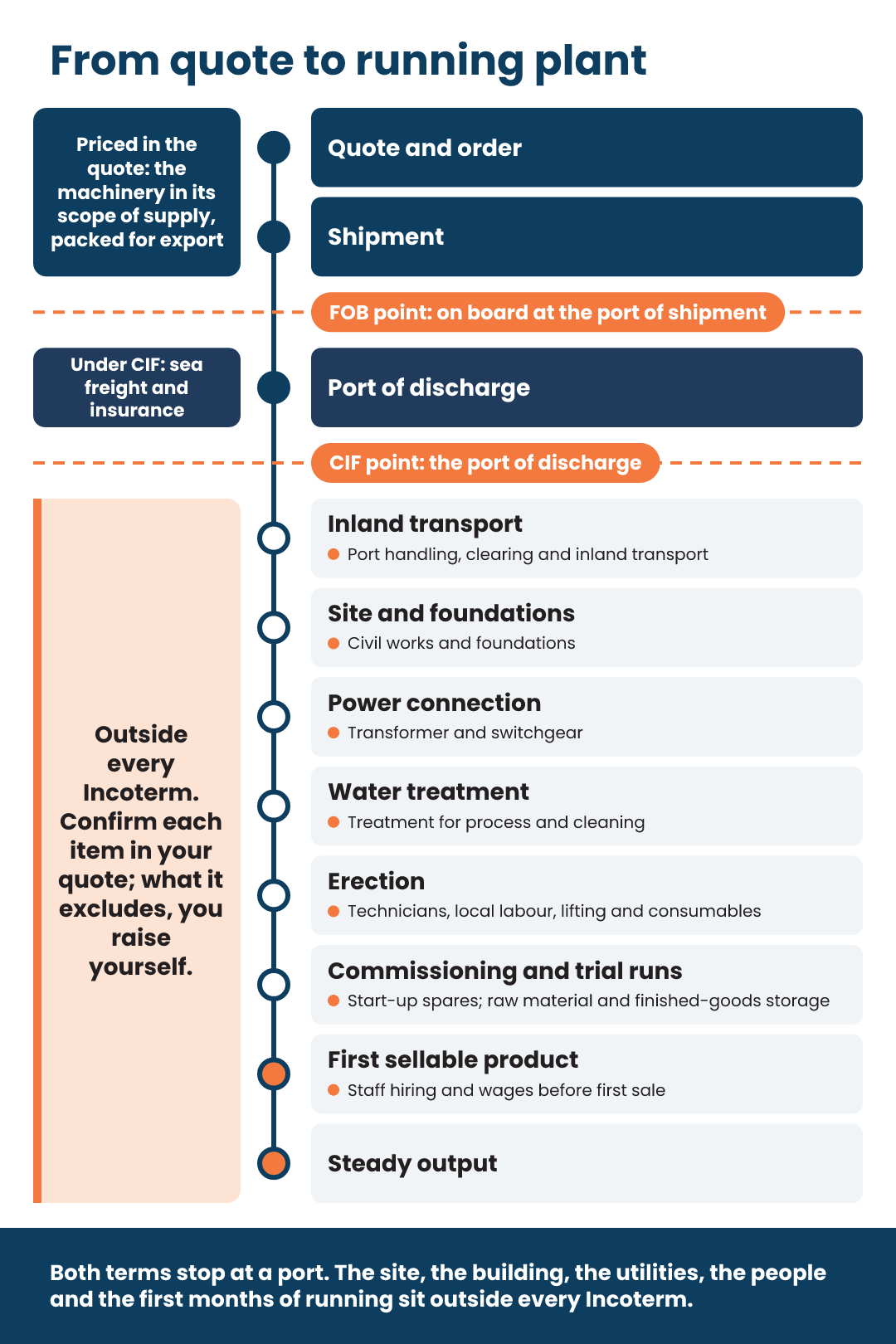
- A machinery quote prices the machines up to a named point, the port of loading under FOB or the port of discharge under CIF. Everything after that point, and everything around the machines, sits outside it unless the scope of supply names it.
- The items outside it surface in a fixed order: transport to site, the floor, the power connection, treated water, erection and commissioning, storage, spares and the people who run the line.
- Each one, left unplanned, holds up the next step, so a plant that was fully funded on the quote stops short of running with the machines already on site.
- Credit offered with the equipment has its own published limits, so confirm in writing which of these items it covers before you count on it.
- Read a quote against the full list before you sign, and compare quotes only on the same scope.
Contents
- The industrial machinery quote arrives: what it prices and where it stops
- Between the port and the gate
- The floor the machines stand on
- Power before the first switch-on
- Water treated before it reaches the process
- Erection and commissioning: who puts it together and proves it runs
- Storage and handling around the line
- Spares on the shelf before the first fault
- People ready before the machines arrive
- Credit offered with the equipment
- What this means in Ghana, Cote d’Ivoire, Uganda and Rwanda
- Reading a quote line by line before you sign
- How Sonika Impex LLP can help
- Frequently asked questions
- Final thoughts
- Sources

The industrial machinery quote arrives: what it prices and where it stops
Take a fruit processing plant as the running example: a line that washes, pulps, pasteurises and fills fruit pulp and juice. The quote names every machine from the washer to the filler, puts a price against each, and states the delivery term. What it prices is the machinery in its scope of supply, packed for export and delivered to the point that term names.
That point is set by the Incoterm. The International Chamber of Commerce describes its Incoterms 2020 rules as a clear allocation of cost, risk and obligations, with every cost of a rule gathered at article A9/B9 [1].
Under FOB, the seller’s side ends once the goods are loaded on board at the port of shipment. Under CIF, the seller also pays the sea freight and buys insurance to the port of discharge. The ICC’s Incoterms 2020 page gives the Institute Cargo Clauses (C) as the default CIF cover, unless the parties agree a higher level [1].
Here’s the catch. Both terms stop at a port. The site, the building, the utilities, the people and the first months of running sit outside every Incoterm.
The quote becomes a problem only when it is mistaken for the cost of the project. That happens the moment a bank, a family or a funder budgets on it. The owner of the fruit plant believes the quote has told them what the plant will cost to set up. It has answered a smaller question: what the machines cost, delivered to a port.
The rest of this article walks the project forward in the order the gaps appear, each one holding up the step after it. The checklist below turns that order into items to confirm in your own quote and its scope of supply.
| Item | What to confirm in your quote | If your quote excludes it |
|---|---|---|
| Machines and their own controls | Each machine and its control panel named in the scope of supply | Ask for it to be added before you sign |
| Packing for export | The packing stated for each item | Ask how each item will be packed |
| Sea freight and insurance | Included under CIF, with the level of cover stated | Book freight and cover yourself under FOB |
| Port handling, clearing and inland transport | Whether any of it is in scope | Budget it with your clearing agent and haulier |
| Civil works and foundations | Whether foundation drawings and loads are supplied | Price the civil works locally |
| Power connection, transformer and switchgear | Which electrical items are in scope | Price the connection with the utility and an electrical contractor |
| Water treatment for process and cleaning | Whether any treatment is in the scope of supply | Size it from a water analysis and price it |
| Erection and commissioning | Who supplies technicians, local labour, lifting and consumables | Settle it in writing before the order |
| Raw material and finished-goods storage | Whether any store, conveyor or racking is in scope | Budget the stores yourself |
| Start-up spares | Which spares ship with the plant | Settle the list before the order |
| Staff hiring and wages before first sale | Training at site, and for whom | Budget wages from erection onwards |
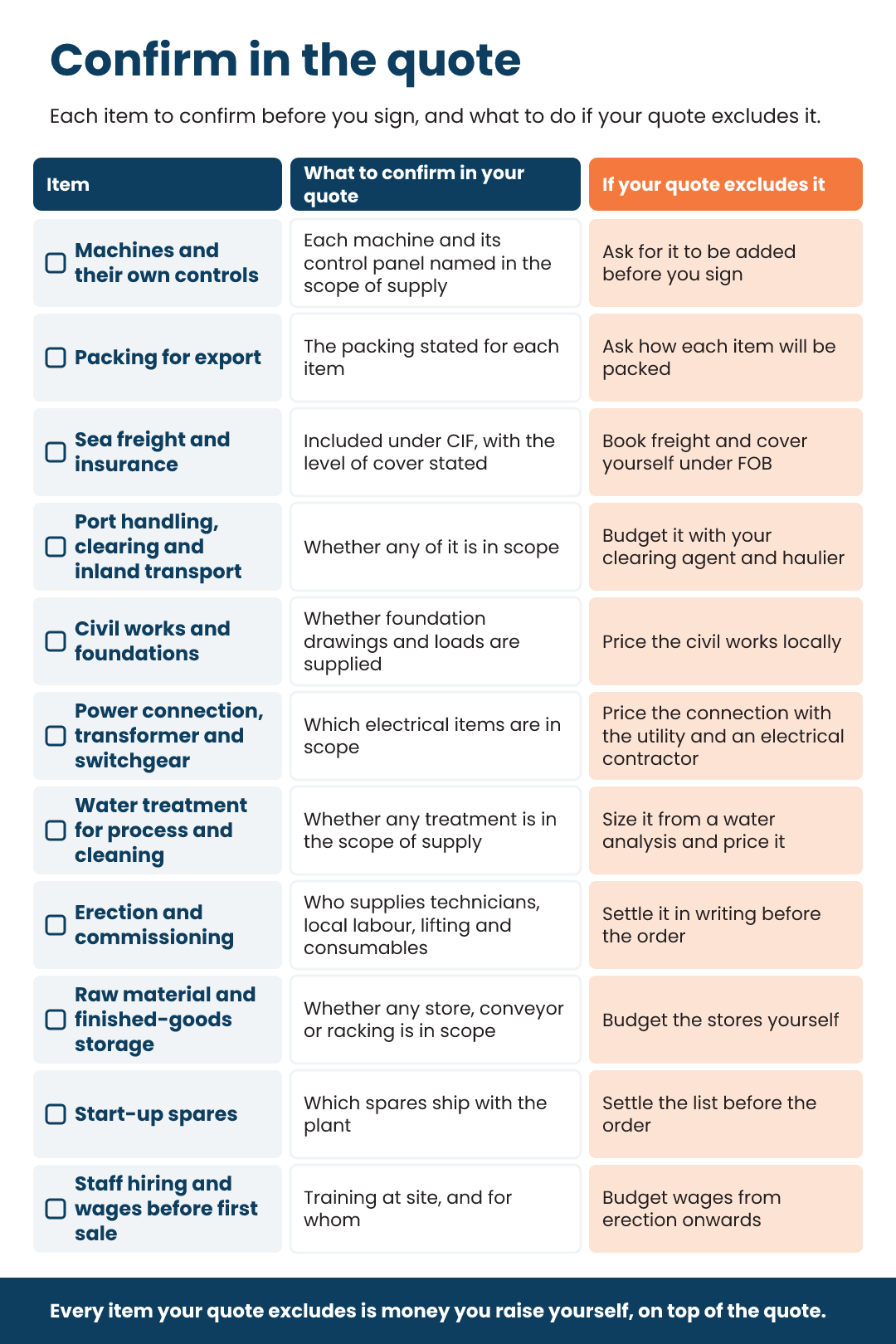
Every item your quote excludes is money you raise yourself, on top of the quote.
Between the port and the gate
The containers reach the port of discharge, and the quote’s last line is already behind them. Under FOB you paid the sea freight and the insurance as well. Port handling, clearing and the trip to your site sit with you under either term, unless the quote names them. The port is usually Tema for Ghana, Abidjan for Cote d’Ivoire, and Mombasa or Dar-es-Salaam for Uganda and Rwanda.
For a landlocked site, the port is only the halfway mark. The Northern Corridor Transport Observatory Report 2025 calls Mombasa the principal maritime gateway to East and Central Africa, with transit traffic up 18.6 percent to 15.88 million tonnes in 2025 and Uganda the largest destination [2]. The same Northern Corridor report (report) found vessel turnaround at Mombasa rose to 192 hours in 2025, vessel waiting time reached 4.7 days, and corridor transport costs remain high and variable [2]. Your own shipment will differ, and the time and money between the ship and your gate still belong in the plan.
Clearance is a separate cost again. Each country’s customs authority sets how imported machinery is declared and cleared, and the duty follows each item’s classification. Clearance times and duty depend on the project and the tariff line, so we don’t state them here. The money has to be ready before the goods are released.
Then there are the last few metres. Heavy items, such as a pasteuriser frame or a boiler, need a crane or forklift at site, and a new plot needs an access road a container truck can use. Ask for the weight and size of the heaviest pieces with the proposal.
The floor the machines stand on
Once the machines are on site, they need somewhere to stand. Check whether your quote’s scope of supply names any civil works or foundations, because whatever it leaves out is yours to build. Nothing can be fixed down until the floor is poured to the loads and bolt positions the layout needs.
A rice mill shows why. The husker, paddy separator, whitener and polisher each sit on their own base, with anchor bolts where the layout drawing puts them. The bucket elevators that link them need pits and openings in exactly the right places. The paddy store and the finished rice store need floors that take stacked bags and stay dry through the rains.
In the team’s experience, here’s where projects go wrong. The building goes up early to show the bank progress, and the floor is poured before the layout drawing exists. When the machines arrive, the bolt positions and pits are wrong, and the machines wait under tarpaulin while concrete is broken out and poured again.
The rule is simple.
Design the floor from the layout drawing, and pour it only after the drawing is final.
For the fruit plant, that means asking for the general arrangement drawing and the foundation loads with the proposal, and handing both to your civil engineer before the order is signed. Requirements differ by machine and by site, so your engineer confirms every figure against your own soil and layout.
Power before the first switch-on
A finished floor with machines bolted to it still produces nothing until the power is on. The connection covers the supply voltage, the transformer, the switchgear, the cabling to each motor and the utility’s inspection. Mark which of these your quote names. Each one it leaves out is yours to arrange with the utility and an electrical contractor.
The plant’s connected load decides which supply you need. In Uganda, the Electricity Regulatory Authority’s tariff schedule sorts industrial consumers by supply voltage and demand, with Medium Industrial at 415 volts and maximum demand up to 500 kVA [3]. The same ERA schedule (tariff schedule) puts Large Industrial at 11,000 or 33,000 volts for demand above 500 and up to 1,500 kVA, and Extra-Large Industrial at that voltage from 1,500 kVA [3]. Cross from one band to the next and you may need a high-voltage supply and a transformer of your own, which is a larger project than a low-voltage meter.
A poultry feed manufacturing plant makes the point clearly. The hammer mill and the pellet mill are the heaviest loads, and together they decide where the plant sits on that scale. You can’t know your band until the supplier has given you the motor list and the connected load with the proposal.
The utility will also want the installation checked. Ghana’s Energy Commission certifies electrical wiring inspectors, and its electrical wiring application forms page sets out that a new industrial installation is inspected and tested before a service connection is made, under the Electrical Wiring Regulations 2011 [4]. That inspection needs finished electrical drawings and a certified installation, so ask the utility early which inspection certificate it needs.
So the power application starts when the layout is fixed. Left until erection, it becomes the reason the machines stand still with the technicians on site.
Water treated before it reaches the process
A processing plant uses water for the product, for cleaning and often for steam. The treatment it needs depends on your borehole or mains, and on the standard your product must meet. On a fruit line, the wash and cleaning water has to be fit for food contact.
Mineral water is the clearest case, because there the water is the product. In Uganda, the Uganda National Bureau of Standards’ standards catalogue, current as of 31 December 2023, lists a compulsory Uganda Standard for packaged natural mineral water that replaced the earlier US EAS 13:2014 specification [5].
Standards also move. In Rwanda, the Rwanda Standards Board’s public review notice put new draft African standards for packaged mineral water and packaged drinking water out for comment until 3 August 2026 [6]. That means the standard a new water plant is tested against may change between the day it is planned and the day it opens.
Here’s the trick. The water analysis comes first, because until you know what is in the source water, nobody can say whether you need filters, softening, reverse osmosis, ultraviolet treatment or ozone. Check whether your quote’s scope of supply includes any treatment at all. If it does not, the treatment plant is a line in your budget, sized from a laboratory report that comes before the order.
Erection and commissioning: who puts it together and proves it runs
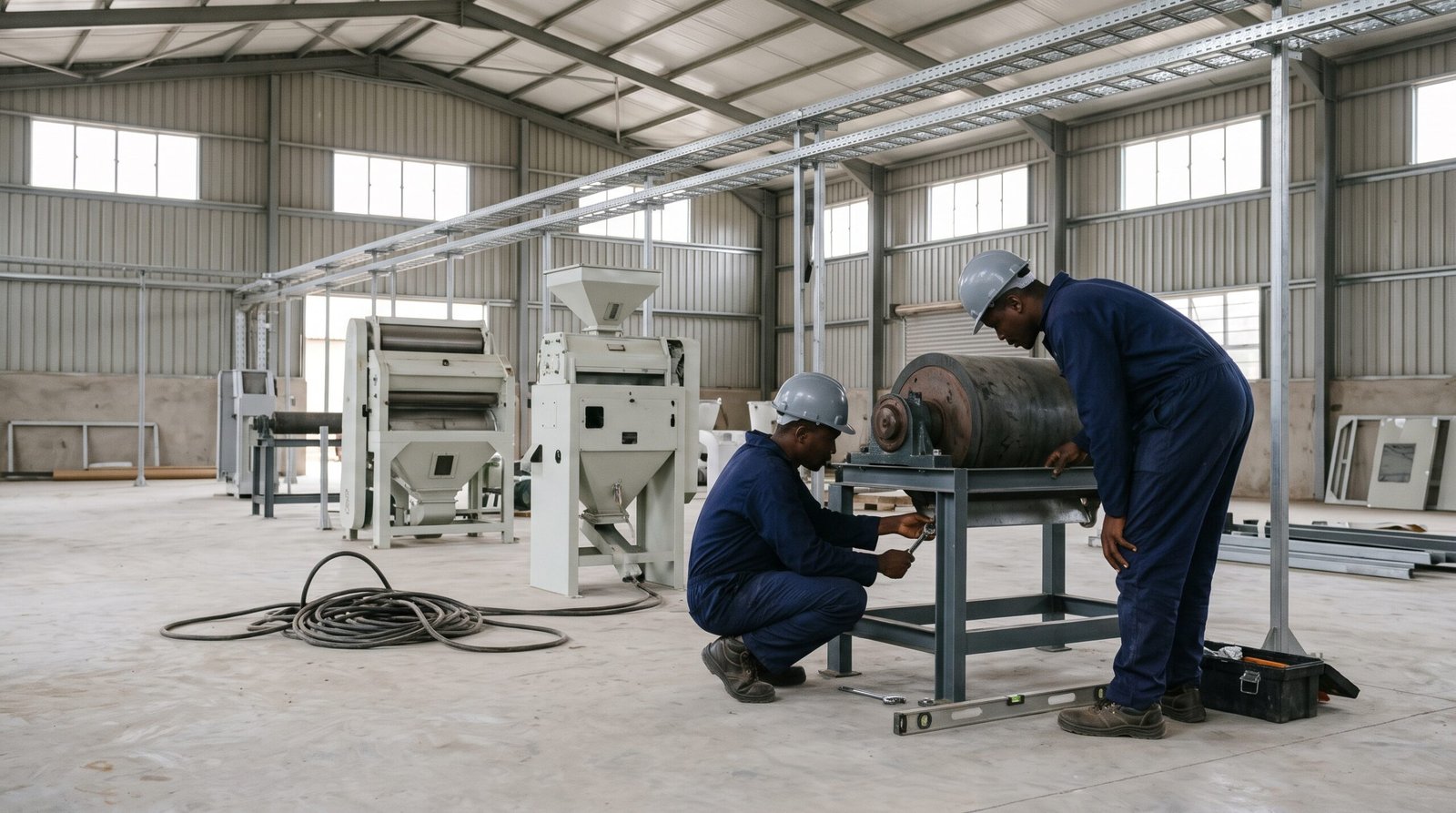
Now the machines are on a finished floor, with power and treated water at the wall. Erection means setting each machine on its base, aligning drives and shafts, connecting pipework and wiring, and running each unit empty. Commissioning means running the whole line on real raw material until it makes product to specification.
On a rice mill, the erection scope needs pinning down line by line. Check whether each quote you hold puts erection and commissioning in the price, prices it separately, or leaves it outside the scope. Where it is included, find out exactly what it covers, whether that is the technicians and their time alone or local labour, lifting and consumables as well.
The questions to settle before the order are practical ones.
- Who sends the technicians, and who pays their travel and stay?
- Who supplies the local fitters and labourers, the crane or chain block, the welding sets, and the oil, grease and other consumables?
- How long do trial runs last, on whose raw material, and what output must the line reach before handover?
- What does handover mean: a signed protocol, a list of open points, the start of the warranty?
Each of these questions has a short answer. An unclear answer to any of them is how a plant ends up installed and idle, with the technicians gone home. Write the answers into the contract, and budget the local side, including the raw material and packaging used in trial runs.
Storage and handling around the line
A line runs only as long as raw material reaches it and finished goods leave it. The raw material store, the buffers and conveyors, the packing material store and the finished-goods store all belong to the plant. Check which of them your quote names, and budget the rest yourself.
On the fruit plant, the season decides how much must be held. Fruit arrives in a rush and has to be processed or chilled quickly. Pulp held in aseptic drums or cold storage keeps the filling line running after the harvest, and bottles, caps, cartons and labels need dry space close to the line.
Our article [Rice Mill Plant Storage Sizing: Why the Smallest Store Sets the Output of Any Processing Plant](/rice-mill-plant-storage-sizing-smallest-store-sets-output/) works through how big each store should be. Here the point is simpler: a plant without its stores runs only when a truck happens to arrive.
Spares on the shelf before the first fault
The first breakdown comes early, before anyone knows which parts wear fastest. That is the worst time to find the shelf empty.
A poultry feed plant wears through parts at a steady rate. Hammer mill screens and beaters wear with every tonne ground, and pellet dies and rollers with every tonne pressed. Bearings, belts, seals and fuses fail with little warning. A feed plant that stops for a screen or a die stops completely, and the birds still need feeding.
Ship the start-up spares with the plant. They travel in the same containers and clear in the same declaration, which is simpler than flying a single part in after a stoppage. Ask the supplier for a list of wear parts for your raw material and your shifts, and buy at least the first set with the order.
Then ask the question that matters most for year three. Who answers for parts after the warranty period has ended, and how are they ordered and shipped? The plant will run long after the warranty, so that answer is part of what you are buying.
People ready before the machines arrive
The last gap is the easiest one to leave until late. Operators, a maintenance fitter, an electrician and a quality person have to be on the payroll before commissioning. Hired after the machines are running, they miss the only time they can learn the line from the people who built it.
On a dairy plant, this matters for safety as much as output, because product safety rests on the people running pasteurisation and cleaning every shift. The best time to learn is during erection and trial runs, when every valve, sensor and setting goes in front of them.
That means wages are paid before the first sale, so budget for them. Where training at site is part of the scope, the supplier provides it. What your staff do with it afterwards rests on who you hire and how long they stay.
Credit offered with the equipment
When a machinery offer includes credit, read what the credit finances as closely as the quote itself. Where it is officially supported export credit, the OECD’s Arrangement on Officially Supported Export Credits requires a down payment of at least 15% of the export contract value, caps official support at 85% of that value excluding local costs, and gives local costs a separate limit of their own [7]. So ask in writing which items in this article the facility covers, which sit under a local-cost limit, and which stay yours to fund. Then ask how the repayment schedule treats a plant that is installed but not yet running.
What this means in Ghana, Cote d’Ivoire, Uganda and Rwanda
The gaps are the same in every market. What changes is the rule that applies to each of them.
Ghana
Machinery usually lands at Tema, and the Energy Commission’s inspection rule set out above applies before the service connection. Confirm the current packaged water standard with the national standards body before the treatment plant is chosen.
Ghana’s investment law has also changed. A government press release states that the Ghana Investment Promotion Authority Act, 2026 (Act 1173), assented to on 15 July 2026, repealed and replaced the 2013 Act, and asks registered enterprises to learn the new requirements [9]. If your budget assumes any investment incentive on imported plant or machinery, confirm it under the new Act before you fix the figure.
Cote d’Ivoire
Machinery usually lands at Abidjan. The Ministry of Economy’s Investment Code page sets out that the Code, as amended in 2019 and 2024, offers investors in targeted sectors a full or a 50% exemption from customs duty and a temporary VAT suspension in the investment phase, by scheme [10]. Whether a project qualifies is decided for each application. Treat it as something to apply for early, and keep it out of the budget until it is granted.
We did not find a current published rule on industrial power connections or packaged water standards in Cote d’Ivoire to cite here. Ask the national utility and the national standards body directly, before the layout is fixed.
Uganda
Machinery usually lands at Mombasa or Dar-es-Salaam and travels inland, so the corridor costs and the power bands set out above both apply. Confirm the current standard for packaged water with the Uganda National Bureau of Standards before the treatment plant is chosen.
The East African Community’s trade regime page sets the Common External Tariff band for raw materials and capital goods at 0% with effect from 1 July 2022 [8]. How each item is classified decides which band it falls in. Confirm the classification of your items with customs, and budget for anything that falls outside the capital goods band.
Rwanda
Rwanda’s cargo also travels the corridors from Mombasa or Dar-es-Salaam, and Rwanda applies the same common external tariff set out on the East African Community’s trade regime page [8]. Plan a water plant against the packaged water standard that will apply when it opens, since the drafts covered above may change it.
We did not find a published rule on industrial power connections in Rwanda to cite here. Ask the utility for its requirements before the layout is fixed.
Reading a quote line by line before you sign
Here is a method you can use the day the quote arrives.
- Mark the Incoterm, and write down exactly where the price stops.
- List every item from this article against the quote, and mark each as included, excluded or unclear.
- Ask for the unclear ones in writing, and get the answer as a revised quote or a scope schedule.
- Price the excluded items yourself, with local quotes for civil works, power, water treatment, transport and lifting.
- Compare quotes only after they cover the same scope.
- Give the bank the full list as the project cost.
Two totals can be compared only once both cover the same list. When erection, spares or training sit outside one quote’s scope, its total is lower by those items, and they come back later as your cost.
The next table pulls the article together: each item that can sit outside the quote, when it surfaces, what it stops, and when to settle it.
| Omitted item | When it surfaces | What it stops | Settle it by |
|---|---|---|---|
| Inland transport and offloading | Arrival at port | Delivery to site | Order |
| Foundations | Machines on site | Erection | Layout drawing |
| Power connection | Erection complete | Trial runs | Layout fixed |
| Treated water | Trial runs | Sellable product | Water analysis |
| Erection and commissioning scope | Machines on site | Handover | Order |
| Storage | First full season | Running hours | Budget |
| Start-up spares | First fault | Production | Order |
| Trained staff | Commissioning | Steady output | Before shipment |
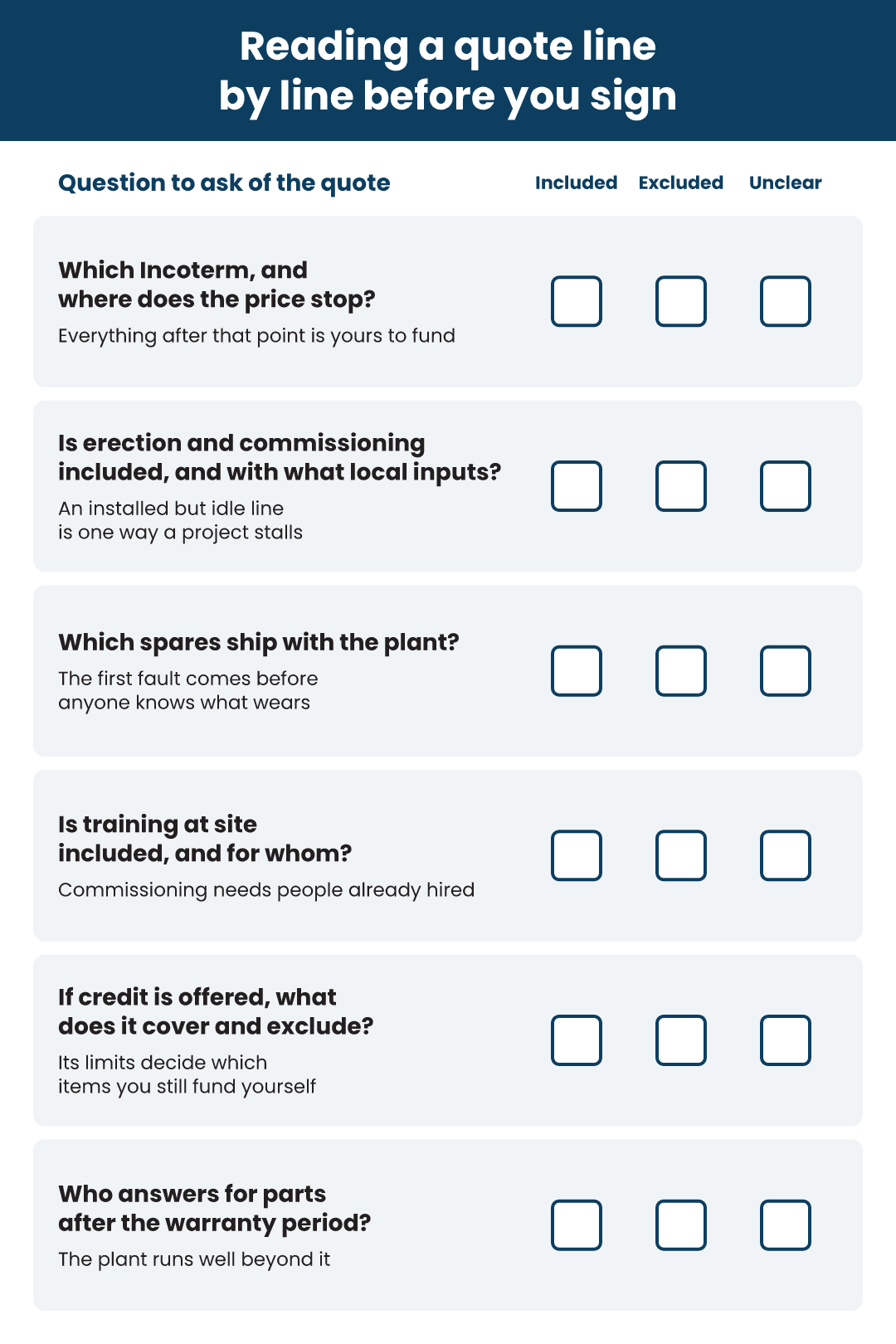
Most rows are settled by the order or the layout drawing, where you still hold the most control. Put the questions below to every supplier and keep the answers in the file.
| Question to ask of the quote | Why it matters |
|---|---|
| Which Incoterm, and where does the price stop? | Everything after that point is yours to fund |
| Is erection and commissioning included, and with what local inputs? | An installed but idle line is one way a project stalls |
| Which spares ship with the plant? | The first fault comes before anyone knows what wears |
| Is training at site included, and for whom? | Commissioning needs people already hired |
| If credit is offered, what does it cover and exclude? | Its limits decide which items you still fund yourself |
| Who answers for parts after the warranty period? | The plant runs well beyond it |
How Sonika Impex LLP can help
For this kind of project, Sonika Impex LLP provides:
- A needs assessment that sets out what the plant needs now, what it will need later and a plan for both, including a plain word when something is not needed yet
- A customer-specific proposal with its scope written out, so you can see what is included before you sign
- Turnkey plants, standalone machinery and working capital materials from a single point of service
- Pre-shipment inspection and packing, with third-party inspection by SGS or Bureau Veritas as required
- Export on FOB or CIF terms, to the port of discharge you need
- Erection and commissioning, and training for project and maintenance staff at your site
- After-sales support that stays available after the warranty period has ended
- Payment by TT or Letter of Credit, open to negotiation around your requirement
- Introductions to banks, financial institutions and other institutions that can help the project. Sonika does not lend, arrange or guarantee finance.
Plants can start at the size your capital and market allow. Rice mill plants come in steps of 100 kg/hour, 1, 2, 3, 5 and 10 TPH of paddy, and feed mill plants in steps of 500 kg/hour, 1–2, 3–5, 10, 20 and 30 TPH. Mineral water plants come in steps from 1,000 to 10,000 litres/hour. The team behind it is family run, in its third generation, with close to five decades of export experience.
Send us:
- What you want to make, and for which buyers
- How much, and how the raw material arrives across the year
- The site: location, nearest port, access for containers, and whether the building exists
- The power and water available at the site today
- Anything already installed, if this is an expansion
- Any quote you already hold, so the scope can be compared line by line
+91 99027 67900 · https://sonikaimpex.com
Frequently asked questions
What documents should travel with the machinery?
The commercial invoice, the packing list with the weight and size of each case, and the bill of lading are the core set. Your clearing agent will tell you what else your country’s customs authority asks for, such as a certificate of origin or an inspection certificate. Ask for drafts of every document before the goods are loaded, so a wrong description is corrected while it is still cheap to fix.
Does pre-shipment inspection replace checking the plant at site?
It does a different job. Pre-shipment inspection, whether by your own engineer or through third-party inspection by SGS or Bureau Veritas, checks the machines against the order before they are packed. It cannot check the foundations, the power or the water at your site, and it cannot show how the line runs on your raw material. That proof comes at commissioning.
What happens if a case arrives damaged?
Inspect every case at the port or at the gate before you sign for it, and write any damage on the delivery receipt. Photograph it, then notify the cargo insurer and the supplier the same day. Under FOB the risk passed to you when the goods were loaded, so your own cargo cover is the policy that responds.
What if the site’s supply voltage differs from the one the motors were quoted for?
Send the supply voltage and frequency at your site with the enquiry, so the motors, panels and control circuits are specified for it. A mismatch found at erection means a transformer or replacement motors, bought locally and in a hurry. For a site that runs on its own generator, give its rating too.
Which material of construction should the quote name?
For food and pharmaceutical machines, ask that the stainless steel grade is named for each machine. SS 304 suits general contact parts and frames, and SS 316 or 316L suits acid, pulpy or hot product. If a line item says only “stainless steel”, ask which grade before you sign.
Should the first stock of packaging material be bought with the plant?
It is worth pricing with the plant, because bottles, preforms, caps, labels and cartons are needed from the first trial run. Shipped with the machinery, they clear with it and are on site when commissioning starts. Either way, the bank should see them in the plan as working capital, apart from the machinery price.
Can I buy the plant in stages and still plan for the full size?
Yes, and the time to decide is before the first floor is poured. Plan the layout, floor area, power supply and water treatment for the plant you expect to run later, then install the machines for the first stage now. Space and load reserved at the start save a second power application or a rebuilt floor later.
What changes when the new line is an expansion of a plant already running?
The existing plant’s utilities become part of the scope. Check whether the present power supply, water treatment, boiler and stores have room for the new line, because each was sized for what is already there. Send the supplier the details of what is installed, so the proposal says which items the new line needs and which it can share.
Final thoughts
Back to the quote on the table. It answered the question it was asked, which was the price of the machines to a named port.
The question the owner needed answered was a different one: what does it take, all of it, to get from this paper to a plant that runs at the output it was bought for? Ask that question of every quote. Put the answer in front of the bank. Then the items outside the quote stop being surprises and become lines in a plan.
Sources
- International Chamber of Commerce (ICC), Incoterms 2020, page dated 2026-07-03, https://iccwbo.org/business-solutions/incoterms-rules/incoterms-2020/ (accessed 2026-10-18)
- Northern Corridor Transit and Transport Coordination Authority (NCTTCA), Northern Corridor Transport Observatory Report 2025, 21st Edition, 2026-08, https://www.ttcanc.org/wp-content/uploads/2026/08/EN-21-TOP-Report.pdf (accessed 2026-10-18)
- Electricity Regulatory Authority, Uganda, Tariff Schedule Q1 2026, 2025-12, https://www.era.go.ug/wp-content/uploads/2025/12/ERA-Tariff-Schedule-Q1-2026.pdf (accessed 2026-10-18)
- Energy Commission, Ghana, Electrical wiring application forms, undated web page, https://www.energycom.gov.gh/index.php/initiatives/electrical-wiring/application-forms (accessed 2026-10-18)
- Uganda National Bureau of Standards, Uganda Standards Catalogue as of 31 December 2023, 2023-12-31, https://www.unbs.go.ug/attachments/menus/27/Uganda%20Standards%20Catalogue%20as%20of%2031%20December%202023-FINAL.pdf (accessed 2026-11-03)
- Rwanda Standards Board, Public review notice: Draft African Standards, 2026-07, https://www.rsb.gov.rw/updates/news-detail/public-review-notice-98 (accessed 2026-10-18)
- OECD, Arrangement on Officially Supported Export Credits, OECD/LEGAL/5005, revised 2026-01, https://legalinstruments.oecd.org/public/doc/253/253.en.pdf (accessed 2026-10-18)
- East African Community, Trade Regime: EAC Common External Tariff, undated web page, https://www.eac.int/regional-framework/trade-regime (accessed 2026-10-18)
- Ghana Investment Promotion Centre, Press release on the passage of the Ghana Investment Promotion Authority Act, 2026 (Act 1173), 2026-07, https://gipc.gov.gh/wp-content/uploads/2026/07/PRESS-RELEASE-PRESIDENT-PASSES-GIPA-BILL-2026.pdf (accessed 2026-10-18)
- Ministere de l’Economie, Cote d’Ivoire, Code des investissements, undated web page, https://economie-ivoirienne.ci/investissements/codes-des-investissements.html (accessed 2026-10-18)