What an industrial machinery quote leaves out: the costs between the price and a running plant
November 5, 2026
Buying From an India Machinery Supplier for Africa: Your Questions on the Costs Between the Port and Your Site
November 10, 2026
How Many Months of Paddy Does Your Rice Mill Plant Need? Sizing the Store Before the Mill
In April 2026, the US Department of Agriculture’s Ghana Grain and Feed Annual placed Ghana’s rice harvests between September and December, and found that paddy once sold across the border now stays at home as excess supply [1]. For a rice mill plant, that is a large volume of paddy arriving inside a short window, and a mill can buy it only if it has somewhere dry to put it.
This article sizes the paddy store and dryer first, because they decide how many months a year your mill turns. It is for owners planning a first rice mill plant in Ghana, Cote d’Ivoire, Uganda or Rwanda, and owners whose mill stands idle after harvest.
In short:
- A rice mill plant runs only while it has dry paddy, so the harvest window and the store set its running months.
- Months of milling after intake stops, times daily paddy need, gives the store’s tonnage.
- Size the dryer to the busiest intake day, so wet paddy reaches storage moisture quickly.
- Keep stored paddy dry, off the floor, inspected and rotated, and temper it before milling.
- Choose the milling rate last: the rate the store can keep fed all year.
Contents
- Why a rice mill runs only as long as its paddy lasts
- Working out how many months the mill must run after harvest
- Drying paddy as fast as it arrives
- Keeping stored paddy in condition until it is milled
- The tempering bin: giving grain time to reach milling moisture
- Sizing a rice mill plant backward from the paddy store
- What this means in Ghana, Cote d’Ivoire, Uganda and Rwanda
- Questions to ask any rice mill plant proposal about storage and drying
- How Sonika Impex LLP can help
- Frequently asked questions
- Final thoughts
Why a rice mill runs only as long as its paddy lasts
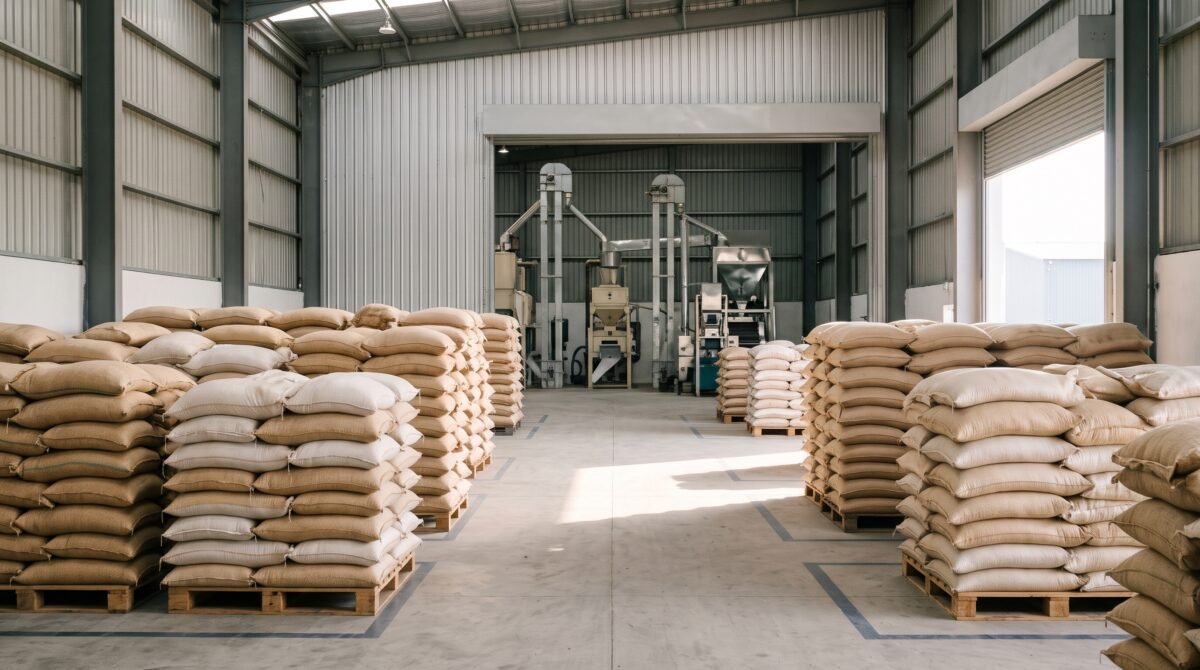
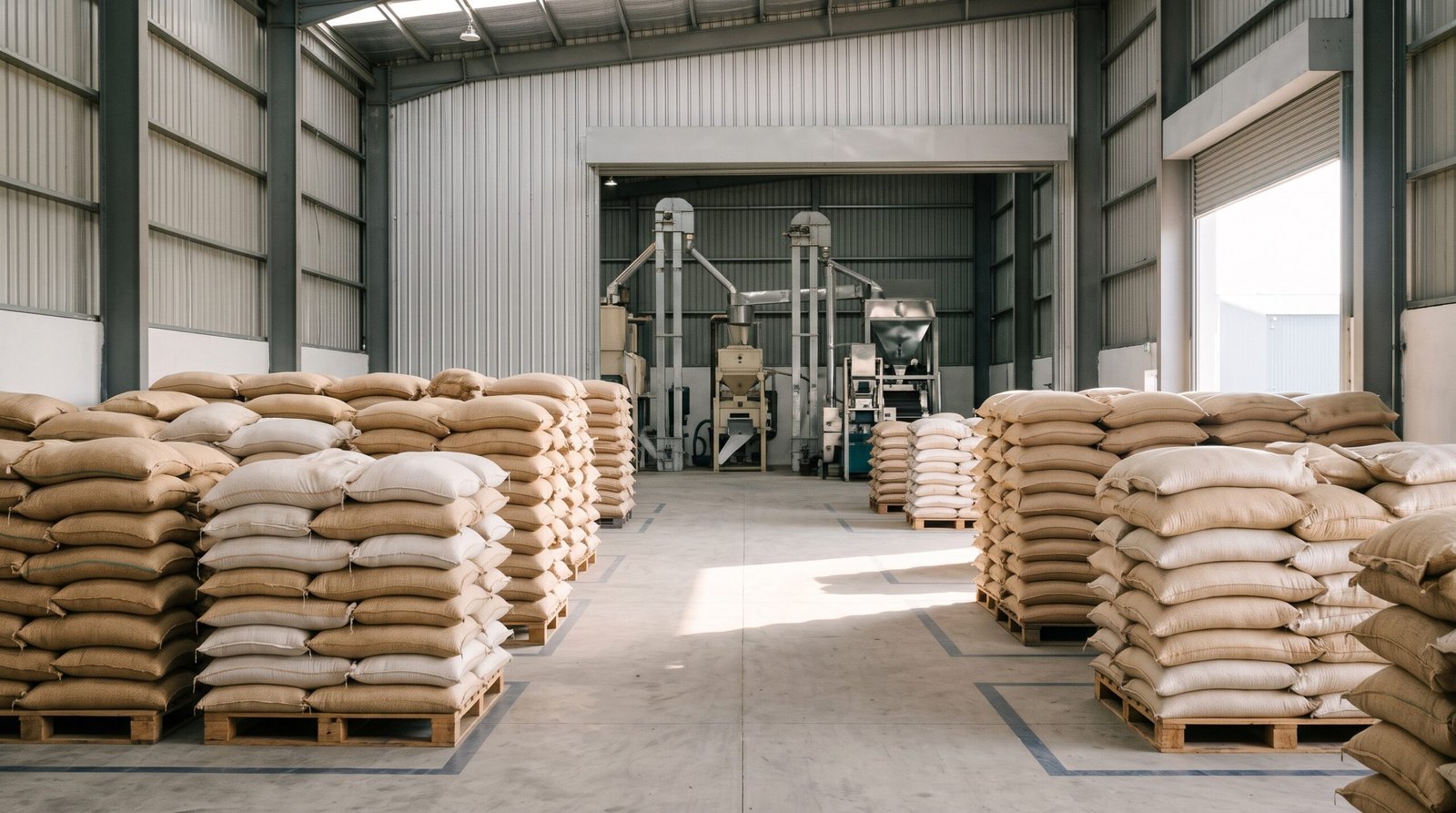
A mill can run on any day of the year. Paddy arrives on only some of them. After the last delivery, the mill lives on what the store holds.
That makes the store the limit on output. A mill holding dry paddy turns a short harvest into steady supply, and a mill without it buys only what it can mill that week.
A larger mill eats through the store faster, then stands idle until the next harvest. The owner pays for a rice mill machine that works part of the year, and repays the loan for all of it. The store sets the running months, and the mill sets only how fast they pass.
Working out how many months the mill must run after harvest
- Map your intake calendar. List the months paddy reaches your gate and roughly how much arrives in each.
- Set your running months. Your buyers usually decide this.
- Find the carry period. Count the months from the end of one intake window to the start of the next. With two seasons, take the longer gap.
- Work out daily paddy need. Multiply your planned milling rate by the hours you plan to run each day.
- Find the store tonnage. Multiply daily paddy need by the working days in the carry period.
- Allow for usable space. The FAO’s post-harvest training manual puts usable volume at less than 50 percent of gross internal volume for a 500-tonne store, rising to about 80 percent for a 10,000-tonne store [2]. The building must be larger than the tonnage.
If the store costs more than your capital allows, lower the milling rate in step 4 and rerun it. A slower mill needs a smaller store for the same carry period.
Drying paddy as fast as it arrives
The store works only if the paddy going in is dry. The FAO training manual on small-scale rice milling notes that harvested paddy often comes in above 20 percent moisture, and must come down to 12 to 14 percent for efficient hulling [3]. The FAO’s rice post-harvest e-mail conference reports that a week of rain at harvest can leave grain germinated, yellowed or rotten, and that a dryer lets a miller buy paddy in any weather [4]. So the dryer belongs in the store calculation, because every tonne passes through it first.
Size the dryer to the busiest day of intake, because paddy arrives in surges when fields are cut. Wet paddy waiting its turn starts to heat, so keep the wait short and aerate the holding bin. The FAO e-mail conference describes two-stage drying, where high temperature and airflow bring very wet grain to about 18 percent, and slow drying then takes it to 14 percent [4]. The FAO milling manual adds that drying too fast causes hairline cracks, which become brokens at the mill [3].
| Point in the chain | Moisture, wet basis | What follows |
|---|---|---|
| At harvest | Often above 20% [3] | Dry promptly |
| After first-stage drying | About 18% [4] | Needs a slow second stage |
| Equilibrium at 70% humidity | 14.0% [5] | Store at or below it |
| Efficient hulling | 12% to 14% [3] | Machines perform poorly outside it |
| Long-term storage | 12% to 13% [5] | Keeps for years if well managed |
| Paddy standard EAS 764 | 13% maximum [6] | All three grades |
| Draft East African milled rice standard | 14% maximum [7] | Finished rice |
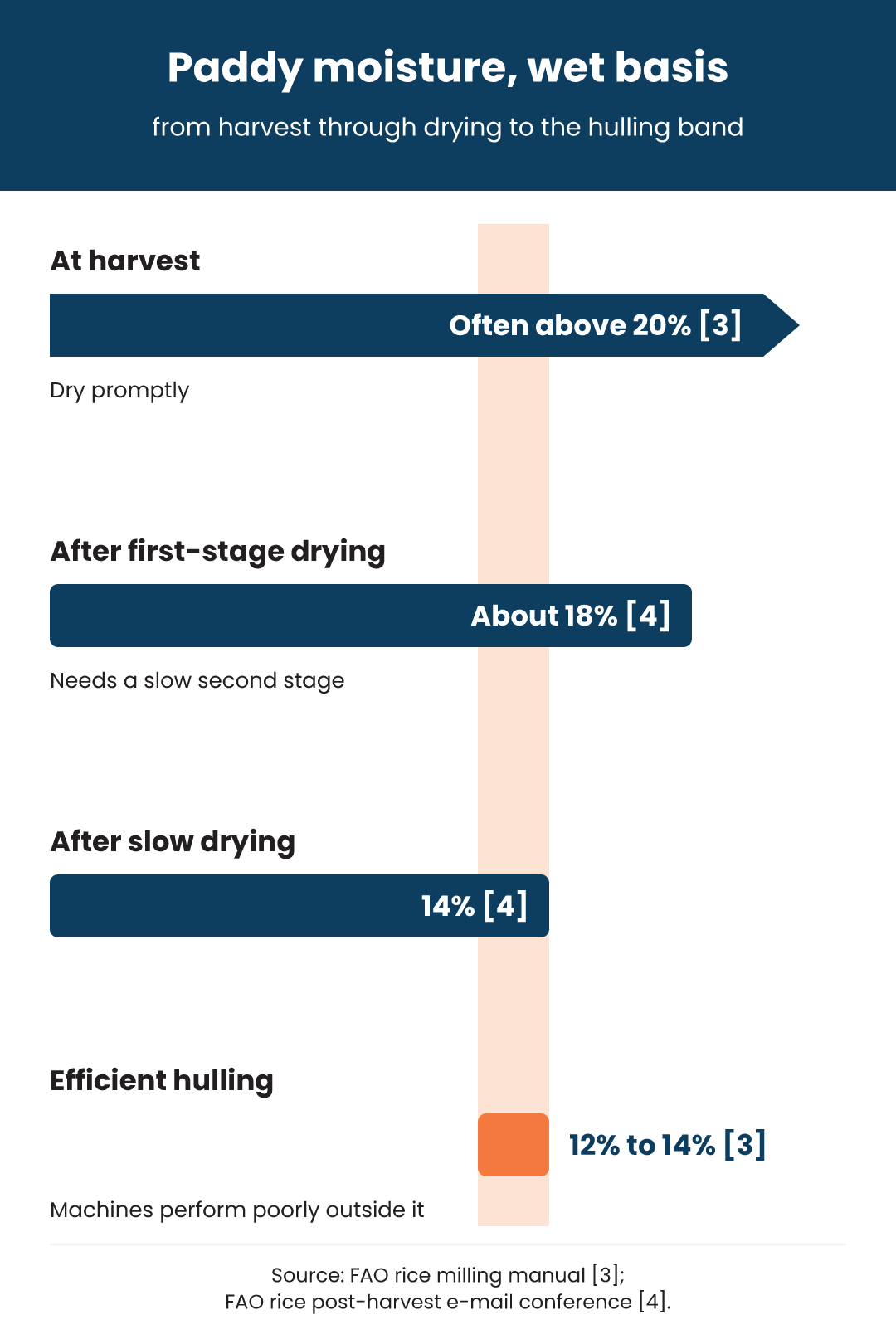
Caption: Paddy moisture, wet basis, from harvest through drying to the hulling band. Source: FAO rice milling manual [3]; FAO rice post-harvest e-mail conference [4].
Read together, the rows set the dryer target. Of the table’s last two rows, only the paddy standard is in force in Uganda and Rwanda: EAS 764 caps paddy at 13 percent [6]. The milled-rice limit comes from DEAS 128:2026, still a draft [7].
The FAO storage manual puts the paddy equilibrium in air of 70 percent humidity at 14.0 percent, above that cap, and gives 12 to 13 percent for long storage [5]. So dried paddy can take moisture back in humid months, and the store must keep it covered and aerated. Paddy held in the long-storage band sits inside the hulling band, so it is ready to mill. Ghana and Cote d’Ivoire sit outside the East African Community, so confirm their limits with the national standards body.
Keeping stored paddy in condition until it is milled
Once dry, paddy has to stay dry for the whole carry period. The FAO manual’s chapter on storage and moisture calls moisture content probably the most important single factor in safe storage, with safe levels depending on variety and aeration [5]. A 2025 trial reported in ORYZA, an international journal of rice, stored paddy for six months: paddy in gunny bags was infested, and paddy in hermetic bags stayed free of insects [8].
In a warehouse, three habits carry most of the weight:
- Keep bags off the floor, stacked for inspection. The FAO warehouse chapter recommends dunnage, poles or pallets against floor moisture, room to check for rodents and insects, and a very clean store [2].
- Rotate the stock. Mill the oldest paddy first, so no lot sits through a second rainy season.
- Check moisture. The FAO storage chapter notes that a store manager usually needs moisture measured to within 1 percent [5].
The tempering bin: giving grain time to reach milling moisture
Drying leaves the inside of each grain wetter than the outside. Milled in that state, it cracks. A 2025 review in the Journal of Cereal Science finds that kernel fissuring during drying is a known cause of breakage in milling, and that tempering temperature and time both affect it [9].
A tempering bin rests the grain so moisture evens out through the kernel. The FAO e-mail conference notes that single-pass sun drying gives grain no tempering phase, and that on a recirculating dryer the feed tank serves as the tempering bin [4].
Brokens are where this reaches your revenue. The draft East African milled rice standard counts any piece smaller than three-quarters of a whole kernel as broken, and allows 5 percent brokens in Grade 1, 15 percent in Grade 2 and 25 percent in Grade 3 [7].
Where such grades apply, skipping tempering can push a batch down a grade. Size the tempering bins from dryer output and rest time, and put a cleaned-paddy buffer ahead of the husker to cover short stoppages.
Sizing a rice mill plant backward from the paddy store
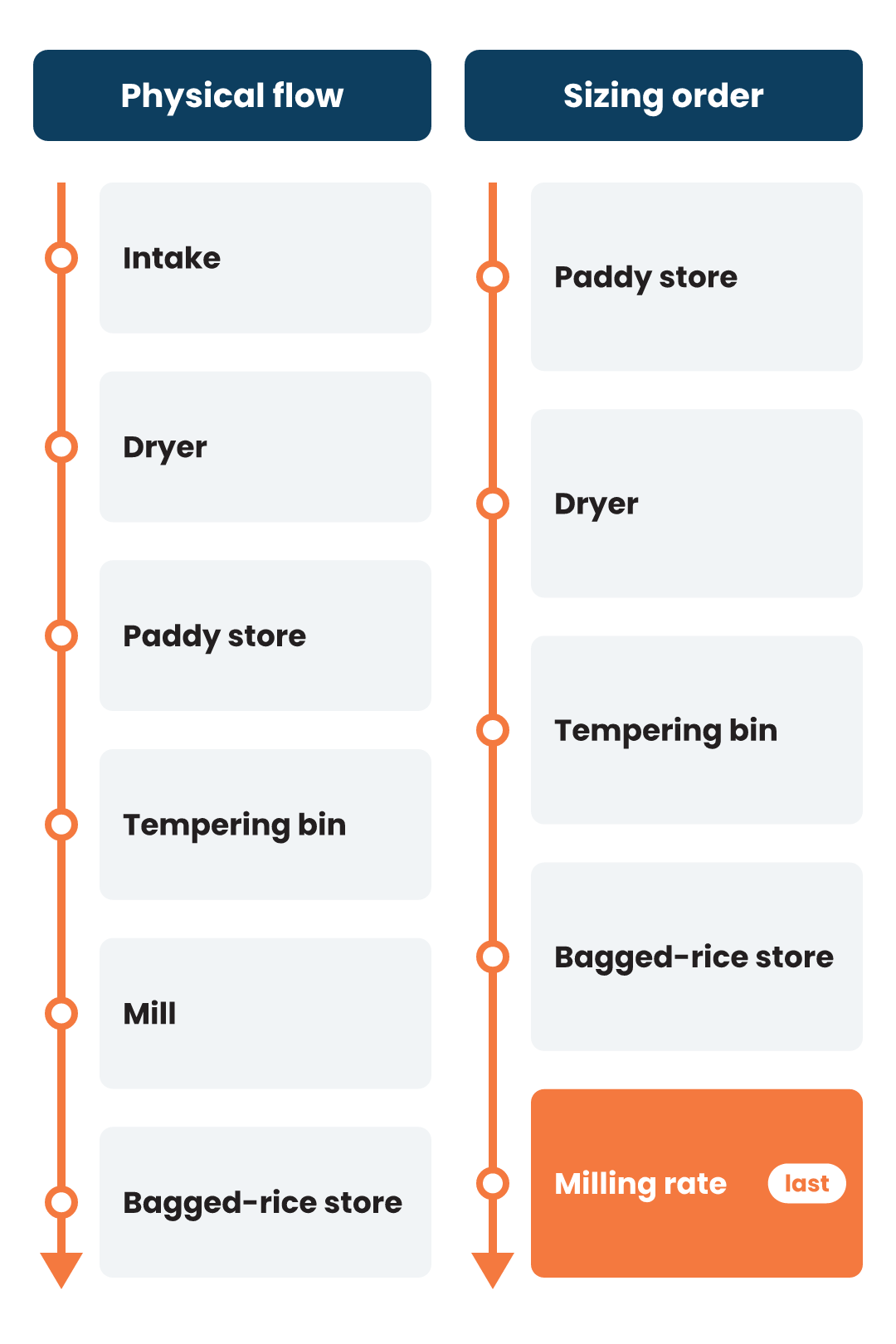
Paddy moves through the plant as intake, dryer, paddy store, tempering bin, mill and bagged-rice store. It is sized in another order. The paddy store comes first, then the dryer, the tempering bins and the bagged-rice store, and the milling rate comes last, tested against your capital.
| Store | What limits it | What sets its size |
|---|---|---|
| Wet-paddy holding | Hours before paddy heats | Peak intake against dryer throughput |
| Dryer | Intake surges, weather | Busiest intake day |
| Paddy store | Harvest window, usable volume, capital | Carry period times daily paddy need |
| Tempering bin | Rest time | Dryer output and rest time |
| Cleaned-paddy buffer | Upstream stoppages | Hours of milling to protect |
| Bagged-rice store | Buyers’ collections | Dispatch cycle plus a slow week |
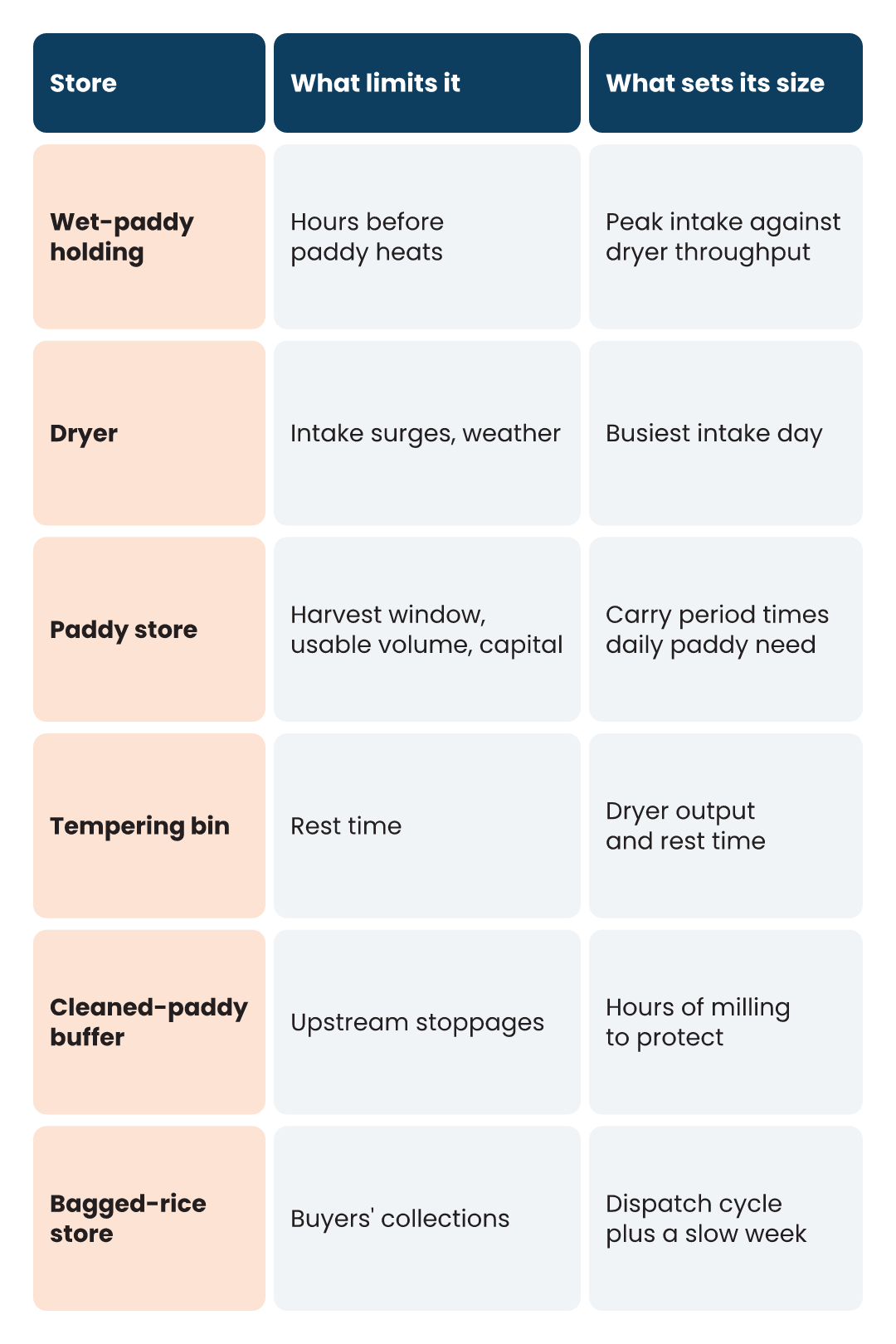
Caption: What limits and sizes each store in a rice mill plant. Source: this article’s sizing method; usable volume from the FAO training manual [2].
Every row is sized from intake, weather, rest time, stoppages or collections. The milling rate is the one figure the stores decide for you, and the one worth putting into a repayment plan.
What this means in Ghana, Cote d’Ivoire, Uganda and Rwanda
Ghana
The USDA’s 2025 Ghana Grain and Feed Annual found that the price of paddy depends heavily on its moisture at sale, and that millers offer less for drier paddy because it breaks more in milling [10]. So the dryer’s target moisture is a pricing decision as well as a storage one. A mill with dry storage can buy at harvest and mill all year.
Cote d’Ivoire
The FAO’s GIEWS country brief for Cote d’Ivoire, dated December 2024, reported the 2024 rice harvest under way in the southern and central bimodal areas and due to finish by year end [11]. Two seasons in the south can shorten the carry period, so map both windows before sizing the store. Confirm intake windows with the agriculture ministry.
Uganda
Bangete’s 2023 study of smallholder rice drying in Kibuku district found initial moisture and grain size the major factors in drying [12]. So paddy can arrive at varied moisture, and every lot needs testing at intake. Confirm harvest windows with the agriculture ministry.
Rwanda
The National Institute of Statistics of Rwanda’s Seasonal Agricultural Survey 2025 describes three seasons: Season A from September to February, Season B from March to June and Season C from July to September [13]. Each season carrying rice is a separate intake window, and the longest gap between them is your carry period. Confirm with the agriculture ministry which seasons your rice falls in.
Questions to ask any rice mill plant proposal about storage and drying
Put these questions to any proposal before you compare prices. A good proposal answers them with figures tied to your own intake.
- How many months of milling does the paddy store carry once intake stops?
- What intake day is the dryer sized to, and is drying done in one stage or two?
- Where is the tempering stage, and how long does grain rest in it?
- How will moisture be measured at intake, after drying and before milling?
- Which parts can be added later without rebuilding, if capital is short?
How Sonika Impex LLP can help
- Rice mill plants from 100 kg/hour to 10 TPH of paddy, turnkey or as standalone machines from pre-cleaner and husker to the rice milling and polishing machine, for new plants, expansion or modernisation.
- Paddy dryers from 5 to 48 tonnes per batch, from mobile recirculating dryers to large column dryers.
- Husk-fired steam boilers from 500 kg/hour to 8 TPH of steam for parboiling, IBR certified where required.
- A needs assessment of what your plant needs now and later, with a plain word when something is not needed yet.
- Pre-shipment inspection, with SGS or Bureau Veritas as required, and export FOB to your port of discharge: typically Tema, Abidjan, Mombasa or Dar-es-Salaam.
- Erection and commissioning, training for project and maintenance staff at your site, and after-sales support.
- Introductions to banks, financial institutions and other institutions that can help the project.
Send us:
- What you want to make, white or parboiled rice, and roughly how much a year
- Your intake calendar: how much paddy, of which varieties, you can buy in each month
- Storage, drying or milling equipment you already have
- The months you want the mill to run, and how often buyers collect
- Site details: power, water and space
+91 99027 67900 · sonikaimpex.com
Frequently asked questions
Can I sun-dry paddy and skip a mechanical dryer?
Sun drying works where labour is available and the weather holds. The [FAO training manual](https://www.fao.org/4/x0039e/X0039E04.htm) notes that grain spread thinly on black plastic sheeting and turned often dries fastest, and that labour is the main limit [2]. A sun-drying yard stops when it rains, so plan how wet paddy will be held on those days.
What is a quick way to check whether paddy is dry enough to store?
A salt test in a sealed jar gives a rough check. The [FAO storage chapter](https://www.fao.org/4/x0039e/X0039E01.htm) says that if dry salt sticks to the jar walls, the grain is above about 15 percent moisture and unsuitable for bulk storage [5]. A calibrated moisture meter is the better tool for daily buying decisions.
Does over-drying cause problems?
Yes. The East African paddy standard, [EAS 764](https://law.resource.org/pub/eac/ibr/eas.764.2011.html), lists over-dried damaged grain as a defect caused by overheating during artificial drying [6]. Over-drying also burns dryer fuel for no gain. Set the dryer to the storage target and measure what comes out.
Should I parboil?
The [FAO milling manual](https://www.fao.org/4/x0039e/X0039E06.htm) describes parboiling as soaking, steaming and drying the paddy, which makes hulling easier and gives a greater proportion of whole-grain rice [3]. It adds a steam supply, a water supply and a second drying step to the plant. Whether it pays depends on what your buyers want.
Can seed paddy be kept in the mill store?
It can, as a separate lot with its own records, because seed must stay alive as well as dry. In the 2025 trial reported in [ORYZA](https://epubs.icar.org.in/index.php/OIJR/article/view/156819), paddy in hermetic bags held germination at 91.7 percent after six months [8]. Keep seed lots away from the milling stock so they are never milled by mistake.
How do I store paddy from different varieties?
Keep each variety in its own stack or bin and mill it as a separate lot. The [FAO storage chapter](https://www.fao.org/4/x0039e/X0039E01.htm) notes that varieties can differ in safe storage moisture [5], and mixed lots mill unevenly.
Should a small mill use bins or a bag warehouse?
The [FAO warehouse chapter](https://www.fao.org/4/x0039e/X0039E04.htm) notes that most grain warehouses are designed for bag storage, and that very small bagged stores carry a high cost per tonne, so bin storage is worth considering at that size [2]. Bins suit a mill that buys paddy in bulk. A bag warehouse suits paddy that arrives already bagged from many small sellers.
How are insects controlled in a bagged paddy store?
The [FAO warehouse chapter](https://www.fao.org/4/x0039e/X0039E04.htm) describes fumigation under a gasproof sheet as the most satisfactory chemical method, and asks for space around stacks for ventilation, access, hygiene and fumigation [2]. The [same chapter](https://www.fao.org/4/x0039e/X0039E04.htm) says pallets should be inspected and sprayed before use [2]. Fumigants are hazardous, so confirm with the national regulator who may apply them.
Can I build the store in stages?
Yes, if the site plan reserves the space and the conveying layout allows for it. Plan the full store from the start, build what the first seasons need, and add bays as intake grows. The milling rate can be raised in step.
Final thoughts
The question was how many months of paddy your rice mill plant needs. Your harvest calendar and your buyers set the answer, and it is a question about the store before it is one about the mill. Paddy that arrives in a short harvest window is useful only to a mill with somewhere dry to put it. Once the store can carry the mill from one harvest to the next, and the dryer and tempering bins can feed it, the right milling rate follows from the paddy you can hold.
For the full picture, read our guide: [Rice Mill Plant Storage Sizing: Why the Smallest Store Sets the Output of Any Processing Plant](/rice-mill-plant-storage-sizing-smallest-store-sets-output/).
Sources
- US Department of Agriculture, Foreign Agricultural Service | Ghana: Grain and Feed Annual 2026, report GH2026-0011, published 3 April 2026 | https://apps.fas.usda.gov/newgainapi/api/Report/DownloadReportByFileName?fileName=Grain+and+Feed+Annual_Accra_Ghana_GH2026-0011.pdf (accessed 2026-10-19)
- FAO | Prevention of post-harvest food losses: a training manual, drying and warehouses, published 1985 | https://www.fao.org/4/x0039e/X0039E04.htm (accessed 2026-10-19)
- FAO | Prevention of post-harvest food losses: a training manual, small-scale rice milling, published 1985 | https://www.fao.org/4/x0039e/X0039E06.htm (accessed 2026-10-19)
- FAO | Rice post-harvest e-mail conference: drying of high moisture paddy, summary published June 1998 | https://www.fao.org/4/x5427e/x5427e0d.htm (accessed 2026-10-19)
- FAO | Prevention of post-harvest food losses: a training manual, storage requirements and moisture content, published 1985 | https://www.fao.org/4/x0039e/X0039E01.htm (accessed 2026-10-19)
- East African Community | EAS 764:2011 Rough (paddy) rice: Specification, first edition 2011 | https://law.resource.org/pub/eac/ibr/eas.764.2011.html (accessed 2026-10-19)
- Rwanda Standards Board | DEAS 128:2026 Milled rice: Specification, draft East African Standard, 2026 | https://www.rsb.gov.rw/fileadmin/user_upload/DEAS_128_2026.pdf (accessed 2026-10-19)
- ORYZA, An International Journal of Rice | Sivashankari and Khandai: Studies on the impact of conventional and hermetic storage techniques on the paddy quality, published 4 July 2025 | https://epubs.icar.org.in/index.php/OIJR/article/view/156819 (accessed 2026-10-19)
- Journal of Cereal Science | Nelwan, Mardjan and Yulni: Unlocking glass transition phenomenon in mitigating drying-induced kernel fissuring in rough rice, a review, volume 124, published 2025 | https://doi.org/10.1016/j.jcs.2025.104224 (accessed 2026-10-19)
- US Department of Agriculture, Foreign Agricultural Service | Ghana: Grain and Feed Annual 2025, report GH2025-0012, published 9 April 2025 | https://apps.fas.usda.gov/newgainapi/api/Report/DownloadReportByFileName?fileName=Grain+and+Feed+Annual_Accra_Ghana_GH2025-0012.pdf (accessed 2026-10-19)
- FAO GIEWS | GIEWS Country Brief: Cote d’Ivoire, reference date 9 December 2024 | https://www.fao.org/giews/countrybrief/country/CIV/pdf/CIV.pdf (accessed 2026-10-19)
- Busitema University repository | Bangete: An assessment of causes of post-harvest losses during drying of rice amongst the smallholder rice farmers in Kibuku district of Uganda, published July 2023 | https://ir.busitema.ac.ug/handle/20.500.12283/3755?show=full (accessed 2026-10-19)
- National Institute of Statistics of Rwanda | Seasonal Agricultural Survey: Annual Report 2025, covering January to December 2025 | https://www.statistics.gov.rw/data-sources/surveys/Seasonal-Agricultural-Survey/Seasonal-Agricultural-Survey/seasonal-agricultural-survey-2025- (accessed 2026-10-19)