Buying From an India Machinery Supplier for Africa: Your Questions on the Costs Between the Port and Your Site
November 10, 2026
Turnkey Fruit Processing Plant Setup Cost: Why Juice, Concentrate, Pulp and Packaged Fruit Lines Price So Differently
November 12, 2026
Choosing a Turnkey Plant Manufacturer in India: The Questions to Settle Before You Sign
On 8 January 2026, Ghana’s Environmental Protection Authority told regulated businesses to regularise their environmental permits, the Ghana Broadcasting Corporation reported on 10 January 2026 [1]. Under the Environmental Protection Act, 2025 (Act 1124) and the Environmental Protection (Environmental Assessment) Regulations, 2025 (LI 2504), operating without a valid environmental permit is an offence, the same report notes [1]. A turnkey plant manufacturer can supply and commission the line, but that permit is the owner’s to obtain, and the plant cannot lawfully run without it.
So the real question behind a turnkey contract is who carries each item between the price and a running plant. Turnkey promises one party accountable for the whole plant, and the contract decides how far that reaches. For a first-plant owner, these are the questions to settle, in the order the project meets them.
In short:
- Turnkey means one party answers for the plant, as far as the scope schedule says.
- Mark civil works, utilities, effluent and permits in the scope schedule: who does each, and by when.
- Commissioning should prove the line on your own raw material, and handover should be signed and documented.
- Settle the spares, the warranty start and support after it.
- Check what credit attached to an offer covers. Your bank needs the full project cost.
Contents
- A. Turnkey covers what the scope schedule says
- B. The site, civil works and utilities each need an owner
- C. Erection, commissioning and handover prove the plant
- D. Spares, warranty and support keep the plant running
- E. Payment terms decide what the bank must fund
- What this means in Ghana, Cote d’Ivoire, Uganda and Rwanda
- What should I settle with a turnkey plant manufacturer before I invest?
- How Sonika Impex LLP can help
- Frequently asked questions
- Final thoughts
- Sources
A. Turnkey covers what the scope schedule says
What does a turnkey plant include?
A turnkey contract makes one party answer for the plant as a working whole. Check the scope schedule for design and layout, the machines and everything connecting them, export packing, erection, commissioning and training.
The word carries no agreed list of items, so each contract defines it afresh. Ask for a scope schedule that marks who supplies every item and names the point of handover.
If an item is missing from the schedule, assume it is yours.
What does standalone machinery leave with me?
Buy machines one by one, from one seller or several, and you become the integrator. Under turnkey, one party answers for the line. Under standalone purchase, each seller answers for its own machine, and the gaps are yours.
| Item | Turnkey plant | Standalone industrial machinery |
|---|---|---|
| Layout and process design | Supplier | You |
| Matching capacities between stages | Supplier | You |
| Conveyors, piping and panels between machines | Supplier, if in scope | You |
| Erection and commissioning | Supplier, with your local inputs | Mark it in each seller’s scope |
| Who answers when the line underperforms | Supplier | Each seller, for its own machine |
The last row matters most, because the gaps between machines are where cost hides.
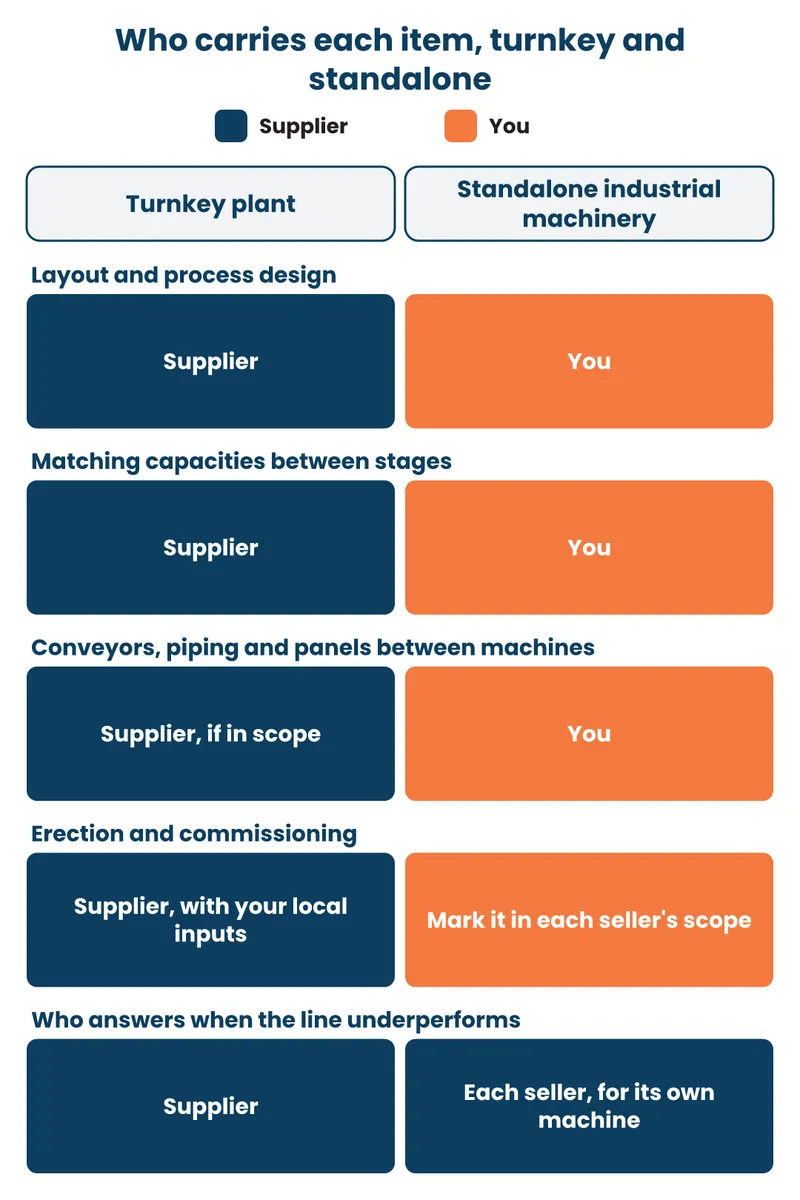
Caption: Who carries each item, turnkey and standalone. Source: the team’s project experience; each contract’s scope schedule decides.
Can part of a plant be bought turnkey?
Yes. A dairy might take the processing hall turnkey and buy its cold rooms separately. Draw the boundary at a clear physical point, such as a flange or a terminal box, and write it into the contract, because that boundary decides who answers when the two sections fail to work together. Plan the full plant at the start, so the first section leaves room for the next.
B. The site, civil works and utilities each need an owner
Who does the civil works and foundations?
Check the scope schedule. Where civil works sit with you, a local contractor works to the supplier’s layout, foundation loads, bolt positions and pit details. Ghana’s Land Use and Spatial Planning Act, 2016 (Act 925) bars physical development of land in a district without a District Assembly permit [2], so the drawings need approval before ground is broken.
Pour the machine bases only after the layout is final. In the team’s experience, a floor poured early is a frequent reason machines wait under tarpaulin.
Who arranges the power connection, water and effluent route?
You do, because the applications are made in the owner’s name. The supplier’s part is the connected load, the water demand at each stage, and the volume and nature of the effluent. Ask for those figures with the proposal.
The effluent route can take longest, because it runs through the environmental assessment. Uganda’s National Environment (Environmental and Social Assessment) Regulations, 2020 bar any ministry, agency or local government from issuing a licence or permit for a covered project without proof of a certificate of approval [3].
C. Erection, commissioning and handover prove the plant
Who erects the plant?
Agree whether the supplier’s technicians carry out or supervise erection. Settle who provides fitters, lifting gear and consumables, who pays the technicians’ travel and stay, and who pays if they wait on an unfinished site. Write these in as buyer’s inputs, each tied to a stage of erection with a date.
What does commissioning prove?
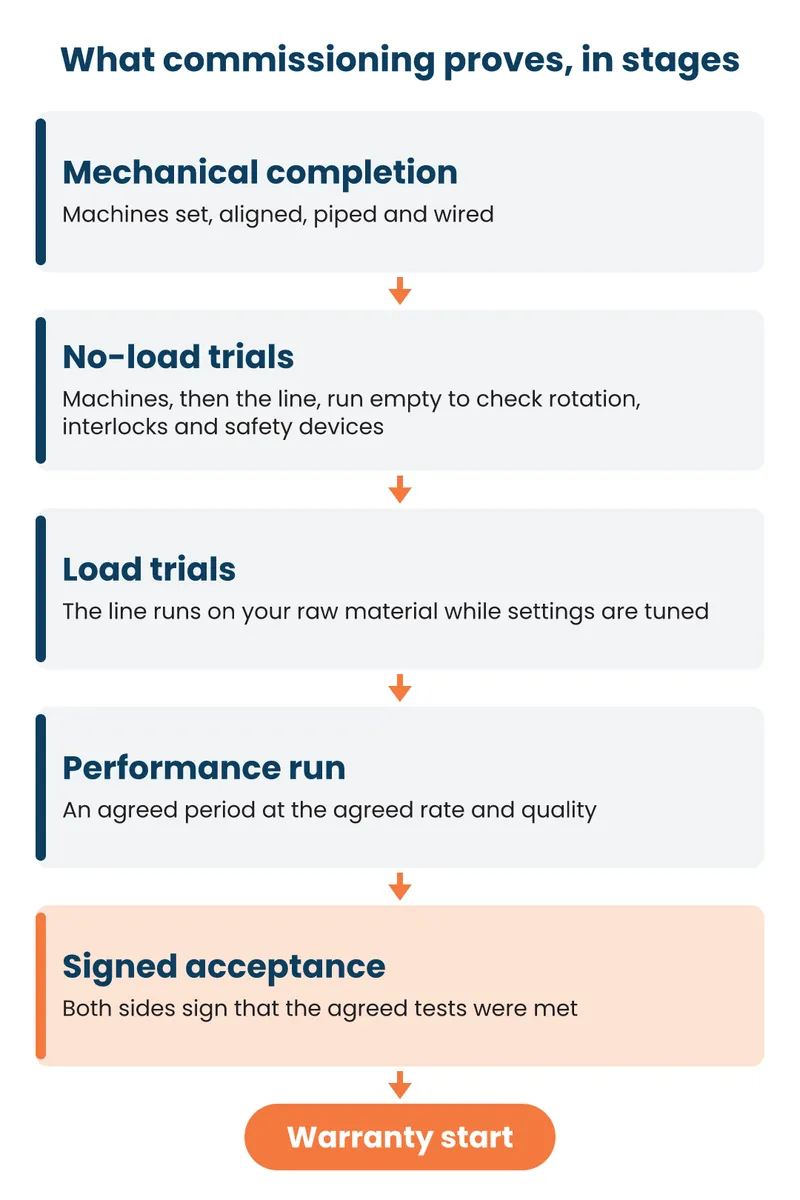
Commissioning proves, in stages, that the line makes product to specification on your own raw material.
- Mechanical completion: machines set, aligned, piped and wired.
- No-load trials: machines, then the line, run empty to check rotation, interlocks and safety devices.
- Load trials: the line runs on your raw material while settings are tuned.
- Performance run: an agreed period at the agreed rate and quality.
- Acceptance: both sides sign that the agreed tests were met.
The flow runs from mechanical completion through empty and loaded trials to a performance run and signed acceptance. Agree the test and its duration in the contract.
What should the handover include?
It starts with a signed acceptance protocol stating what the line achieved and on what raw material. Open points go on a list, each with a closing date and a named person. The documents follow: as-built drawings, electrical diagrams, operating and maintenance manuals, and the spares list with part numbers. Agree whether the handover date starts the warranty; handover also moves daily responsibility to you.
How is training done?
Training during erection and trial runs puts each valve, sensor and setting in front of your staff. So hire your fitter, electrician and operators before the technicians arrive. Agree who is trained, on which machines, and for how long. Record the sessions and attendees in the handover documents.
D. Spares, warranty and support keep the plant running
Which spares ship with the plant?
Ship start-up spares in the same containers as the plant. A part already on site avoids air freight and a second clearance while the plant waits. Ask for the list split into wear parts, such as screens, rollers and seals, and parts that fail with little warning, such as bearings and fuses.
When does the warranty start?
Settle it in writing, because the possible start dates sit far apart: shipment, arrival, end of erection, or signed acceptance. A warranty that starts at shipment may be partly spent before the plant runs. Agree what it covers, such as defective parts, and what voids it, such as untreated water. Its length is set in each contract.
What support continues after the warranty?
Ask who answers for parts and service once the warranty ends, how parts are ordered and where they ship from. Parts supply decides how long a breakdown stops the plant. Get the after-sales terms in the proposal.
E. Payment terms decide what the bank must fund
What does supplier credit pay for, and what does it leave unpaid?
Check what credit attached to an offer covers. Where it covers only the export contract, everything outside it, such as civil works, power, water treatment and permits, still needs its own funding unless the facility names it. So does the down payment, and so do wages and working capital until the plant sells product.
Ask in writing what the facility covers, line by line, what down payment it needs and whether any local costs are included. The plant still has to reach its output to repay the credit, so the support behind the machines is part of what the credit costs.
FOB or CIF, TT or Letter of Credit?
The ICC Incoterms 2020 rules allocate cost, risk and obligations between seller and buyer [4]. Under FOB, the price stops at the Indian port of loading, and you arrange sea freight and insurance as budget lines of your own, with the cover you choose. Under CIF, the same rules have the seller pay both to the port of discharge, with the Institute Cargo Clauses (C) as default cover unless higher cover is agreed [4].
Payment in advance by TT sends your money before the goods ship, so it weighs on cash flow during the build. A Letter of Credit ties payment to shipping documents that match its terms, and your bank checks them before it pays. A TT can also be split between an advance and a payment against shipment.
What should the bank see?
The full project cost: the supplier’s scope plus every item on your side of the schedule. Give your bank the scope schedule, the payment and freight terms, and your estimates for clearing, inland transport, civil works, utilities, permits, wages before first sale and working capital. A gap found mid-project has to be funded after the money is committed.
What this means in Ghana, Cote d’Ivoire, Uganda and Rwanda
Each permit below goes on your side of the scope schedule, with a date.
Ghana
The District Assembly permit under Act 925 comes first [2]. The environmental permit named in the opening belongs on the plan ahead of trial runs. The Department of Factories Inspectorate approves building plans for premises intended as factories and registers factories, under the Factories, Offices and Shops Act, 1970 (Act 328) [5].
Cote d’Ivoire
The Ministry of Economy states that environmental law is set by the Environment Code, Law No. 2023-900 of 23 November 2023 [6]. Its procedures page names the Agence Nationale de l’Environnement as the single window for environmental assessments [7], so the supplier’s effluent data goes to one agency. Research for this article found no current published list of which processing plants need a full impact study, so confirm that with the agency before fixing erection dates.
Uganda
Under the 2020 regulations, a covered project cannot be implemented without a certificate of approval from the National Environment Management Authority [3]. Under the Occupational Safety and Health Act, 2006, anyone who will use premises as a workplace must notify the Commissioner not less than one month beforehand, and the workplace is then registered [8]. Count back from your staff’s first day on site.
Rwanda
Ministerial Order No 003/MoE/25 of 19 August 2025 puts industries on the full assessment list, and a listed project cannot be implemented without a certificate of approval [9]. The certificate comes before erection.
The 2025 order repeals only an earlier impact assessment list [9]. The Rwanda Environment Management Authority still cites Ministerial Order No. 001/2021 for audits: listed projects must submit regular environmental audit reports to it [10]. Confirm building permits with the district office.
What should I settle with a turnkey plant manufacturer before I invest?
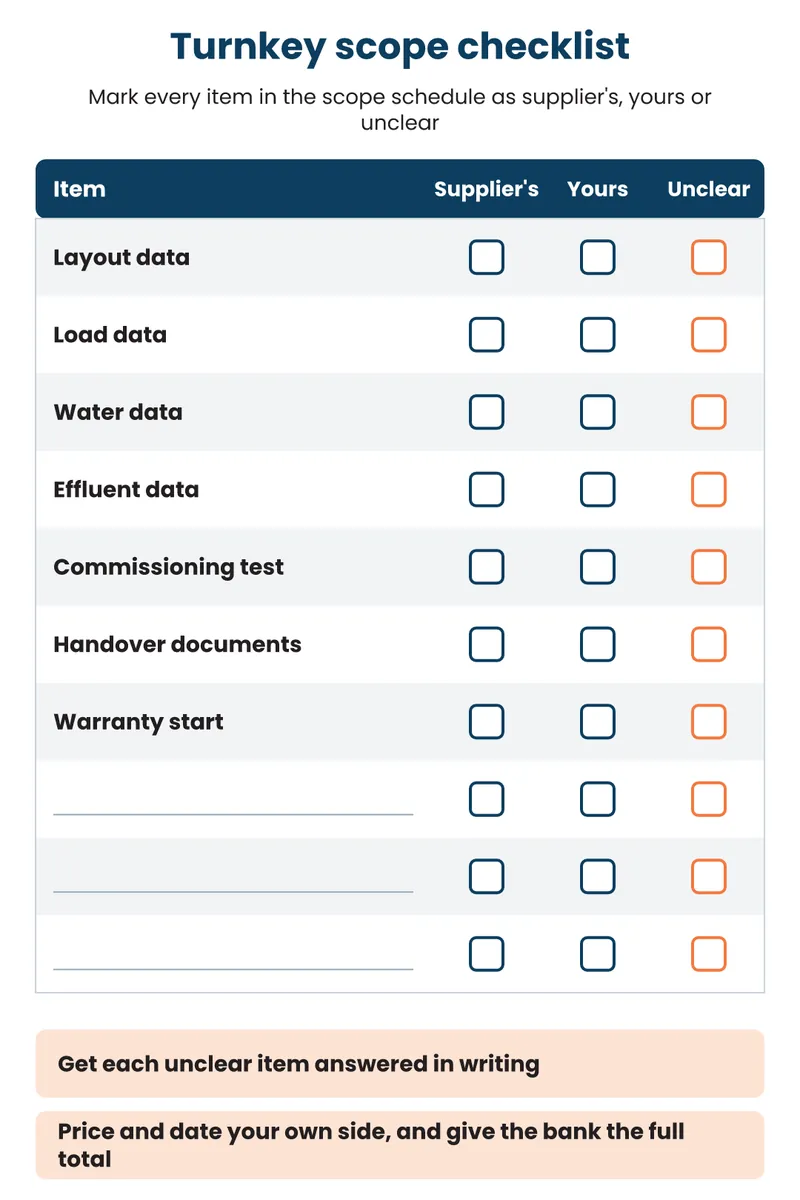
- Mark every item in the scope schedule as supplier’s, yours or unclear.
- Get each unclear item answered in writing.
- Ask for layout, load, water and effluent data with the proposal.
- Write the commissioning test, handover documents and warranty start into the contract.
- Price and date your own side, and give the bank the full total.
One mistake to avoid is comparing two turnkey offers on the total alone. Two totals compare fairly only when both scope schedules list the same items.
How Sonika Impex LLP can help
For a turnkey project, Sonika Impex LLP provides:
- A needs assessment: what the plant needs now and later, a plan for both, and a plain word when something is not needed yet
- A customer-specific proposal for turnkey plants, standalone machinery and working capital materials
- Pre-shipment inspection and packing, with third-party inspection by SGS or Bureau Veritas as required
- Export on FOB terms by preference, or CIF, with TT or Letter of Credit, open to negotiation
- Erection, commissioning, training for project and maintenance staff at your site, and support after the warranty ends
- Introductions to banks, financial institutions and other institutions that can help; Sonika does not lend, arrange or guarantee finance
The team is family run, with close to five decades of export experience and 200+ projects implemented.
Send us:
- What you want to make, and how much
- Your raw material and how its supply varies across the year
- The site, its power and water today, and whether the building exists
- Any equipment already installed, and which parts you want turnkey
+91 99027 67900 · sonikaimpex.com
Frequently asked questions
Should a turnkey price be one figure or split by section?
Ask for it split by section and by service: machines, erection, commissioning and training each priced on their own line. A split price lets you compare offers item by item and see what each section costs. It also helps if you later decide to buy one section in a second stage.
Can my own local contractor do the erection under a turnkey contract?
Yes, with the supplier’s technicians supervising. Agree in writing who answers for alignment and fit, because faults found at commissioning will be traced back to erection. The supplier’s sign-off on each machine before trials keeps that question settled.
What happens if my site is not ready when the technicians arrive?
Check how waiting time is charged, and agree the standby terms in the contract. Ask the supplier to give notice before mobilising, and confirm in writing that the floor, power and water are ready. A short site checklist, signed before travel is booked, helps avoid these disputes.
Who should hold the control software and passwords?
You should, from the day of handover. Ask for the control programs, any passwords and a backup copy as part of the handover documents. With them, your engineer can check settings and restore a backup after a fault, and plan any later change with the supplier.
Do I need my own engineer if I buy turnkey?
It helps, even with one party accountable for the plant. Your own engineer or consultant checks the civil works, the power installation and the water supply on your side, and witnesses the commissioning tests. That gives you an independent view on the day you sign acceptance.
Can another supplier expand a turnkey plant later?
Yes, if the connection points were planned and the control programs were handed over. A later supplier ties in safely only when it knows how the panels and controls were built. Leaving space and spare capacity in the panels at the start makes that easier.
What is checked at pre-shipment inspection?
The goods are checked against the packing list, the specifications and the agreed tests before they are packed and sealed. Inspection by SGS or Bureau Veritas can be written into the contract where your bank or regulator asks for it. Check the export packing too, because the crates face sea freight, inland roads and weeks of site storage.
Should the performance run use raw material from my hardest season?
Where you can, yes, because a line that meets its rate on easy raw material may fall short when the season turns. If the harder season falls after commissioning, agree a second check for that season in the contract. Record the raw material used in each test in the acceptance protocol.
Which electricity supply class will a plant in Uganda fall under?
Uganda’s [Electricity Regulatory Authority](https://www.era.go.ug/wp-content/uploads/2025/12/ERA-Tariff-Schedule-Q1-2026.pdf) classes Medium Industrial consumers at 415 volts up to 500 kVA, Large Industrial at 11,000 or 33,000 volts for demand between 500 and 1,500 kVA, and Extra-Large Industrial at 1,500 kVA and above [11]. Your connected load decides the class. Get that load from the proposal before you apply, because the class sets the supply voltage and the substation you may need.
Does the electrical installation need inspection before power is connected in Ghana?
Yes. Ghana’s [Energy Commission](https://www.energycom.gov.gh/index.php/initiatives/electrical-wiring/application-forms) requires new industrial installations to be inspected and tested before a service connection is made, under Regulation 11 of the Electrical Wiring Regulations 2011 [12]. Book a certified inspector once the wiring is complete and before trial runs are dated.
Final thoughts
Return to the permit Ghana’s Environmental Protection Authority told businesses to regularise in January 2026, as the GBC report noted [1].
The opening asked who carries each item between the price and a running plant. The sharper question is which items carry your name, and by what date. Settle those before you sign, and turnkey means what you paid for.
For the full picture, read our guide: [What an industrial machinery quote leaves out: the costs between the price and a running plant](/what-an-industrial-machinery-quote-leaves-out)
Sources
- Ghana Broadcasting Corporation | EPA orders businesses to regularise permits as enforcement intensifies (10 January 2026) | https://www.gbcghanaonline.com/news/epa-orders-businesses-to-regularise-permits-as-enforcement-intensifies/2026/ (accessed 2026-10-19)
- Government of Ghana | Land Use and Spatial Planning Act, 2016 (Act 925) (22 September 2016) | https://leap.unep.org/akn/gh/act/2016/925/eng@2016-09-22 (accessed 2026-10-19)
- Government of Uganda | National Environment (Environmental and Social Assessment) Regulations, 2020 (21 December 2020) | https://leap.unep.org/akn/ug/act/si/2020/143/eng@2020-12-21 (accessed 2026-10-19)
- International Chamber of Commerce | Incoterms 2020 (page updated July 2026) | https://iccwbo.org/business-solutions/incoterms-rules/incoterms-2020/ (accessed 2026-10-19)
- Ministry of Employment and Labour Relations, Ghana | Department of Factories Inspectorate (undated) | https://melr.gov.gh/4/15/23/department-of-factories-inspectorate (accessed 2026-10-19)
- Ministere de l’Economie, Cote d’Ivoire | Sector codes: Environmental Code, Law No. 2023-900 of 23 November 2023 (undated page) | https://economie-ivoirienne.ci/en/investissements/sector-codes.html (accessed 2026-10-19)
- Ministere de l’Economie, Cote d’Ivoire | Procedures and legal acts for environmental and social impact studies (updated 13 February 2023) | https://www.economie-ivoirienne.ci/node/249 (accessed 2026-10-19)
- Government of Uganda | Occupational Safety and Health Act, 2006 (8 June 2006) | https://ulii.org/akn/ug/act/2006/9/eng@2006-06-08/source (accessed 2026-10-19)
- Ministry of Environment, Rwanda | Official Gazette n° Special of 20/08/2025: Ministerial Order No 003/MoE/25 of 19/08/2025 on environmental and social impact assessment (20 August 2025) | https://businessprocedures.rdb.rw/media/db0f3a5b-ba19-40ed-af2f-fd9e47cd7dd2.pdf (accessed 2026-10-19)
- Rwanda Environment Management Authority | Environmental Audit Certificate (undated) | https://www.rema.gov.rw/services/environmental-audit-certificate (accessed 2026-10-19)
- Electricity Regulatory Authority, Uganda | Tariff schedule, first quarter 2026: customer categories (undated, issued for the first quarter of 2026) | https://www.era.go.ug/wp-content/uploads/2025/12/ERA-Tariff-Schedule-Q1-2026.pdf (accessed 2026-10-19)
- Energy Commission, Ghana | Electrical wiring: certification and application forms (undated) | https://www.energycom.gov.gh/index.php/initiatives/electrical-wiring/application-forms (accessed 2026-10-19)