How Many Months of Paddy Does Your Rice Mill Plant Need? Sizing the Store Before the Mill
November 7, 2026
Choosing a Turnkey Plant Manufacturer in India: The Questions to Settle Before You Sign
November 11, 2026
Buying From an India Machinery Supplier for Africa: Your Questions on the Costs Between the Port and Your Site
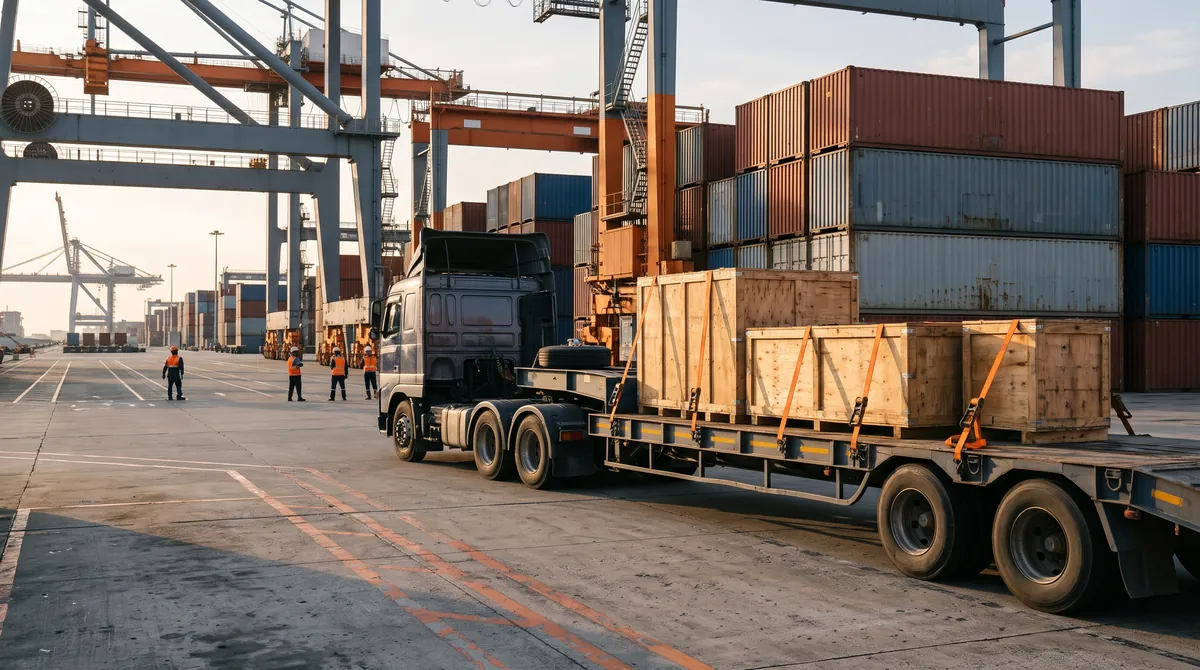
On 30 June 2026, the Ghana Shippers’ Authority published shippers’ complaints about containers held at a Tema terminal for weeks, with rent and demurrage at the importer’s expense, often for importers who had done everything the regulations asked [1]. On the eastern route, the Northern Corridor Transport Observatory Report found that in 2025 vessel turnaround at Mombasa rose to 192 hours, and ships waited 4.7 days for a berth [2]. If you are importing machinery from India, those weeks sit between the FOB price on your quote and the plant on your site.
The answers below cover that stretch, for the first-plant owner who carries the cost and the banker checking the budget. They run in the order the costs arrive, from loading in India to storage at site.
In short:
- Under FOB, the supplier’s price ends at loading in India. Every cost after that is yours.
- You clear the goods through a licensed agent, and duty follows each item’s tariff line.
- Port days cost money daily, so have documents, duty money and trucks ready before the ship docks.
- Machinery duty and VAT relief counts only once it is granted in writing.
- The bank should see the landed cost at site, and quotes should be compared to that same point.
Contents
- The quote’s terms set where your costs begin
- You clear the port through a licensed agent
- You move the crates from the port to site
- The landed cost is the figure the budget needs
- What this means in Ghana, Cote d’Ivoire, Uganda and Rwanda
- What should I ask before importing machinery from India?
- How Sonika Impex LLP can help
- Frequently asked questions
- Final thoughts
The quote’s terms set where your costs begin
What does FOB cover?
FOB, free on board, prices the machinery packed for export and loaded onto the vessel you nominate at the Indian port of shipment named in the quote. The International Chamber of Commerce’s FOB explainer says that under the Incoterms 2020 rule the seller delivers once the goods are on board, risk passes to you there, and you assume all costs after it [3]. Buying FOB keeps the sea leg in your hands, because your own forwarder books the vessel and the cover.
What does CIF add?
CIF, cost, insurance and freight, adds sea freight and marine insurance to the named port of discharge. The International Chamber of Commerce’s CIF explainer states that risk still passes to you when the goods are loaded in India, and that the seller may buy limited cover on the Institute Cargo Clauses (C) [4].
Check the cover level. The International Chamber of Commerce’s Incoterms 2020 rules keep Clauses (C) as the default unless the contract asks for more [5]. A crushed control panel can hold up the whole plant, so write the cover level into the contract.
Which suits a first plant?
FOB suits a first plant once there is a forwarder in your own market who knows your port. Freight and cover then arrive as separate lines, which are easier to defend to a bank. CIF suits a buyer who has no forwarder yet and wants one price to the port.
Write the Incoterm and its named port into the quote, because that port is where the supplier’s costs stop.
What sits outside both?
Each Incoterms 2020 rule lists its costs at article A9/B9, the International Chamber of Commerce explains, so you can check where the seller’s list ends [5]. Under both, the same CIF explainer notes, the buyer pays the duties, taxes and other costs of import clearance [4].
| Cost or task | Under FOB | Under CIF |
|---|---|---|
| Export packing and loading | Seller | Seller |
| Sea freight | Buyer | Seller |
| Marine insurance to the port | Buyer | Seller, Clauses (C) by default |
| Port charges and clearing | Buyer | Buyer |
| Duty, taxes and levies | Buyer | Buyer |
| Inland transport and insurance | Buyer | Buyer |
| Offloading and storage at site | Buyer | Buyer |
In the order it happens, the journey runs:
- Loading in India, where the FOB price ends.
- Sea voyage.
- Discharge, where port charges start.
- Clearance, where duty and taxes are paid.
- Release by the shipping agent.
- Inland transport to site.
- Offloading at site.
- Storage until erection.
Under FOB, every stage after loading is a cost you carry.
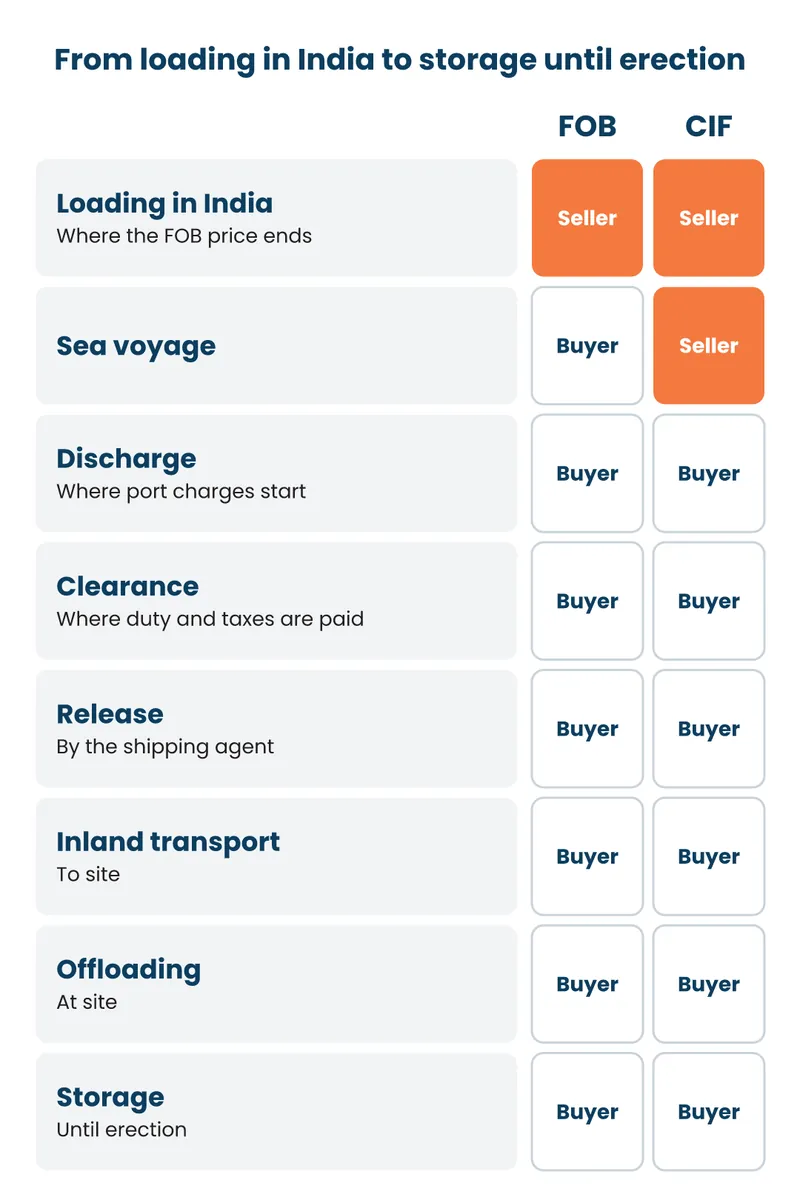
Caption: Under FOB, the buyer’s costs start at loading in India. Under CIF, they start at the port of discharge. Source: Incoterms 2020, International Chamber of Commerce [5].
You clear the port through a licensed agent
Who clears customs, and which documents are needed?
You do, through a licensed agent. The Ghana Ports and Harbours Authority states that section 43 of the Customs Act, 2015 (Act 891) requires importers other than self-declarants to use licensed customs house agents [6]. The Rwanda Revenue Authority obliges importers to use licensed clearing agencies, and holds the importer liable for the agent’s offences [7].
The supplier provides the paper. For Rwanda, the Rwanda Revenue Authority’s list is the original commercial invoice, the packing list, the bill of lading and, where one applies, a certificate of origin [7]. The Ghana Ports and Harbours Authority adds a taxpayer identification number and a validated cargo tracking note [6]. Appoint the agent before the ship sails, so mismatches are caught in time.
Which duties, levies and port charges belong in the budget?
Budget four lines: duty, taxes and levies, port charges, and agent and shipping line charges. Duty follows each item’s classification, so have your agent classify the packing list early. Ghana and Cote d’Ivoire apply the ECOWAS Common External Tariff, and the ECOWAS Commission places capital goods in its Band 1, at 5% [10].
Taxes sit on top of duty. The Ghana Revenue Authority lists the charges beyond import duty, among them VAT, the National Health Insurance Levy and the ECOWAS and African Union levies [11]. Relief is granted scheme by scheme, as Cote d’Ivoire’s Investment Code shows [12].
What happens when containers sit too long at the port?
They cost money every day: port rent after the free period, and the shipping line’s demurrage after its free days. The Ghana Shippers’ Authority complaints from Tema show those charges running even when the delay lay outside the importer’s control [1]. Get the free periods and daily rates in writing before shipment. Then remove the causes within your reach: a document that doesn’t match the cargo, duty money still being raised, or a truck nobody booked.
You move the crates from the port to site
Who arranges inland transport and heavy or over-size loads?
You do, unless the contract says otherwise. The Northern Corridor report calls Mombasa the principal gateway for transit cargo to Uganda and Rwanda, with transit traffic up 18.6% to 15.88 million tonnes in 2025, and finds transport costs along the corridor high and variable [2]. So get a firm rate close to shipment.
Heavy or over-size pieces, such as a boiler or a long conveyor frame, may need a low-bed trailer, a permit, an escort and a route checked for bridges.
Who insures the goods after the port?
You do. Under CIF the seller insures against your risk on the sea voyage to the named port, as the International Chamber of Commerce’s CIF explainer describes [4]. Whether that policy reaches your site depends on its wording. The road leg needs its own cover, including the lift at site.
A simple arrangement is one policy from the port of shipment to your site, covering crates waiting there. Under FOB you place it yourself.
Who unloads at site, and where are crates stored until erection?
You do. Unloading needs a forklift or crane sized to the heaviest piece, labour, and an access road a container truck can use in the rains. Store crates dry, raised and covered, and keep serial plates readable, because some reliefs are checked after installation, as the Uganda note below shows.
The landed cost is the figure the budget needs
What should the bank see as the landed cost?
The bank should see the machinery delivered to site and ready to erect. Start with the FOB price, then add sea freight, insurance, port, clearing and shipping line charges, duty and taxes, inland transport, offloading, storage and a contingency for delays. Give each line a written source, because a credit officer may read a line without one as a guess.
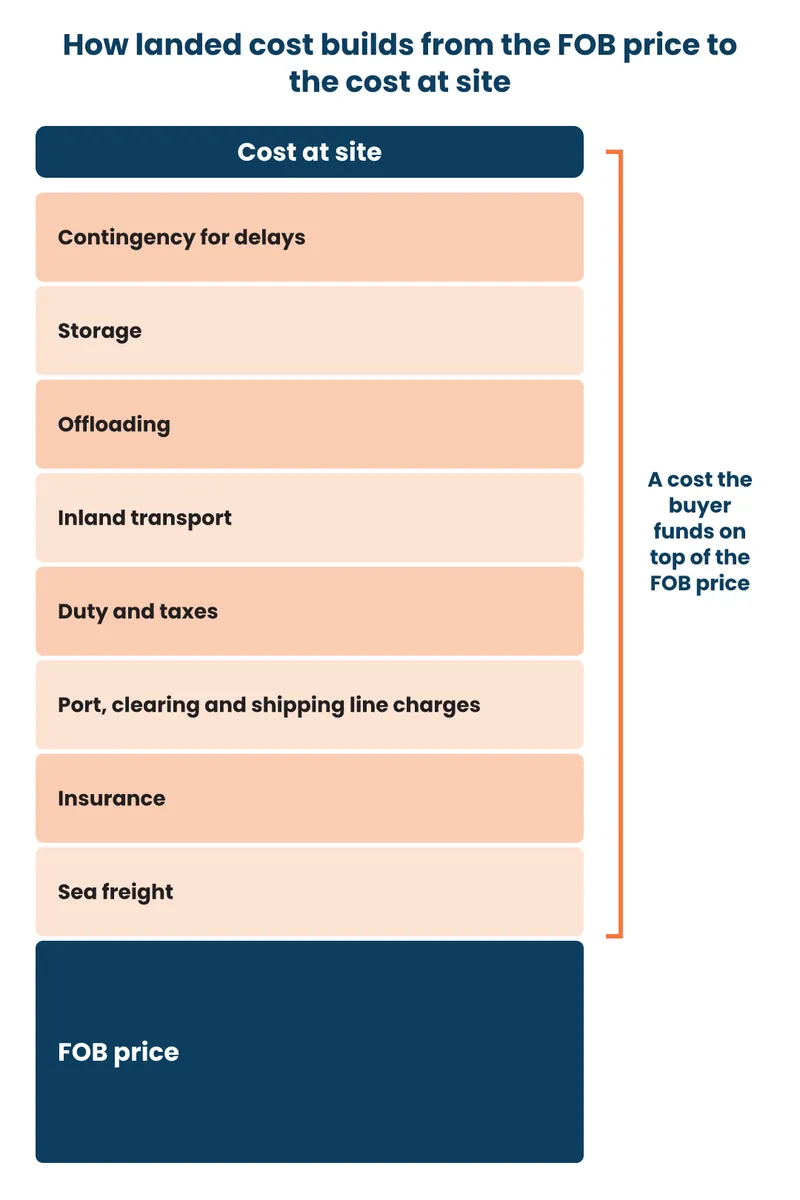
Caption: Each segment is a cost the buyer funds on top of the FOB price. Source: Incoterms 2020 [5]; tax base from the Rwanda Revenue Authority [17], in the Rwanda note below.
How do I compare two quotes on different terms?
Bring both quotes to the same point first, ideally your site, by adding the lines above to each. An FOB quote needs freight and insurance added before it is compared. A CIF quote needs its insurance level and named port checked. Then check scope, such as start-up spares or erection: mark each line included, excluded or unclear, and get the unclear lines answered in writing.
What this means in Ghana, Cote d’Ivoire, Uganda and Rwanda
Budget full duty and tax in every market until relief is confirmed in writing.
Ghana
Machinery for Ghana usually lands at Tema. The Ghana Ports and Harbours Authority places release after valuation and duty payment [6], so duty money must be ready first. Under section 6 of the Exemptions Act, 2022 (Act 1083), an exemption agreement is void without the Finance Minister’s prior written approval [14], so a promised exemption stays out of the budget until that approval exists.
Cote d’Ivoire
Machinery usually lands at Abidjan. The economy ministry’s Investment Code grants customs duty and VAT advantages in the investment phase, depending on the scheme [12], so budget full duty and VAT until your scheme is approved. The economy ministry also lists a conformity verification of goods before shipment, approved by decree 2017-567 [9], so build that verification into the dispatch date.
Uganda
Machinery usually lands at Mombasa or Dar-es-Salaam, so price the road leg from the coast as its own line. The East African Community places capital goods in the EAC 0% band [15]. The Uganda Revenue Authority discharges VAT deferred at import only after inspecting the installed machinery [13], so keep installation records.
Rwanda
Under the Single Customs Territory, the Rwanda Revenue Authority explains, goods need only one customs declaration, made in the country to which they are consigned [16]. Capital goods fall in the same EAC 0% band [15].
Under the Rwanda Revenue Authority’s VAT guide, VAT of 18% on imports is payable on entry, on a base that adds insurance, freight, customs duty and port charges to the customs value [17]. The Ministry of Trade and Industry processes VAT exemption applications for industrial machinery online, under Law No. 049/2023 [18], so apply before shipment.
What should I ask before importing machinery from India?
Ask these of every supplier quoting you. Each answer becomes a line in the landed cost.
| Question | Why it matters |
|---|---|
| Which Incoterm and named port? | That port is where the supplier’s costs stop |
| What insurance level does a CIF price include? | The default is Clauses (C) under Incoterms 2020 [5] |
| When will document copies reach my agent? | A mismatch costs storage days |
| What do the largest pieces weigh and measure? | They decide trailers, permits and lifting |
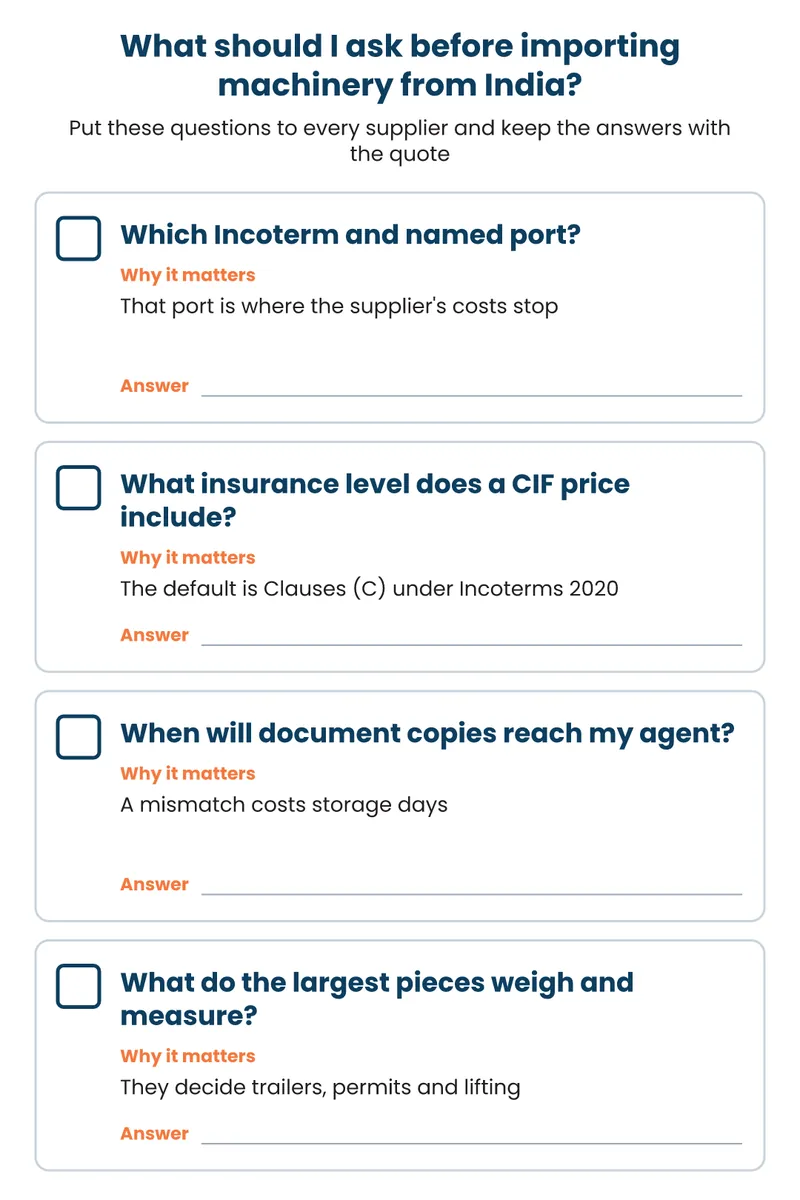
Caption: Put these questions to every supplier and keep the answers with the quote. Source: Incoterms 2020 [5].
Three mistakes are worth naming: budgeting on the quote total, counting an exemption before it is granted, and an unready site that keeps crates waiting.
How Sonika Impex LLP can help
Sonika Impex LLP provides:
- A needs assessment and a customer-specific proposal
- Turnkey plants, standalone machinery and working capital materials from a single point of service
- Pre-shipment inspection and packing, with third-party inspection by SGS or Bureau Veritas as required
- Export on FOB terms by preference, or CIF, to your port: typically Tema, Abidjan, Mombasa or Dar-es-Salaam
- Erection and commissioning, training for project and maintenance staff at your site, and after-sales support
- Payment by TT or Letter of Credit, open to negotiation
- Introductions to banks and other institutions that can help. Sonika does not lend, arrange or guarantee finance.
Send us:
- What you want to make, and how much
- Your raw material supply across the year
- Site location, nearest port and truck access
- Power and water at site
- Anything already installed, and any quote you hold
+91 99027 67900 · sonikaimpex.com
Frequently asked questions
Can a plant be shipped in more than one consignment?
Yes, where the plant allows it. Each consignment clears on its own declaration and pays its own port and agent charges, so splitting adds cost. It can still make sense when the site is built in stages, because the first machines then arrive when their foundations are ready.
What if a machine is too large for a standard container?
It ships on an open-top or flat-rack container, or as break-bulk cargo. Each of these costs more and needs more handling at both ports. Ask the supplier early which pieces fall in this group, so freight and lifting can be priced correctly.
Is it worth shipping start-up spares with the machinery?
Usually, yes. They travel in the same containers and clear in the same declaration. A part flown in after a stoppage pays air freight and its own clearance while the plant waits. Agree in the needs assessment which spares are needed at start-up and which can wait.
What is a pro forma invoice used for?
It is the supplier’s priced offer in invoice form, issued before shipment. A bank can use it to open a Letter of Credit or assess a loan, and some import formalities ask for it. Make sure its scope and term match the final contract.
How does a Letter of Credit link to the shipping documents?
The bank pays against documents that match the terms of the credit. If the invoice, packing list or bill of lading differs from those terms, payment and release can both be held up. Agree the document list with the supplier before the credit is opened.
Does an exempt import into Uganda still need approval before clearance?
The [Uganda Revenue Authority](https://ura.go.ug/?p=69350) states that from 1 February 2026, exempt importations no longer need pre-clearance approval from the Commissioner Customs [8]. The importer or licensed agent declares the goods directly, with the documents that justify the exemption. Have those documents with your agent before the ship arrives.
How should the crates be marked?
Each crate should carry a number and marks that match the packing list, with its gross weight and lifting points shown. That lets your agent and the customs examiner find any item quickly, and tells the crane driver where to lift. Ask for the packing list to give the size and weight of every crate.
Who pays if crates arrive damaged?
That depends on where the damage happened and which policy covered that leg. Note the damage on the delivery documents, photograph it, and inform the insurer at once. Keep the crate and packing until the surveyor has seen them.
Can I attend the pre-shipment inspection myself?
Ask the supplier before you order whether you, or someone acting for you, can attend, and put the answer in the contract. Third-party inspection by SGS or Bureau Veritas is also available as required. Ask for the inspection to check the machines against the packing list as well as the specification, because a mismatch found in India is easier to fix than one found at the port.
Final thoughts
Back to the containers held at Tema, charged to importers who had often done everything asked, as the Ghana Shippers’ Authority reported [1]. An FOB price stops at a port in India. What the stretch after that port costs, who arranges each step, and which reliefs count are yours to settle. Settle them before you sign, and the weeks at the port become known lines in a budget your bank can read.
For the full picture, read our guide: [What an industrial machinery quote leaves out: the costs between the price and a running plant](/what-an-industrial-machinery-quote-leaves-out).
Sources
- Ghana Shippers’ Authority | Shippers decry container evacuation delays at Tema Port | published 2026-06-30 | https://shippers.org.gh/?p=42424 (accessed 2026-10-19)
- Northern Corridor Transit and Transport Coordination Authority | Northern Corridor Transport Observatory Report 2025, 21st Edition | published 2026-08 | https://www.ttcanc.org/wp-content/uploads/2026/08/EN-21-TOP-Report.pdf (accessed 2026-10-19)
- International Chamber of Commerce | FOB and FAS Incoterms 2020 explained: Key differences | published 2025-05-13 | https://academy.iccwbo.org/incoterms-2020-fas-or-fob/ (accessed 2026-10-19)
- International Chamber of Commerce | CFR and CIF Incoterms 2020 explained: Key differences | published 2024-08-21 | https://academy.iccwbo.org/incoterms-2020-cfr-or-cif (accessed 2026-10-19)
- International Chamber of Commerce | Incoterms 2020 | published 2026-07-03 | https://iccwbo.org/business-solutions/incoterms-rules/incoterms-2020/ (accessed 2026-10-19)
- Ghana Ports and Harbours Authority | Port Process: import clearance | undated | https://ghanaports.gov.gh/page/index/18/3LNYK28F/Port-Process (accessed 2026-10-19)
- Rwanda Revenue Authority | Importation 2025 | published 2025 | https://www.rra.gov.rw/fileadmin/user_upload/IMPORTATION_2025.pdf (accessed 2026-10-19)
- Uganda Revenue Authority | Exempt importations that will not require pre-clearance approval from the Office of the Commissioner Customs | published 2026-03-03 | https://ura.go.ug/?p=69350 (accessed 2026-10-19)
- Ministere de l’Economie, Cote d’Ivoire | Commerce exterieur | published 2025-11-26 | https://economie-ivoirienne.ci/activites-sectorielles/commerce-exterieur.html (accessed 2026-10-19)
- ECOWAS Commission | ECOWAS Common External Tariff | undated | https://ecotis.ecowas.int/?p=24111 (accessed 2026-10-19)
- Ghana Revenue Authority | Customs Tariffs and Levies | undated | https://gra.gov.gh/?p=7900 (accessed 2026-10-19)
- Ministere de l’Economie, Cote d’Ivoire | Code des investissements | undated | https://economie-ivoirienne.ci/investissements/codes-des-investissements.html (accessed 2026-10-19)
- Uganda Revenue Authority | Online application for discharge of VAT deferred at importation | published 2026-03-31 | https://ura.go.ug/en/online-application-for-discharge-of-vat-deferred-at-importation/ (accessed 2026-10-19)
- Ministry of Finance, Ghana | Exemptions Act, 2022 (Act 1083) | published 2022-09 | https://www.mofep.gov.gh/sites/default/files/acts/EXEMPTIONS-ACT-2022-ACT-1083.pdf (accessed 2026-10-19)
- East African Community | Trade Regime: EAC Common External Tariff | undated | https://www.eac.int/regional-framework/trade-regime (accessed 2026-10-19)
- Rwanda Revenue Authority | Single Customs Territory along the Central Corridor | undated | https://www.rra.gov.rw/fileadmin/img/single-customs-territory-along.html (accessed 2026-10-19)
- Rwanda Revenue Authority | Value Added Tax 2025 | published 2025 | https://www.rra.gov.rw/fileadmin/user_upload/VAT__EN_2025.pdf (accessed 2026-10-19)
- Ministry of Trade and Industry, Rwanda | VAT exemption application process for industrial machinery | undated | https://www.minicom.gov.rw/news-detail/minicom-introduces-vat-exemption-application-process-via-irembo-platform (accessed 2026-10-19)