Most first mineral water plants are chosen from a quote for the bottling line. The decisions that set the cost and the quality sit upstream of it: the source water, the treatment route it calls for, the bottle and cap supply, and the standard the product is tested against in its market.
November 15, 2026
Automatic Bottle Filling and Capping Machine: Building Pouch, Bottle and Jar Lines for Custom-Label Orders
November 17, 2026
Buying From a Packaged Drinking Water Plant Exporter in India: Check the Treatment Plant Against Your Water Analysis
On 22 July 2026, Citi Newsroom reported that Ghana’s Food and Drugs Authority had closed 44 food manufacturing facilities, sachet water producers among them, for operating without licences or in unhygienic conditions [1]. A licence and a clean floor are only part of what an inspector checks. In a packaged drinking water plant, the water must also meet the standard, and that depends on a treatment route chosen long before the inspection.
The treatment frame is the part to check hardest, and the question is how to tell, before you pay, whether it will treat the water in your own source. This article checks it line by line against your laboratory analysis. It is written for the owner or engineer planning a first plant or adding a line, and for the consultant or bank reviewing the project.
In short:
- The route follows the product you will sell and the water you have, so start from your analysis.
- Every result above its limit needs a step, a vessel and an instrument on the frame.
- Size treatment to every line at full speed, plus rinse water, cleaning and reject.
- Everything the water touches should be food-grade, stated part by part.
- Prove the plant with drawings, inspection and commissioning on your own water.
Contents
- Why the treatment route starts with your product and your water
- Matching every line of your water analysis to a treatment step
- Sizing the treatment plant to the filler’s full speed
- Food-grade materials wherever water touches the plant
- Cleaning-in-place for membranes and lines
- Proving the plant before you pay: drawings, inspection and commissioning tests
- What this means in Ghana, Cote d’Ivoire, Uganda and Rwanda
- Questions to settle before you order a packaged drinking water plant
- How Sonika Impex LLP can help
- Frequently asked questions
- Final thoughts
Why the treatment route starts with your product and your water
The route starts with what you will sell. The Codex Alimentarius Standard for Natural Mineral Waters allows natural mineral water only limited treatment, such as filtering out iron, manganese, sulphur or arsenic compounds, where the essential mineral content stays unchanged [2]. The Codex General Standard for Bottled/Packaged Drinking Waters lets prepared water come from any supply and receive any microbial treatment, if the finished water meets the standard, including the latest WHO Guidelines for Drinking-water Quality [3]. The current WHO Guidelines were published on 17 June 2026, and they are the basis for national drinking-water standards [4].
So the same borehole can lead to two different plants. Natural mineral water allows only limited treatment, so the source itself must be sound. Prepared drinking water can take a full route, such as reverse osmosis.
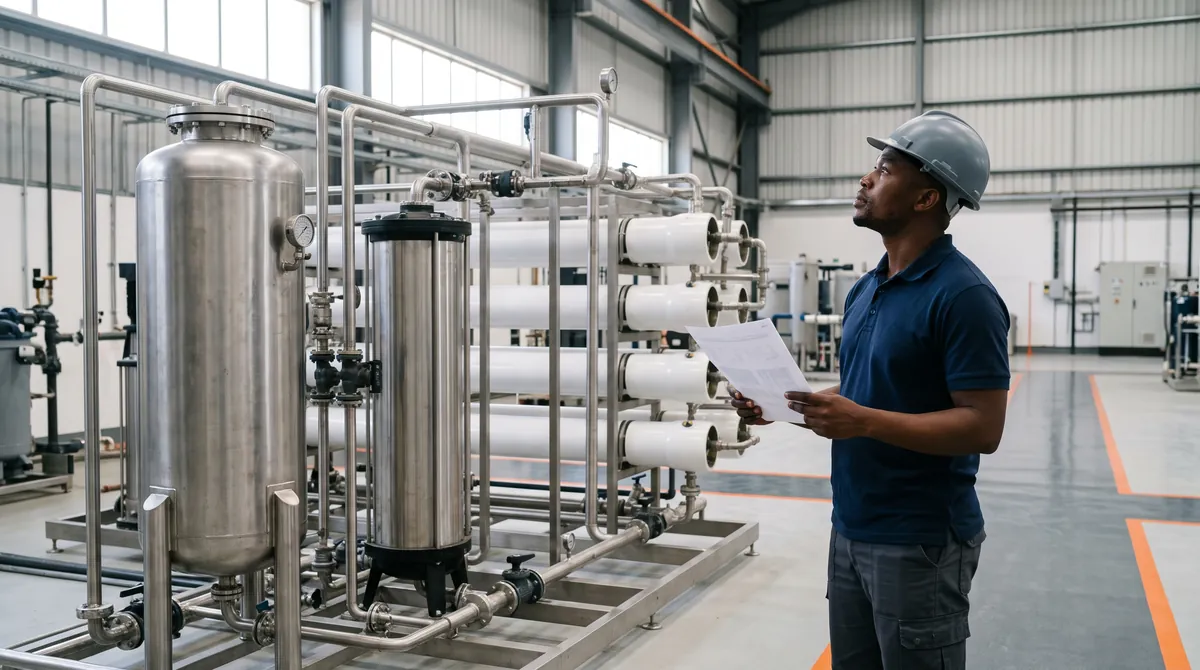
The second decision is what sits on the frame. A named stage tells you little until you see its vessel size, membrane count and instruments. A frame can only be judged against a fixed reference, and your water analysis is that reference.
Matching every line of your water analysis to a treatment step
Start with the laboratory report, tested against the parameter list in your market’s standard. Each result above its limit needs a step, and each step needs something physical on the frame. The WHO Guidelines set out treatment methods and their performance in a dedicated annex [4].
| What the analysis shows | The step that deals with it | What to look for on the frame |
|---|---|---|
| Turbidity | Sand filtration | Vessel, backwash valve, pressure gauges |
| Chlorine, odour or organics | Activated carbon | Separate carbon vessel |
| Iron or manganese | Oxidation, then filtration | Dosing pump or aerator, contact tank |
| Hardness | Softening | Resin vessel, brine tank |
| Dissolved solids, nitrate, fluoride or arsenic | Reverse osmosis | Membrane model and count, conductivity and flow meters |
| Minerals stripped by reverse osmosis | Mineral dosing | Dosing pump and tank |
| Microbial counts | Ultraviolet | UV chamber rated for full flow |
| Bromide, where ozone is used | Controlled ozonation | Ozone generator with dose control |
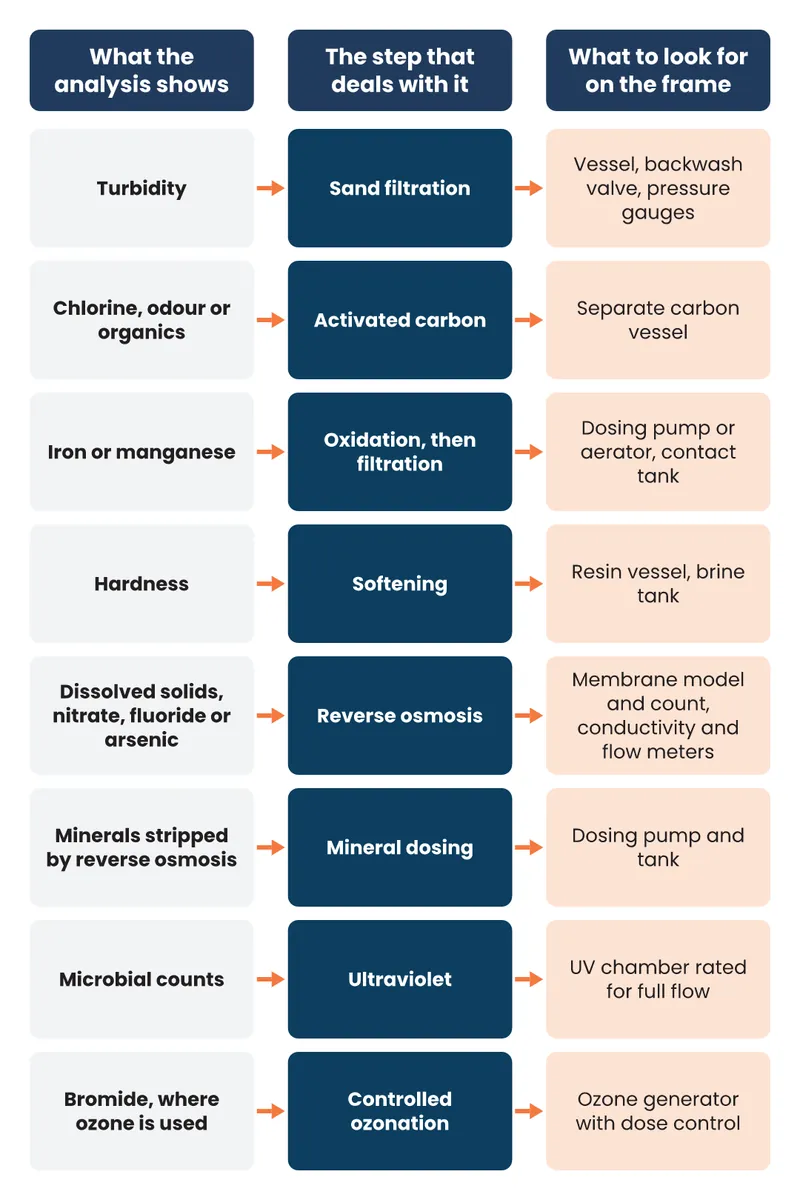
Caption: Each analysis result points to a treatment step, and each step to equipment on the frame. Source: WHO Guidelines for drinking-water quality, treatment methods annex [4].
Two rows need care. Without conductivity meters on the reverse osmosis stage, you cannot see the membranes losing their hold on salts until a laboratory result fails. And where the source carries bromide, the WHO Guidelines explain that ozone can convert it into bromate, so ask for bromate to be tested in the finished water at commissioning [4].
A step listed with no vessel on the drawing is missing.
Sizing the treatment plant to the filler’s full speed
The filler sets the pace, and treatment must keep up with it all shift. Work the figure out in this order:
- Filler demand. Rated bottles per minute, times your largest bottle’s volume, times the minutes in an hour.
- Other lines. Add the pouch and jar lines, if they run alongside.
- Rinse water. Add the treated water used to rinse bottles and wash jars.
- Cleaning time. The plant makes no water during backwash or membrane cleaning, so cover it with capacity or storage.
- Reverse osmosis reject. Ask for the recovery figure on your water, and size the borehole and pre-treatment to the feed flow.
Written as a flow: filler demand plus other lines, rinse water and cleaning cover gives the permeate; permeate plus reject gives the borehole feed.
The figure is sensitive, because a change in filler speed, bottle size or recovery moves all of it. Ask for the permeate output in litres per hour, the feed flow and the filler speed the plant was sized against.
Size the treatment side for the next line you plan.
Size the packing side for today.
Food-grade materials wherever water touches the plant
In a water plant the water is the food, so every surface it meets after the raw water tank is a food contact surface. The Codex General Principles of Food Hygiene ask that such surfaces be non-toxic, durable, smooth, non-absorbent and inert to food, detergents and disinfectants, in a layout that permits cleaning [5]. That covers every tank, pipe, pump, hose and gasket the treated water passes through.
Stainless steel is the usual material. A 2024 study of stainless steel in the food industry explains that its chromium oxide layer resists corrosion and imparts no taste or colour [6]. The same study found some grades more vulnerable to localised corrosion than others, and set a chloride ceiling of 150 mg/L for solutions touching the most vulnerable grade it studied [6].
Your analysis gives your raw water’s chloride level, and the reject stream carries more salt than the feed. Choose the grade for the water each part carries.
Ask for the stainless grade of each tank, vessel, pipe run and wetted pump part. Ask for food-contact declarations on the plastics, hoses and gaskets, because filter housings and hoses carry their own declarations, separate from the steel.
Cleaning-in-place for membranes and lines
Every reverse osmosis membrane fouls in time. A 2024 study of a seawater reverse osmosis plant in the Maldives names precipitates, colloids, bacteria, biofilm and dissolved organic matter as the foulants, and the energy needed to hold pressure rises as they build up [7]. Cleaning-in-place restores performance, if the plant was built for it.
The chemistry follows the fouling. At the study’s plant, which treats seawater drawn from boreholes, operators use citric acid against scale and high-pH cleaners against organic fouling and biofouling [7]. The authors warn that strong acids risk damaging the membrane [7].
A membrane cleaning cycle usually runs in this order:
- Isolate. Valves connect the membranes to the cleaning tank.
- Flush. Clean water pushes out the feed water.
- Recirculate. A pump circulates the cleaning solution.
- Soak. The solution stands for the set time.
- Rinse. Clean water flushes until pH and conductivity are normal.
- Check. Pressure, flow and conductivity are compared with readings before cleaning.
Written as a flow: isolate, flush, recirculate, soak, rinse and check, then return the train to service.
On the frame, that means a cleaning tank, a cleaning pump, switch-over valves and instruments to read the result. Without them, each cleaning means disconnecting hoses by hand, so it gets put off. The same study replaces membranes when permeate conductivity rises or flow falls beyond what cleaning recovers [7], a trend you see only if the meters are read every shift. Ask for the cleaning procedure in writing, each chemical named.
Proving the plant before you pay: drawings, inspection and commissioning tests
All of this can be checked before you pay, in this order:
- Drawings. A process and instrumentation drawing labelling every vessel and instrument, and a bill of materials with makes, models and grades.
- Works inspection. The assembled frame checked against the drawing.
- Pre-shipment inspection and packing, with third-party inspection by SGS or Bureau Veritas where required.
- Erection and commissioning. The plant runs on your own source water, at the flow your lines will draw.
- Commissioning tests. Pressures, flows and conductivity are recorded, and finished water samples go to an accredited laboratory.
- Handover. Drawings, manuals, cleaning procedure and spares list come with the laboratory report.
Written as a flow: drawings, works inspection, pre-shipment inspection, erection, commissioning on your water, laboratory test, then handover.
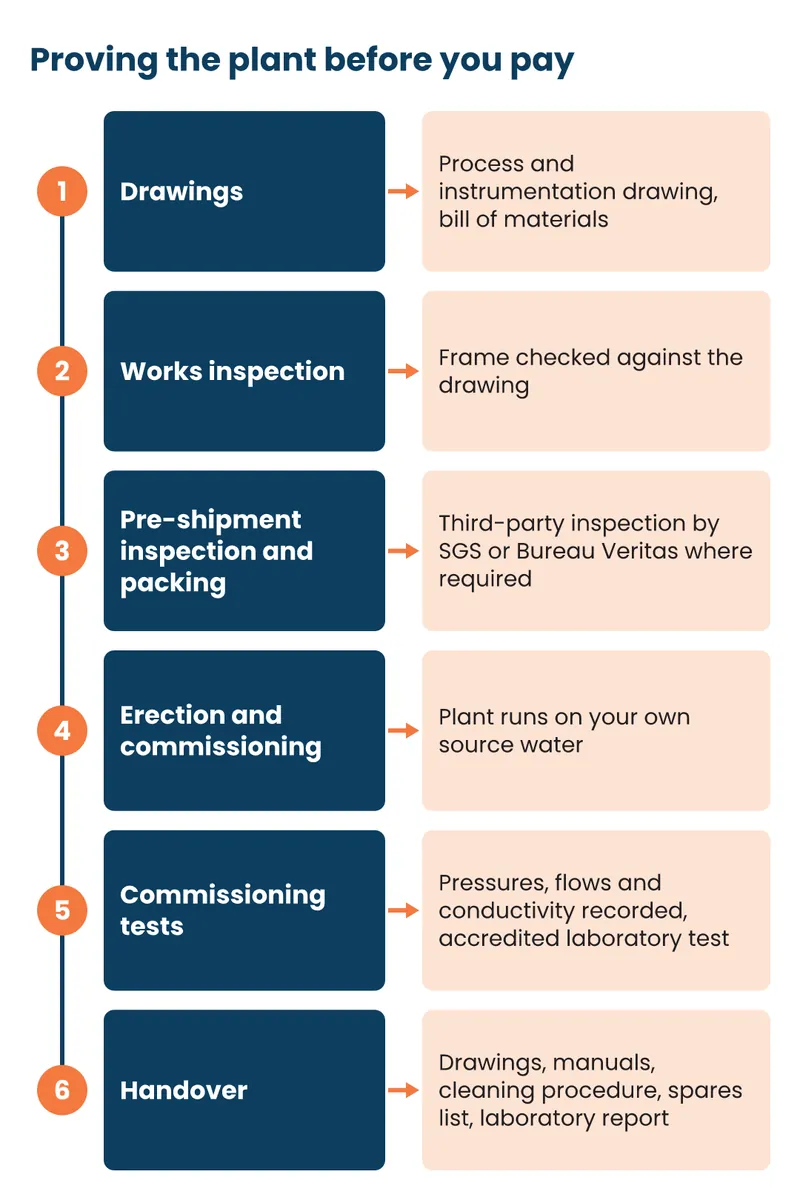
Works inspection proves the frame was built as drawn. Commissioning on your own source proves the route was right. Agree in the contract which results the plant must reach and what happens if one fails.
What this means in Ghana, Cote d’Ivoire, Uganda and Rwanda
Ghana
The Food and Drugs Authority licenses packaged water plants, and the product must meet GS 175-1 for drinking water or GS 220 for mineral water, the Ghana News Agency reported from the Trade Minister’s statement to Parliament [8]. On 15 November 2024 the same agency reported an Authority officer in the Western Region saying that producers without reverse osmosis equipment would not be allowed to operate from January 2025 [9]. For a Ghana plant, that puts reverse osmosis on the frame. Confirm with the Authority how it applies in your region.
Cote d’Ivoire
Côte d’Ivoire’s Water Code of 23 November 2023 defines natural mineral water as underground water packaged without any treatment, and table water as water of various origins made potable before sale [10]. Both need prior authorisation, and under the Water Code the WHO standards apply until national standards are set [10]. A reverse osmosis route therefore points to table water. Confirm this with the ministry in charge of water resources.
Uganda
The October 2024 catalogue of East African Standards lists EAS 153:2018 for packaged drinking water [11]. Ask the Uganda National Bureau of Standards which edition it enforces, and test your finished water against that edition at commissioning.
Rwanda
The Rwanda Standards Board describes the revised East African standards as aligned with WHO and Codex guidance and used to assess the efficiency of treatment systems [12]. The October 2024 catalogue lists EAS 13:2023 for packaged mineral water, replacing EAS 13:2018 [11]. Confirm the edition and the registration route with the Board.
Questions to settle before you order a packaged drinking water plant
Ask for written answers.
- Which line of my analysis does each treatment step answer?
- What permeate output is the plant rated for, at which filler speed, and from what feed flow?
- What recovery do you expect on my water, and where does the reject go?
- Is cleaning-in-place built in and shown on the drawing?
- Which tests will be run at commissioning, and against which standard?
In the team’s experience, the same mistakes recur: buying before the analysis is done, sizing treatment to today’s filler alone, and signing before the drawing shows the membrane count and the meters.
How Sonika Impex LLP can help
For a packaged drinking water plant, Sonika Impex LLP supplies:
- A needs assessment of now and later, saying plainly when a step is not needed yet
- A customer-specific proposal setting the treatment route against your analysis
- Water plants from 1,000 to 10,000 litres/hour, turnkey or standalone: water treatment, pouch, bottle, 5L and 20L jar lines, labelling and blow moulding
- Rinse-fill-cap bottling at 15, 25, 40, 60 and 120 bottles/minute at 1 litre, and working capital materials such as preforms
- Pre-shipment inspection and packing, with third-party inspection by SGS or Bureau Veritas as required
- Export FOB by preference, or CIF to Tema, Abidjan, Mombasa, Dar-es-Salaam or the port you name
- Erection, commissioning, training for project and maintenance staff at your site, and after-sales support after the warranty period ends
Send us:
- What you plan to make, mineral water or drinking water, and the pack formats
- How much, now and at the next stage
- Your source: the analysis and its sampling date, the source type, and its yield in dry and wet seasons
- Site, nearest port and power supply
- Anything already installed
+91 99027 67900 · sonikaimpex.com
Frequently asked questions
How should the source water sample be taken?
Ask the laboratory for its own sterile bottles and sampling instructions. Run the borehole long enough to draw fresh water from the aquifer before filling, and record the date, time and sampling point. A sample left warm before testing can give a misleading microbial count, so get it to the laboratory as quickly as its instructions require.
Can a treatment plant be upgraded if my source water changes?
Often, if space and pipework were left for it. A softener, an extra filter or more membrane elements can be added to a well-planned skid. Ask at the design stage where an added step would go, so the floor space and connections stay free.
Do I still need a softener if the plant has reverse osmosis?
It depends on your hardness and the membrane design, because hardness can scale membranes. Some routes soften the water ahead of the membranes. Others dose a scale inhibitor. Ask which approach suits your analysis, and why.
Should the treatment plant and the bottling line come from the same supplier?
The two meet at the treated water tank, the flow and the controls. With one counterparty, one name answers for that interface. With two, write the flow, tank size and control signals into both contracts, so the interface has an owner.
What should the daily operating log record?
Feed and permeate conductivity, pressures before and after each stage, flows, UV lamp hours and each cleaning with its chemicals. Kept every shift, it shows a slow decline before it becomes a failed sample. It is also the record a regulator or your bank may ask to see.
What consumables should I keep on the shelf?
Micron cartridges, UV lamps and sleeves, cleaning chemicals, and gaskets and seals for pumps and housings. Membranes are a larger purchase, usually planned on a longer cycle. Because a shipment takes time to arrive, set a reorder point for each item.
Can the reject water be reused?
Reject can go to floor, crate or jar washing where the local authority allows it. It carries the salts the membranes removed, so it must be kept away from the product. The discharge route needs the authority’s acceptance before the plant runs.
Who should be present at commissioning?
Your own operators, the engineer who will run the plant, and the supplier’s commissioning engineer. Have your operators take readings themselves during the tests. If your licence process includes a premises inspection, ask the regulator when it should take place.
What raw water is a standard treatment route drawn for?
As a design basis, a standard route is drawn for raw water at pH 6.5 to 7.5, TDS below 750 ppm and hardness below 300 ppm. A source outside those limits needs added steps or larger vessels. Your analysis tells you which side of each limit you sit on.
How fine is the filtration before and after reverse osmosis?
Sand filtration takes the water to about 20 micron, a bag filter to 10 micron, and a cartridge to 5 micron before the membranes. A 0.2 micron filter after the storage tank catches anything picked up there. Ask where each housing sits on the drawing, and how often each cartridge is changed.
Final thoughts
The question at the start was how to tell, before you pay, whether a treatment frame will treat your own water. Set against your analysis, it narrows: does each line of the report have a step, a vessel and an instrument, sized, cleanable and proven on your source? A frame that answers yes on every line is a plant for your water. Any line left open is a question to settle before you sign.
For the full picture, read our guide: [Mineral water plant cost starts at the source](/mineral-water-plant-cost-starts-at-the-source)
Sources
- Citi Newsroom | FDA shuts down 44 food manufacturing facilities over safety breaches | 2026-07-22 | https://www.citinewsroom.com/2026/07/fda-shuts-down-44-food-manufacturing-facilities-over-safety-breaches/ (accessed 2026-10-19)
- FAO/WHO Codex Alimentarius Commission | Codex Standard for Natural Mineral Waters, CXS 108-1981, revised 2008, amended 2011 | 2011 | https://www.fao.org/input/download/standards/223/CXS_108e.pdf (accessed 2026-10-19)
- FAO/WHO Codex Alimentarius Commission | General Standard for Bottled/Packaged Drinking Waters (Other than Natural Mineral Waters), CXS 227-2001 | 2001 | https://www.fao.org/input/download/standards/369/CXS_227e.pdf (accessed 2026-10-19)
- World Health Organization | Guidelines for drinking-water quality: fourth edition incorporating the first, second and third addenda | 2026-06-17 | https://www.who.int/publications/i/item/9789240121225 (accessed 2026-10-19)
- FAO/WHO Codex Alimentarius Commission (parallel text of the FAO 2022 edition) | General Principles of Food Hygiene, CXC 1-1969, revised 2020 and 2022 | 2022 | https://n-shokuei.jp/eisei/pdf/ippangensoku_2022.pdf (accessed 2026-10-19)
- Materials (MDPI), Rossi, Leso and Calovi | Study of the Corrosion Behavior of Stainless Steel in Food Industry, vol. 17, article 1617 | 2024-04-01 | https://www.mdpi.com/1996-1944/17/7/1617 (accessed 2026-10-19)
- The Maldives National Journal of Research, Vol. 12, Special Issue | Evaluation of Effectiveness of Cleaning-in-Place of Membranes and Optimum Period of Membrane Replacement on a Seawater Reverse Osmosis Plant | 2024 | https://mnjr.mnu.edu.mv/journal/article/download/180/111/740 (accessed 2026-10-19)
- Ghana News Agency | Ghana to end water importation after passage of Ghana Accreditation Service Bill | 2023-06-13 | https://gna.org.gh/2023/06/ghana-to-end-water-importation-after-passage-of-ghana-accreditation-service-bill-trade-minister/ (accessed 2026-10-19)
- Ghana News Agency | Packaged water manufacturers urged to observe safety standards in food production | 2024-11-15 | https://gna.org.gh/2024/11/packaged-water-manufacturers-urged-to-observe-safety-standards-in-food-production/ (accessed 2026-10-19)
- Republic of Côte d’Ivoire, Journal Officiel (via FAOLEX) | Loi n° 2023-902 du 23 novembre 2023 portant Code de l’Eau | 2024-01-15 | https://faolex.fao.org/docs/pdf/IVC228174.pdf (accessed 2026-10-19)
- East African Community Secretariat (hosted by Tanzania Bureau of Standards) | Catalogue of East African Standards 2024 | 2024-10 | https://www.tbs.go.tz/uploads/text-editor/files/EAS%20CATALOGUE%20OCTOBER%20-%202024%20%281%29_1786633482.pdf (accessed 2026-10-19)
- Rwanda Standards Board | Safe drinking water | undated | https://www.rsb.gov.rw/updates/news-detail/safe-drinking-water (accessed 2026-10-19)