Buying From a Packaged Drinking Water Plant Exporter in India: Check the Treatment Plant Against Your Water Analysis
November 16, 2026
Water Bottling Plant: Making Your Own Bottles or Buying Them, and Securing the Preform Supply
November 18, 2026
Automatic Bottle Filling and Capping Machine: Building Pouch, Bottle and Jar Lines for Custom-Label Orders
Your pouch line is busy, and buyers have started asking for bottles with their own name on the label, so an automatic bottle filling and capping machine looks like the next step. On 25 June 2026 the Ghana News Agency reported a study of low-income households in four peri-urban communities in Accra: about 77 per cent relied on sachet water alone for drinking [1]. In February 2026 Graphic Online reported that Ghana’s Food and Drugs Authority had added heavy metal tests for all registered sachet and bottled water producers [8]. Demand for each format is real, and so is the scrutiny of every pack.
This article sets out how pouch, bottle and jar lines work and how to add one in stages, for processors adding a format and owners planning a first plant.
In short:
- Add formats in the order your buyers take them, because each has its own machine, materials and delivery.
- A pouch line is a form-fill-seal machine and a steady supply of printed film.
- A bottle monoblock rinses, fills and caps in one enclosure, and its change parts decide which bottles it runs.
- Custom-label orders reward fast changeovers, and every label must still meet your regulator’s rules.
- Before adding a line, check that treatment, floor, stores and registrations can carry it.
Contents
- Matching your lines to what your buyers take
- The pouch line: form-fill-seal machines and film supply
- How an automatic bottle filling and capping machine works
- Custom labels: label types, labellers and changeover time
- 5L and 20L jar lines: washing, filling and returns
- Adding a new format to a running plant
- What this means in Ghana, Cote d’Ivoire, Uganda and Rwanda
- What to ask before you add a format
- How Sonika Impex LLP can help
- Frequently asked questions
- Final thoughts
- Sources
Matching your lines to what your buyers take
You already know which format moves in your area, so the planning question is which buyers will keep a new line running every week. On 15 November 2024 the Ghana News Agency reported Ghana’s regulator telling Western Region producers that its standards cover sachet, bottled and dispenser jar water, and that plants without reverse osmosis could not operate from January 2025 [2]. So in Ghana the water standard stays the same from one format to the next, and what changes is the machine, the materials and the route to the buyer.
Add the format your existing buyers already ask for, and plan the building for the formats after it.
Each format ties up its own working capital before anything is sold:
| Format | Machine | Materials to stock | Route to the buyer |
|---|---|---|---|
| Pouch | Form-fill-seal machine | Printed film on reels | Daily volume through retail |
| Bottle | Rinse, fill and cap monoblock, labeller, coder | Preforms or bottles, caps, labels | Retail, offices, custom labels |
| 5L jar | Jar filler and capper | Jars, caps, labels | Retail, usually one-way |
| 20L jar | Washing, filling and capping line | Returnable jars, caps | Delivery round with collection |
Read the last column first: a 20L jar adds a collection round as well.
The pouch line: form-fill-seal machines and film supply
Sachet water is a daily purchase for many buyers: in the Ghana News Agency’s June 2026 report, about 77 per cent of the peri-urban Accra households studied relied on it alone [1]. If you are planning a first plant, this is how a form-fill-seal machine makes each pouch from printed polyethylene film as it fills it:
- Film unwinding. The reel feeds film over rollers at controlled tension.
- Film disinfection. A UV lamp treats the inner face of the film.
- Forming. A collar folds the film into a tube.
- Vertical sealing. Heated jaws seal the long edge.
- Filling. A metered volume of treated water drops into the tube.
- Cross sealing and cutting. Jaws seal one pouch’s top and the next one’s bottom, and a blade parts them.
Written as a flow: film unwinding, film disinfection, forming, vertical sealing, filling, then cross sealing and cutting.
If you already run one, the film matters as much as the machine. Each artwork change means a new print run with the printer’s minimum, so hold enough clean, dry stock to cover a reprint. A pouch line that runs out of film in the busy months stands idle, however well the machine runs.
How an automatic bottle filling and capping machine works
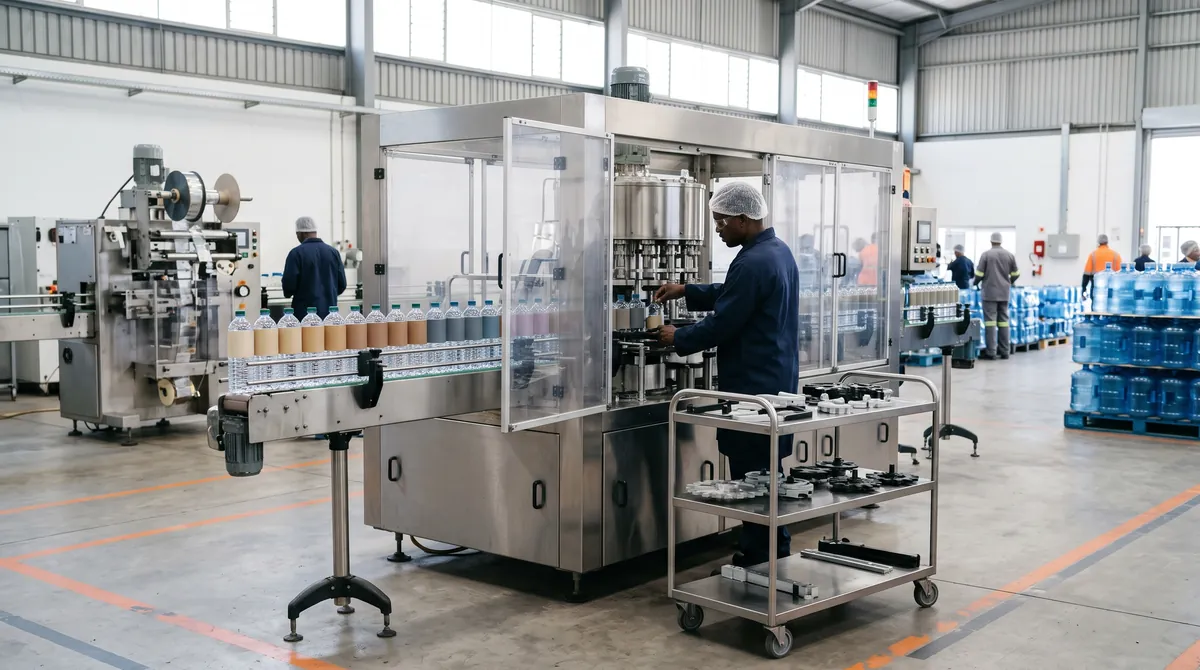
Custom-label orders sit on the bottle line, so flexibility matters as much as speed. The machine is usually a monoblock: rinsing, filling and capping share one guarded enclosure, so each bottle is open only briefly. The Codex hygiene code for packaged drinking waters asks that filling and sealing protect against contamination, and that closures be tamper resistant [3].
- Bottle infeed. Bottles arrive from the blow moulder or from stock.
- Rinsing. Grippers invert each bottle, rinse it with treated water and drain it.
- Filling. Valves fill each bottle to a set level.
- Capping. Caps feed from a hopper and are tightened to a set torque.
- Inspection. Low fills and missing or crooked caps are rejected.
- Labelling. The label for the order is applied.
- Coding. Batch and date are printed on every bottle.
- Packing. Bottles are shrink-wrapped or cartoned.
Written as a flow: bottle infeed, rinsing, filling, capping, inspection, labelling, coding, then packing.
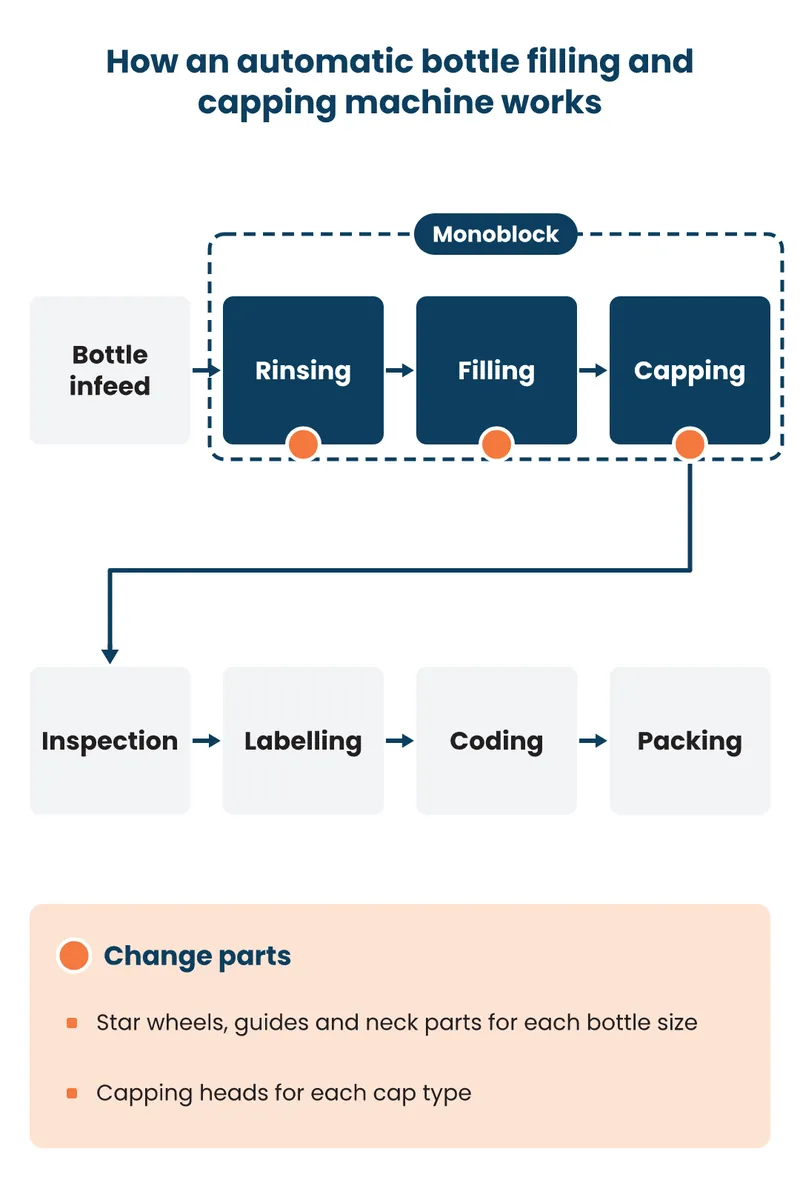
The trick is in the change parts. Each bottle size needs its own star wheels, guides and neck parts, and each cap type needs matching capping heads. A machine bought with parts for one bottle fills only that bottle, so have change parts for every size and cap specified in the proposal.
Size the first bottle line to the orders you hold today, and leave floor space and treatment capacity for a faster one.
Custom labels: label types, labellers and changeover time
Custom-label orders are short runs, and a slow changeover eats the margin on each. Three label types come up, each with its own machine:
| Label type | How it is applied | Machine | Changeover involves |
|---|---|---|---|
| Wrap-around | A cut label glued round the bottle | Wrap-around labeller | Label reel, glue, bottle guides |
| Shrink sleeve | A printed sleeve shrunk on by heat | Sleeve applicator and shrink tunnel | Sleeve size, tunnel settings |
| Self-adhesive | Peeled from a liner and pressed on | Pressure-sensitive labeller | Label roll, position |
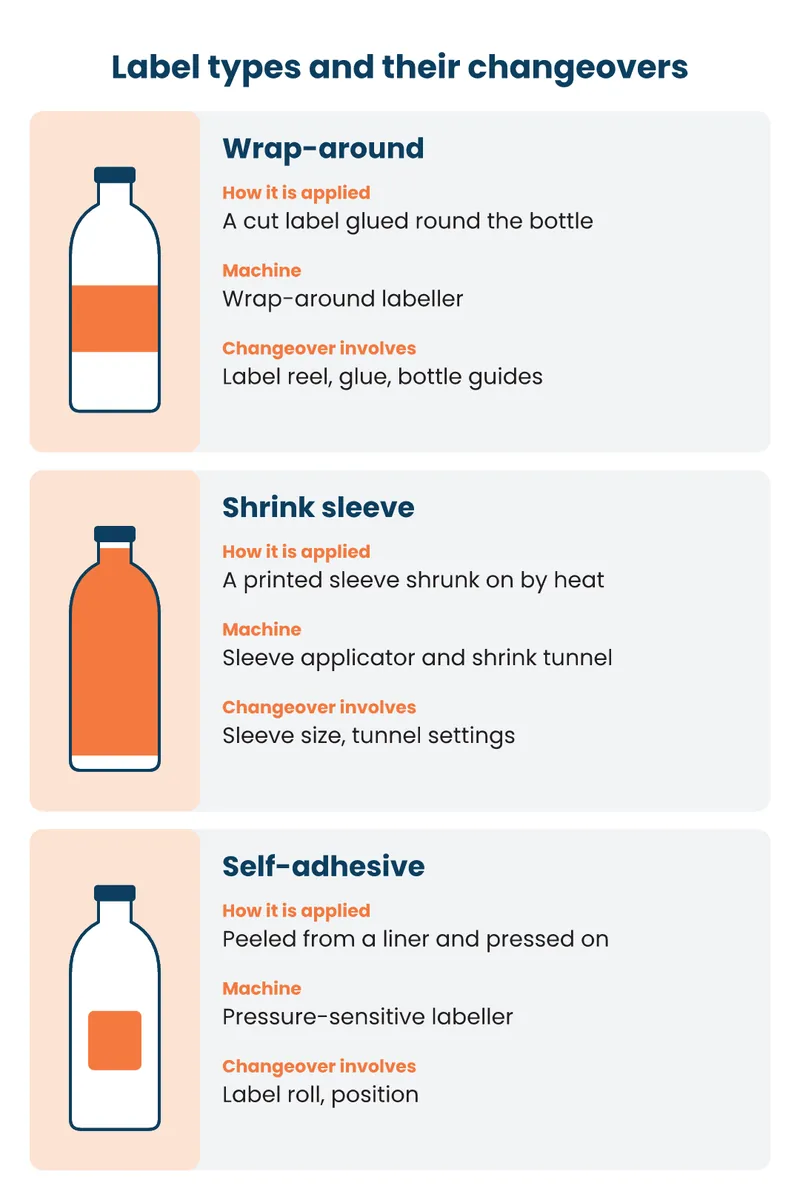
Caption: Label types and their changeovers. Source: the team’s experience; labelling rules, Codex [4].
Self-adhesive labels suit short runs. Shrink sleeves give full-body branding. Ask the supplier to show a full changeover during inspection, and time it.
The coder needs the same attention. The Codex labelling standard requires each container to be permanently marked to identify the producing factory and the lot, with a date mark [4]. The draft East African labelling standard adds the date of manufacture, and requires indelible, legible labels in English or the partner state’s official language [5]. The Codex standard for packaged water bars statements that mislead about origin or composition, and lets national authorities require treatments to be declared [6].
A custom label carries the buyer’s name, and it must still carry everything your regulator requires.
5L and 20L jar lines: washing, filling and returns
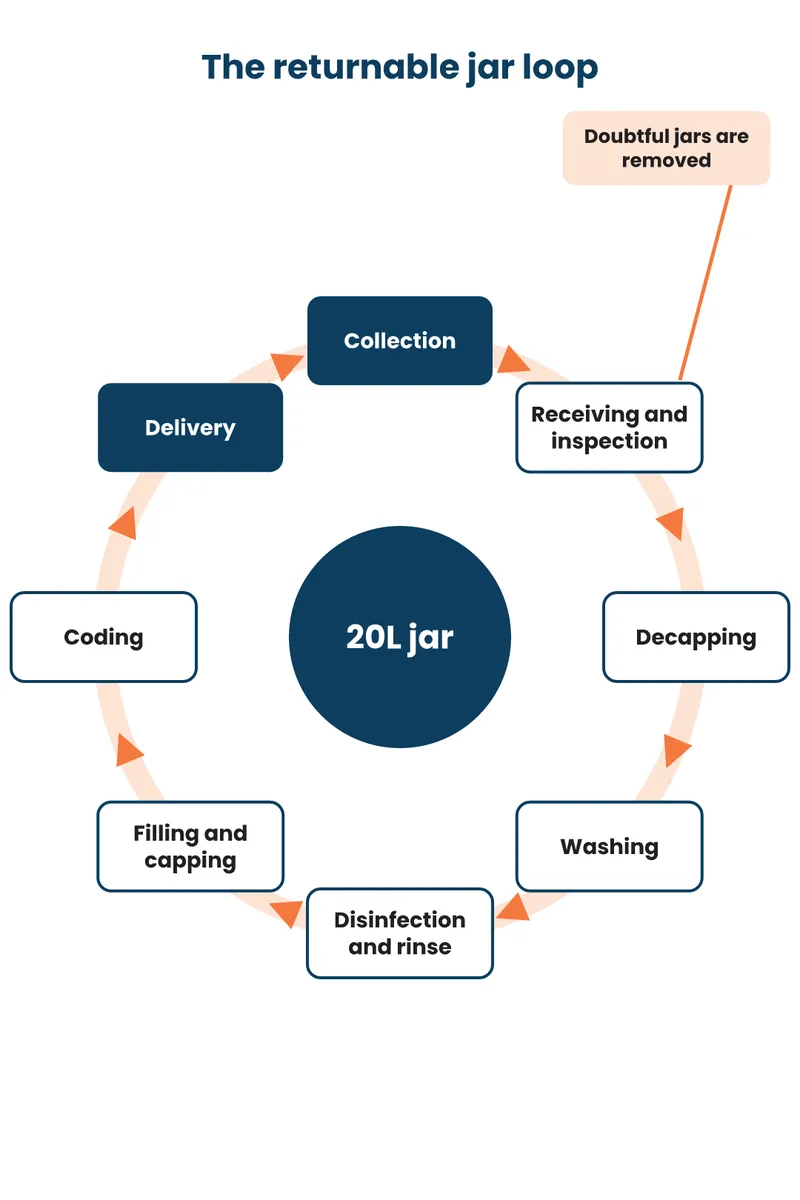
A 5L jar is usually sold once and runs on a simple filler and capper. A 20L jar comes back, so you collect as well as deliver, and returned jars carry the risk. The Codex hygiene code says reused containers should be washed and disinfected, individually inspected, and kept out of service if used for anything that could contaminate the product [3]. The line follows from that:
- Receiving and inspection. Doubtful jars are removed.
- Decapping. Old caps and seals come off.
- Washing. The outside, then the inside, is cleaned with detergent and hot water.
- Disinfection and rinse. The jar is disinfected and rinsed with treated water.
- Filling and capping. The jar is filled and a new cap and seal fitted.
- Coding. Batch and date are applied.
Written as a flow: receiving and inspection, decapping, washing, disinfection and rinse, filling and capping, then coding. Don’t underestimate the space: dirty returns are washed apart from filling, and empties need stacking room.
Adding a new format to a running plant
A new line draws on everything the plant already has. Check three things before ordering:
- Treatment capacity. Compare what all lines draw at full speed together with the treatment plant and treated water tank. A line that outruns treatment slows every line.
- Floor and stores. Each format needs its own area and store, with raw materials kept out of the filling area.
- Utilities and people. Each line adds power and compressed air load, and needs trained operators.
Then the licences. In October 2025 the Ghana News Agency reported Ghana’s regulator stating that manufacturing in an unlicensed facility is illegal, and urging producers to register facilities and products [7]. So ask whether a new format or label needs its own registration.
Stage it. Size the treatment plant and building for the next stage, and buy packing lines for today. A packing line can be added to a prepared floor. An undersized treatment plant has to be rebuilt.
What this means in Ghana, Cote d’Ivoire, Uganda and Rwanda
Ghana
The Ghana News Agency reported in November 2024 that the regulator told Western Region producers that plants without reverse osmosis would not be allowed to operate from January 2025 [2]. A new bottle or jar line there shares the pouch line’s reverse osmosis capacity. The Ghana News Agency also reported nine Western North sachet producers suspended in October 2025 over expired registration licences [7], so keep registrations current.
In February 2026 Graphic Online reported added heavy metal tests for registered sachet and bottled water [8], so each format adds testing cost. In July 2026 Modern Ghana reported 44 facilities closed in Ga East and Ga West, sachet producers among them, largely for operating without licences [9]. License the new line before it runs.
Cote d’Ivoire
The Water Code requires prior authorisation, issued with the ministry in charge of water resources, to import and market natural mineral water and table water, and its oversight extends to packaging [10]. Ask the authority whether your authorisation covers a new pack. Confirm label particulars with it before printing custom labels.
Uganda
According to the COMESA-EAC-SADC non-tariff barriers mechanism, Uganda adopted US EAS 153:2014, Packaged drinking water, issued by the Uganda National Bureau of Standards, with implementation from 21 April 2015 [11]. The Rwanda Standards Board reports that the standard was revised as EAS 153:2018 [12], and the draft East African labelling standard, DEAS 38:2024, is set to replace EAS 38:2014 [5]. Confirm with the Bureau which editions custom-label artwork must follow.
Rwanda
The Rwanda Standards Board holds the secretariat of the East African committee that revised the packaged drinking water standards in 2018 [12]. Rwanda’s Law No. 17/2019 prohibits the manufacture, import, use and sale of plastic carry bags and single-use plastic items, with exceptions only on prior written application [13]. Confirm with the environment authority how the law treats a pouch or one-way bottle, and price a returnable 20L jar line alongside it.
What to ask before you add a format
Three mistakes recur: a line bought for one bottle and one label, film running out mid-season, and a treatment plant too small to feed the new line. Whichever supplier you buy from, ask:
- Which buyers will take this format every week, and how much?
- Which bottle sizes, caps and labels must the line run, with change parts quoted for each?
- How long does a full changeover take, shown during inspection?
- Will treatment carry every line at full speed together?
- What registration or authorisation does the new format or label need?
Send the same formats, sizes and label types to every supplier, so the proposals describe the same line.
How Sonika Impex LLP can help
Sonika Impex LLP starts from a needs assessment: what your plant needs now, what it will need later, a plan for both, and a plain word when a format is not needed yet. Supply is turnkey or as standalone machines:
- Mineral water plant machinery for plants from 1,000 to 10,000 litres/hour, sized to your water, market and pack sizes
- Rinse-fill-cap monoblocks in steps from 15 to 120 bottles/minute at 1 litre
- Water treatment, pouch, 5L and 20L jar, labelling, shrink wrapping and coding machines, each matched to your formats
- Blow moulding machines, and working capital materials including preforms
- Pre-shipment inspection, with SGS or Bureau Veritas as required
- Export on FOB terms by preference, or CIF, payment by TT or Letter of Credit, open to negotiation
- Erection, commissioning, training for project and maintenance staff at your site, and after-sales support beyond the warranty
Send us:
- Formats sold today, the one to add, and monthly volumes including custom-label orders
- Bottle sizes, caps and label types the line must run
- Your source water analysis, and how its yield holds through the dry season
- Treatment plant output and lines already installed
- Floor area, power available and your nearest port
+91 99027 67900 · sonikaimpex.com
Frequently asked questions
Can one form-fill-seal machine pack different pouch sizes?
Usually, within limits set at purchase. The fill volume is adjustable, but a change in pouch width needs a different forming collar and film of the matching width. List the pouch sizes you expect to sell when you ask for the machine.
Should the blow moulder and the bottle filler be bought together?
They can be staged. You can start on bought-in bottles and add blow moulding later, which keeps the first order smaller. Specify the neck finish and bottle sizes up front, so the filler’s change parts and the later moulds match.
Should caps be bought in, and how are they matched to the bottle?
Buying caps in keeps the first plant simpler. The cap must match the bottle’s neck finish exactly, so fix the neck finish first and buy caps and preforms to it. Keep a sample of each approved cap, and check each new lot against it before it reaches the hopper.
Can a customer supply their own labels for a custom order?
It can work, provided you approve the artwork and the label stock before printing. Their labels must suit your labeller’s reel or roll format and carry every particular your regulator requires. Agree in writing who answers for a label that breaks the rules.
What happens to bottles and pouches the line rejects?
Rejected packs should leave the line into a marked bin and never be refilled or resealed. Record the count and the cause each shift, because a rising reject rate is often the first sign of a worn part or a drifting setting. Keep rejects well away from finished stock.
What spare parts should be kept for a bottling line?
Keep filling valve seals, capping head parts, conveyor and star wheel wear parts, and labeller consumables on the shelf. Ask the supplier for a recommended spares list priced in the proposal. Plan it with your maintenance staff before commissioning.
What documents should come with a filling line?
Ask for the operating and maintenance manuals, electrical and pneumatic drawings, a list of change parts by bottle size, and the recommended spares list. Ask too for the specification of the materials that touch the water. Your maintenance staff and your regulator will both want these papers.
Is a semi-automatic jar line enough to start?
For a small delivery round, it often is. Semi-automatic washing and filling cost less but need more hands and careful supervision of each wash. Leave floor space and drainage for an automatic line when the round grows.
How are 20L jar returns tracked?
One way is a deposit per jar and a count at each delivery and collection. A simple register of jars issued, returned and rejected shows where jars go missing. The deposit level is a commercial decision for your market.
Final thoughts
Back to the busy pouch line and the buyers asking for their own label. Whether to buy an automatic bottle filling and capping machine comes down to which format your buyers will keep busy every week, and whether the water, stores and registrations behind it can carry one more line. Settle that, and the machine becomes a choice of sizes, labels and change parts on a floor already planned for it.
For the full picture, read our guide: [Mineral water plant cost starts at the source](/mineral-water-plant-cost-starts-at-the-source)
Sources
- Ghana News Agency | Study: Six in 10 peri-urban Accra households face water insecurity | 2026-06-25 | https://gna.org.gh/2026/06/study-six-in-10-peri-urban-accra-households-face-water-insecurity/ (accessed 2026-10-19)
- Ghana News Agency | Packaged water manufacturers urged to observe safety standards in food production | 2024-11-15 | https://gna.org.gh/2024/11/packaged-water-manufacturers-urged-to-observe-safety-standards-in-food-production/ (accessed 2026-10-19)
- FAO/WHO Codex Alimentarius Commission (FAO document repository) | Draft Code of Hygienic Practice for Packaged/Bottled Drinking Waters (Other than Natural Mineral Waters), at Step 8, adopted as CAC/RCP 48-2001 | 2001 | https://www.fao.org/4/x4296e/x4296e0o.htm (accessed 2026-10-19)
- FAO/WHO Codex Alimentarius Commission (text hosted by Vanuatu Bureau of Standards) | General Standard for the Labelling of Prepackaged Foods, CXS 1-1985 | adopted 1985, revised 2018 | https://vbs.gov.vu/national-standards/images/catalogue/CXS_001e.pdf (accessed 2026-10-19)
- East African Standards Committee (published by Kenya Bureau of Standards) | DEAS 38:2024, Labelling of pre-packaged foods: General requirements | 2024 | https://kebs.org/wp-content/uploads/2025/02/DEAS-38-2024-Labelling-and-pre-packaged-foods-Requirements.pdf (accessed 2026-10-19)
- FAO/WHO Codex Alimentarius Commission | General Standard for Bottled/Packaged Drinking Waters (Other than Natural Mineral Waters), CXS 227-2001 | adopted 2001, amended 2019 | https://www.fao.org/fao-who-codexalimentarius/sh-proxy/en/?lnk=1&url=https%253A%252F%252Fworkspace.fao.org%252Fsites%252Fcodex%252FStandards%252FCXS%2B227-2001%252FCXS_227e.pdf (accessed 2026-10-19)
- Ghana News Agency | FDA suspends operations of nine sachet water producers in Western North Region | 2025-10-19 | https://gna.org.gh/2025/10/fda-suspends-operations-of-nine-sachet-water-producers-in-western-north-region/ (accessed 2026-10-19)
- Graphic Online | FDA expands heavy metal tests for sachet and bottled water | 2026-02-03 | https://www.graphic.com.gh/news/general-news/fda-expands-heavy-metal-tests-for-sachet-and-bottled-water.html (accessed 2026-10-19)
- Modern Ghana | FDA shuts down 44 food facilities: inside Ghana’s latest push against unsafe sachet water and cold stores | 2026-07-24 | https://www.modernghana.com/news/1513269/fda-shuts-down-44-food-facilities-inside-ghanas.html (accessed 2026-10-19)
- Republic of Côte d’Ivoire, Journal Officiel (via FAOLEX) | Loi n° 2023-902 du 23 novembre 2023 portant Code de l’Eau | 2023-11-23 | https://faolex.fao.org/docs/pdf/IVC228174.pdf (accessed 2026-10-19)
- COMESA-EAC-SADC Non-Tariff Barriers Reporting, Monitoring and Eliminating Mechanism | US EAS 153:2014, Packaged drinking water, Specification | Uganda Gazette, 2015-04-21 | https://tradebarriers.org/ntm/regulations/view/907 (accessed 2026-10-19)
- Rwanda Standards Board | Safe drinking water | undated | https://www.rsb.gov.rw/updates/news-detail/safe-drinking-water (accessed 2026-10-19)
- UNEP Law and Environment Assistance Platform (FAOLEX content) | Law No. 17/2019 of 10 August 2019 relating to the Prohibition of manufacturing, importation, use and sale of Plastic Carry Bags and Single-use Plastic Items | 2019-08-10 | https://leap.unep.org/en/countries/rw/national-legislation/law-no-172019-relating-prohibition-manufacturing-importation-use (accessed 2026-10-19)