Mineral Water Plant Project Report: What the Bank Needs to See, and How to Plan Your Costing, Cash Flow and ROI
November 20, 2026Unlocking the Power of Format Factory v5.22.0 for Your Business Workflows
November 22, 2026
Storage built at a third of what you fill leaves capacity idle
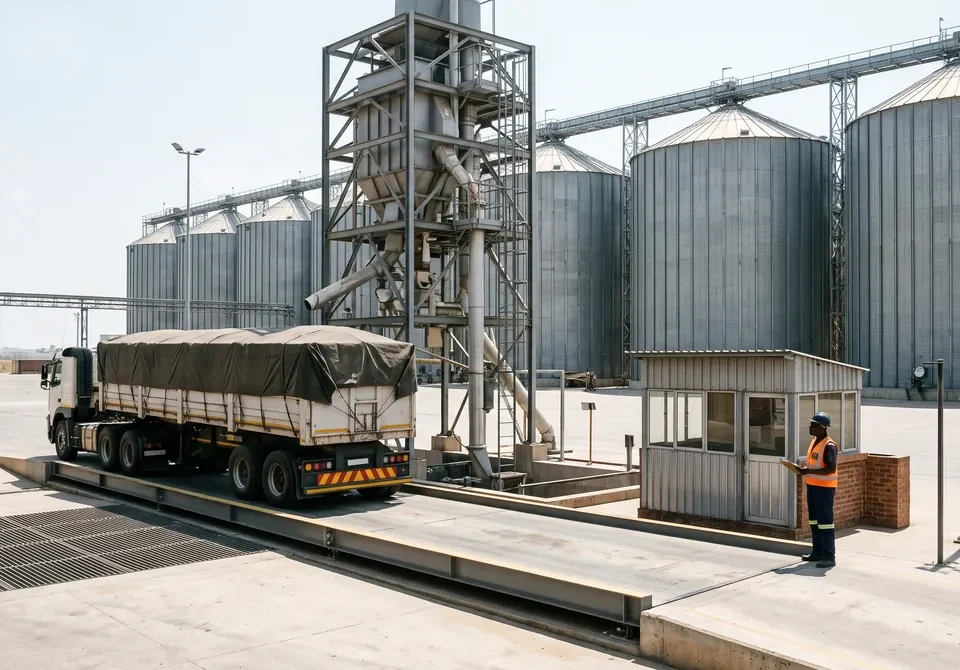
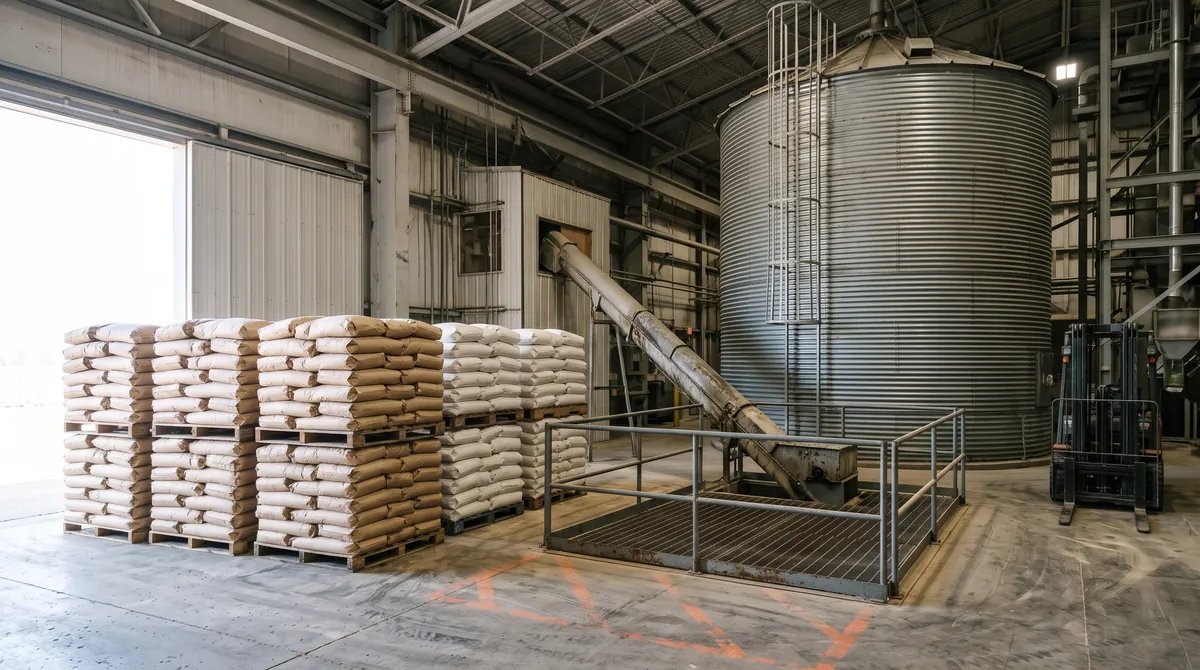
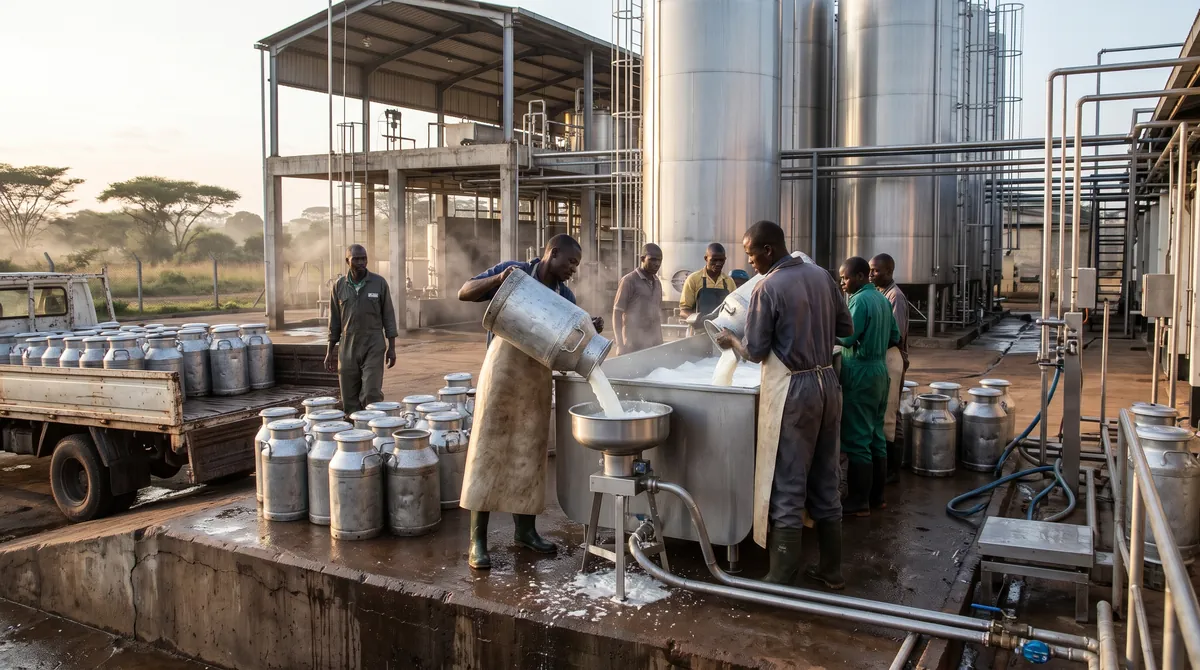
In August 2026, Uganda’s Daily Monitor reported that a dry spell which began in May 2026 had run past its expected end in July, cutting milk production across Ankole, Kigezi and parts of greater Masaka (Daily Monitor, 24 August 2026) [1]. For a dairy in that corridor, the pasteuriser is ready and the milk is short. A rice mill plant in Ghana lives the same pattern on a different calendar. Paddy arrives in a harvest window, and rice mill plant storage is what keeps the mill running long after it closes.
This article is about the storage that decides how much of a plant’s rated capacity you’ll ever use. It covers the three stores every processing plant has, what each one must do, and how to size them before the processing rate is fixed. The worked examples are a rice mill plant, a maize milling plant, a feed mill plant, a mineral water plant and a dairy processing plant. It’s written for owners planning a first plant, owners expanding one, and the bankers and consultants who review those plans.
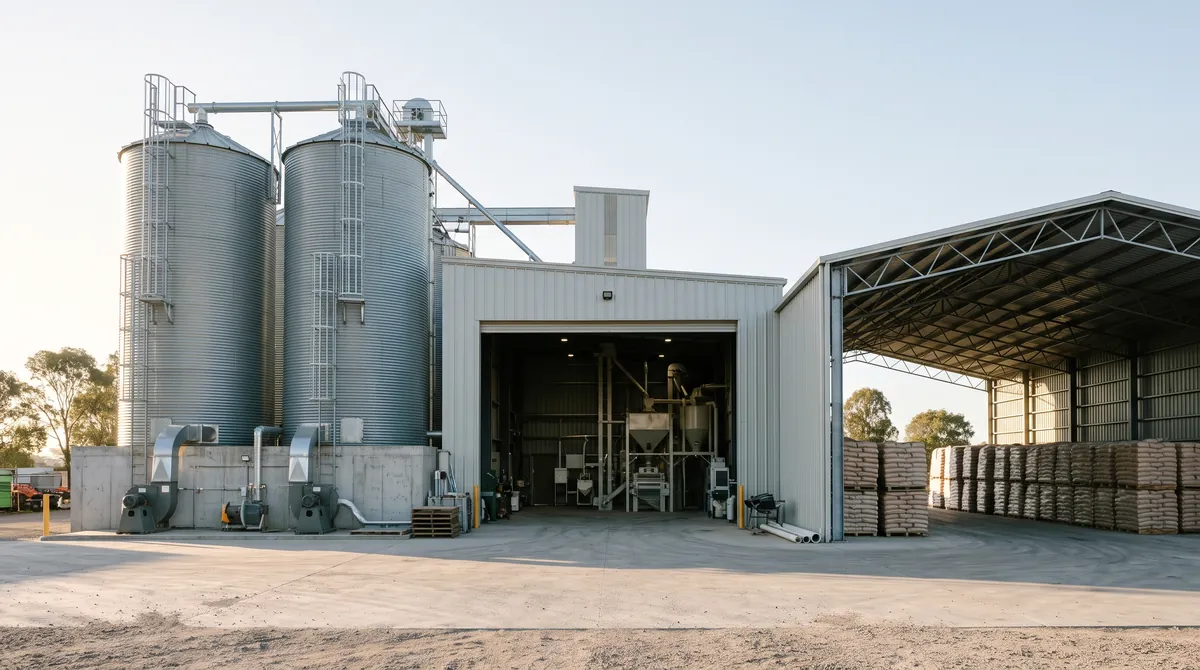
> In short: > – Every processing plant has three stores: raw material, work in progress and finished goods. > – The smallest of the three sets what the whole plant can process, whatever the main machine is rated for. > – Raw material arrives on the farm’s calendar, so the raw-material store has to carry the plant between harvests or collection rounds. > – Buffers let each stage run at its own pace, and the finished-goods store lets the plant keep producing between trucks. > – Size the stores first, each against its own constraint, and fix the processing rate last.
Contents
- Why a rice mill plant runs below its rating
- Three stores, one ceiling
- Supply follows the farm’s calendar
- What sits between the truck and the first machine
- Buffers between stages let each one keep its own pace
- A store at the end of the line is still a store
- Rice mill plant storage: sizing the mill backward from the smallest store
- What this means in Ghana, Cote d’Ivoire, Uganda and Rwanda
- What skipping this step costs, and how to check a proposal
- How Sonika Impex LLP can help
- Frequently asked questions
- Final thoughts
- Sources
Why a rice mill plant runs below its rating
A processing plant is described by the speed of its main machine. The mill is rated for so many tonnes an hour, the filler for so many bottles a minute. That figure goes into the project report, the bank’s appraisal and the owner’s plan for repaying the loan. On its own, it doesn’t tell you what the plant will produce.
The same gap can open in every industry this article follows. A rice mill can be sized for the rate at which paddy is milled in the busiest weeks. A feed mill plant can be sized for its pellet press, a mineral water plant for its filler and a dairy processing plant for its pasteuriser. If the storage around that machine is sized for a fraction of its rate, or planned last once the machinery budget is fixed, the rating stops describing the plant.
The result is a plant that can’t run at its own speed. The main machine waits for material, or it stops because finished product has nowhere to go. Here’s the catch: idle capacity still has to be paid for, and the repayments arrive every month whether the mill runs or stands.
If you’re planning a first plant, this is the gap to close before a single machine is chosen. It costs very little to settle on paper and a great deal to discover after commissioning.
Three stores, one ceiling
Every processing plant has three kinds of storage, and each answers its own question.
Raw-material storage answers this: how long can the plant keep running from what has already arrived? Work-in-progress storage answers this: can one stage keep running while the next one pauses? Finished-goods storage answers this: can the plant keep producing while it waits for the next truck, order or market day?
The table sets the three side by side for the five plants this article follows. The material changes completely from row to row, and the logic holds.
| Plant | Raw-material store | Work-in-progress store | Finished-goods store |
|---|---|---|---|
| Rice mill | Paddy in bins, silos or a warehouse, dried and aerated | Holding and tempering bins between cleaning, husking, whitening and grading | Bagged rice in 10 to 50 kg bags |
| Maize milling plant | Shelled maize in silos | Conditioning and tempering bins ahead of the mill | Flour or grits in 25 and 50 kg bags |
| Feed mill plant | Maize, soya, premix and other ingredients | Mash bins ahead of the pellet press | Bagged feed in 50 kg bags |
| Mineral water plant | Raw water from the borehole or supply line | Treated-water tank ahead of the filler | Filled bottles in cartons or shrink packs |
| Dairy processing plant | Chilled raw milk in tanks | Buffer tank between the pasteuriser and packing | Packed product in a cold room at +4 °C |
Read across any row and the point is the same. The smallest of the three stores sets what the whole plant can process. A mill that can run all day, fed by a store that empties by midday, is a half-day mill. A pasteuriser feeding a cold room that fills by evening is a day-shift pasteuriser.
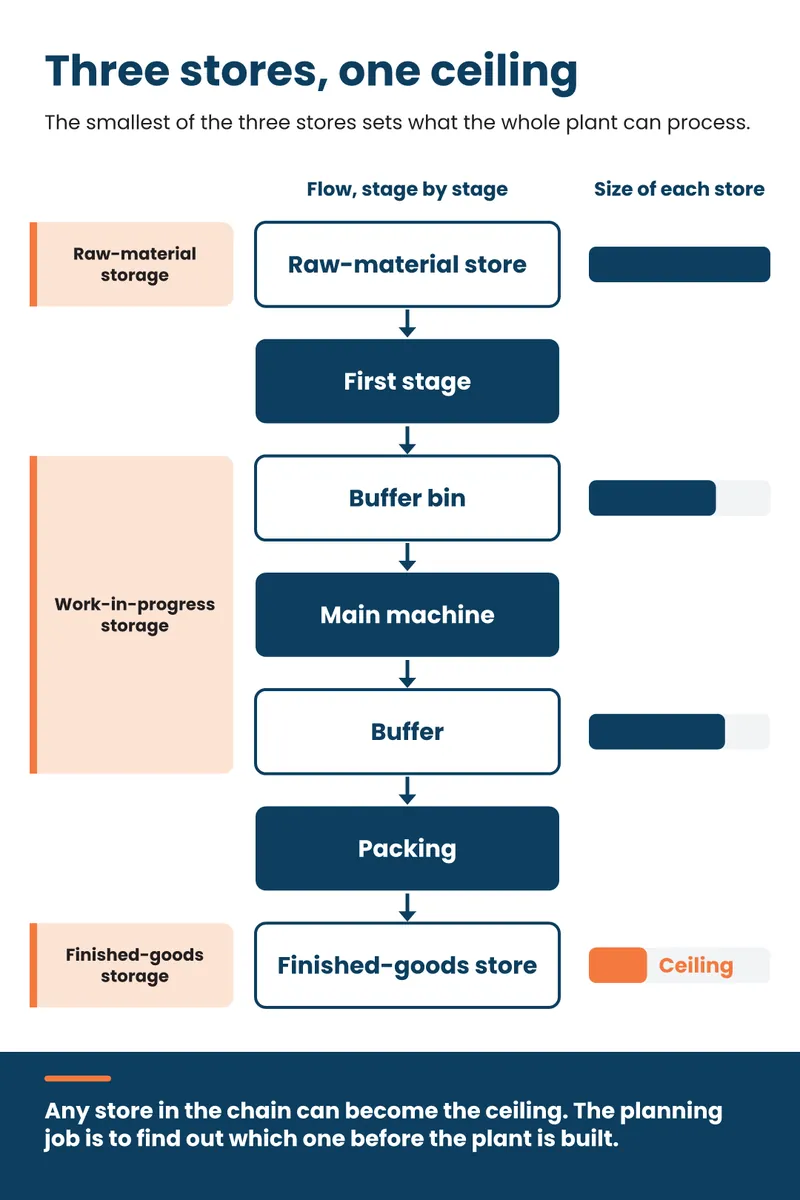
The flow runs stage by stage: raw-material store, first stage, buffer bin, main machine, buffer, packing, finished-goods store. Any store in that chain can become the ceiling, and the planning job is to find out which one before the plant is built.
Supply follows the farm’s calendar
Raw material arrives when it is harvested, collected or delivered. That calendar belongs to the farm, the season and the weather, and the machine’s rating has no say in it.
Ghana’s rice sector shows this clearly. A government strategic brief on Ghana’s rice business notes that rice mills outside the Lower Volta region run only during the dry season, and that paddy prices and quality vary by season (Ghana rice business strategic brief) [2]. A mill in that position can stand idle for part of the year, or it can hold enough paddy to keep running after the harvest window has closed. The second choice is a storage decision, and it has to be made before the mill is sized.
The window itself is narrow and dated. FAO’s crop monitoring service, GIEWS, reported in August 2025 that rice harvesting in southern Ghana was expected between September and October 2025 (FAO GIEWS Country Brief: Ghana, 19 August 2025) [3]. A mill that receives most of its paddy over a few weeks and must run for months afterwards needs a raw-material store measured in months of milling.
Rwanda shows how much the calendar can differ by crop within one country. The National Institute of Statistics of Rwanda recorded 481,246 tonnes of maize in Season A and 117,711 tonnes in Season B (NISR, Seasonal Agricultural Survey 2025) [4]. Paddy rice was spread far more evenly, at 69,680 tonnes in Season A and 72,976 tonnes in Season B (NISR, Seasonal Agricultural Survey 2025) [4]. So a maize mill there takes in most of its grain in one season, while a rice mill sees two intakes of similar size.
Milk follows a calendar set by rain and pasture. The 2026 dry spell in Uganda’s cattle corridor, reported by the Daily Monitor on 24 August 2026, cut milk production across Ankole, Kigezi and parts of greater Masaka (Daily Monitor, 24 August 2026) [1]. A dairy processing plant sized against the wet-season peak runs well below its rating in a season like that. A plant sized against the dry-season low turns milk away when supply recovers.
Raw milk can’t be held across a season, so for a dairy the answer lies partly in the collection plan. It also lies in products that keep, such as butter, ghee or cheese, made from flush-season milk.
Size the raw-material store to the longest gap between intakes, measured in the leanest year you can remember.
What sits between the truck and the first machine
The raw-material store does more than hold tonnage. What it must do depends on what it holds, and getting this right is harder than it sounds.
Paddy is harvested at 20 to 25 percent moisture. That is well above the band in which rice is milled, which FAO’s rice post-harvest compendium puts at around 14 percent (FAO, Rice post-harvest compendium) [8]. So a rice mill plant needs a dryer sized to the harvest-week intake, which makes the dryer the one machine sized to the peak.
Aeration is the other half of the job. One silo design for maize, as an example, assumes grain at 12 percent moisture and fits four aeration fans to each silo. The fans keep warm, damp pockets from building up between filling and milling.
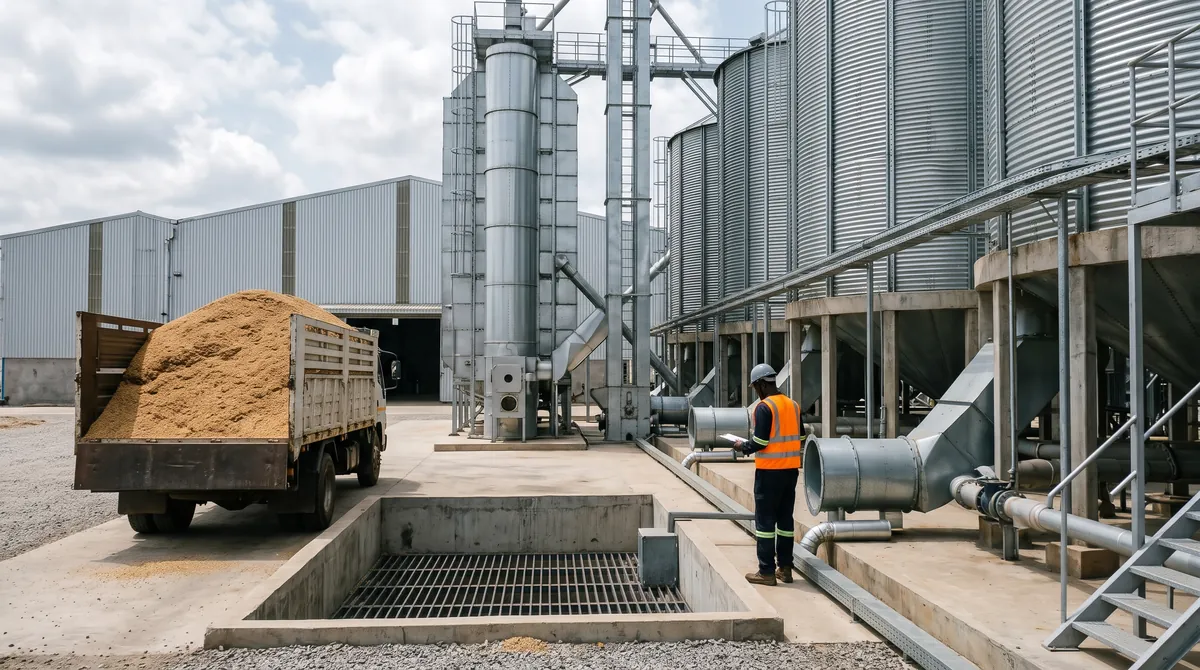
For grain, the raw-material store works as a sequence of steps, in this order:
- Intake and testing. Each load is weighed and checked for moisture and foreign matter.
- Pre-cleaning. Straw, stones and dust come out before drying or storage.
- Drying. Paddy comes down from harvest moisture to a safe storage moisture.
- Holding with aeration. Grain waits in bins or silos, with air moved through it.
- Draw-off in order. The oldest grain goes to the mill first.
The slowest of these steps during harvest weeks decides how much paddy the store can actually take in.
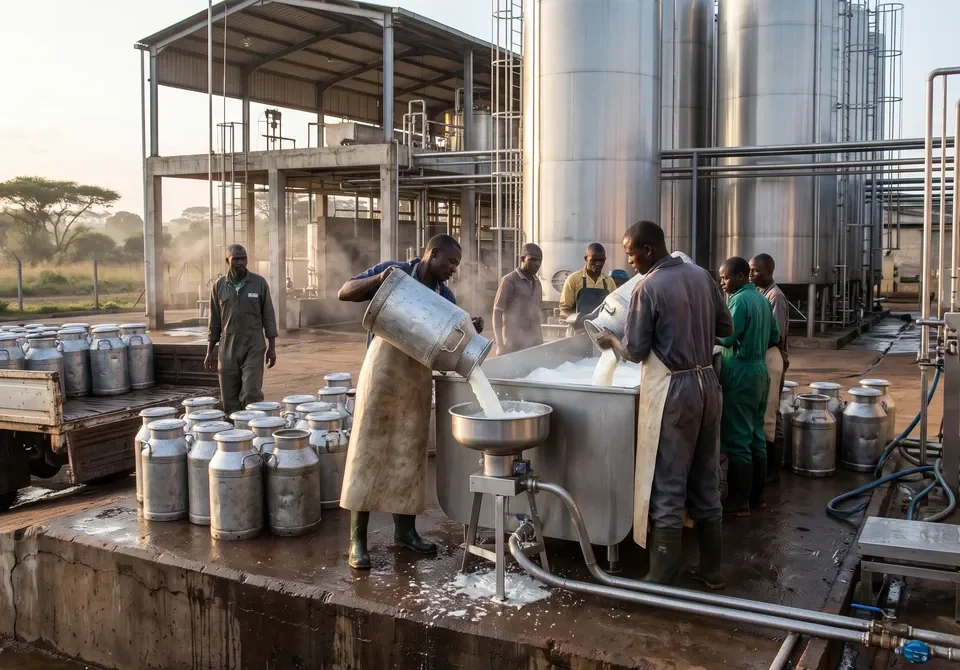
For a dairy processing plant, the raw-material store is chilled. FAO’s dairy guidance explains that natural inhibitors hold bacterial numbers in check for the first three to four hours after milking, and that cooling to 4 °C within that period keeps the milk’s original quality (FAO, Milk preservation) [6]. Raw milk reaches a plant at up to 35 °C and has to be chilled to 4 °C, so reception needs chilling capacity sized to the largest morning delivery.
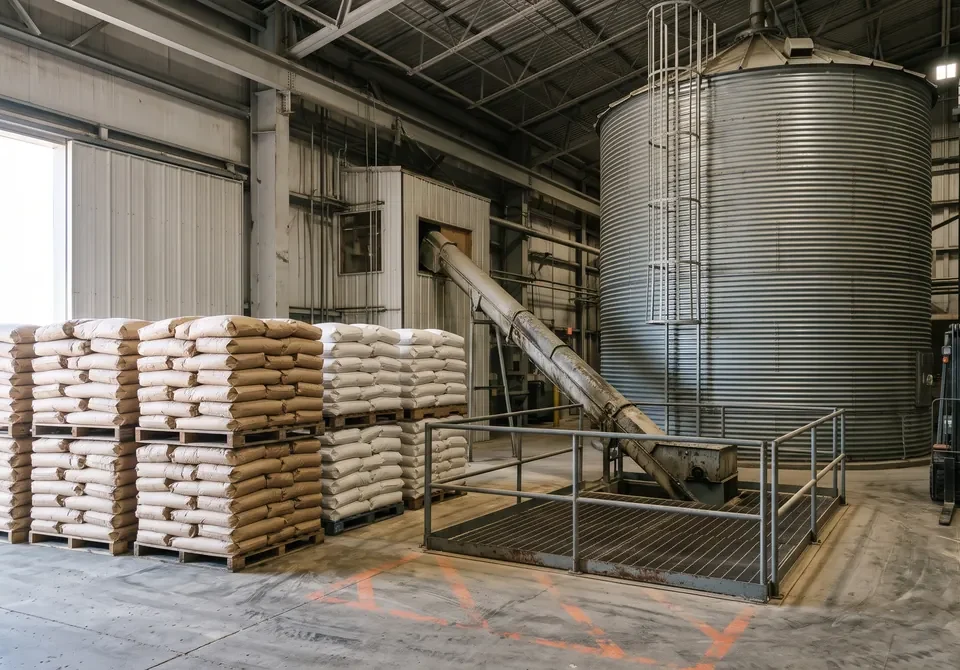
For a feed mill plant, the store is a set of ingredient bins and a warehouse, and its job is rotation. FAO’s guidance on feed mill operation notes that ingredient supply is often scarce and discontinuous, particularly for protein, so storage in well-run feed mills is commonly sized to several weeks of production (FAO, Feed mill storage) [7].
The table puts each raw-material store against its job, and against what you’ll see when the store is too small or too simple.
| Plant | What the raw-material store must do | What goes wrong when it can’t |
|---|---|---|
| Rice mill | Dry paddy and hold it aerated until milling | Mould, and more brokens at the mill |
| Maize milling plant | Hold shelled maize dry and aerated in silos | Insect damage and mould |
| Feed mill plant | Hold weeks of ingredients and rotate them | Stale or mouldy ingredients reaching the mixer |
| Mineral water plant | Hold raw water against supply interruptions | Treatment and filling stop with the supply |
| Dairy processing plant | Chill incoming milk quickly and hold it cold | Milk lost to souring before the line reaches it |
So the full question is how long material will sit before it’s processed, and what the store must do to keep it in condition for that long. A store sized only for volume can lose material the plant has already paid for.
Buffers between stages let each one keep its own pace
Work-in-progress storage is the easiest store to overlook, because it doesn’t look like a machine. It’s the holding bin between cleaning and husking in a rice mill, and the mash bin between mixer and pellet press in a feed mill plant. In a mineral water plant it’s the treated-water tank ahead of the filler. In a dairy processing plant it’s the buffer tank between the pasteuriser and the packing machine.
Without these buffers, every stage is tied directly to the next, and the line runs only as fast as its slowest connected step. When one stage stops for a backwash, a screen change, a cleaning cycle or a short repair, every stage before it stops as well.
Here’s where a well-designed line gets clever. A buffer lets each stage run at its own pace. In a mineral water plant, reverse osmosis can run up to 22 hours a day while the filler runs on the shifts the market needs, and the treated-water tank absorbs the difference. In feed, a mixer works in batches of 5 to 7 minutes while the pellet press runs continuously, and the mash bin turns one rhythm into the other.
Buffers also give the process the conditions it needs. FAO’s rice post-harvest compendium notes that grain reaching the mill wetter than about 14 percent will powder, while grain that is too dry will break into brokens (FAO, Rice post-harvest compendium) [8]. A tempering bin between drying and milling gives grain time to settle into that band. Leave it out, and the mill still runs, but it turns out more brokens.
Maize and wheat milling work the same way. In the mill designs the team works with, conditioning bins hold 10 to 20 tonnes each and sit between cleaning and the first grinding stage.
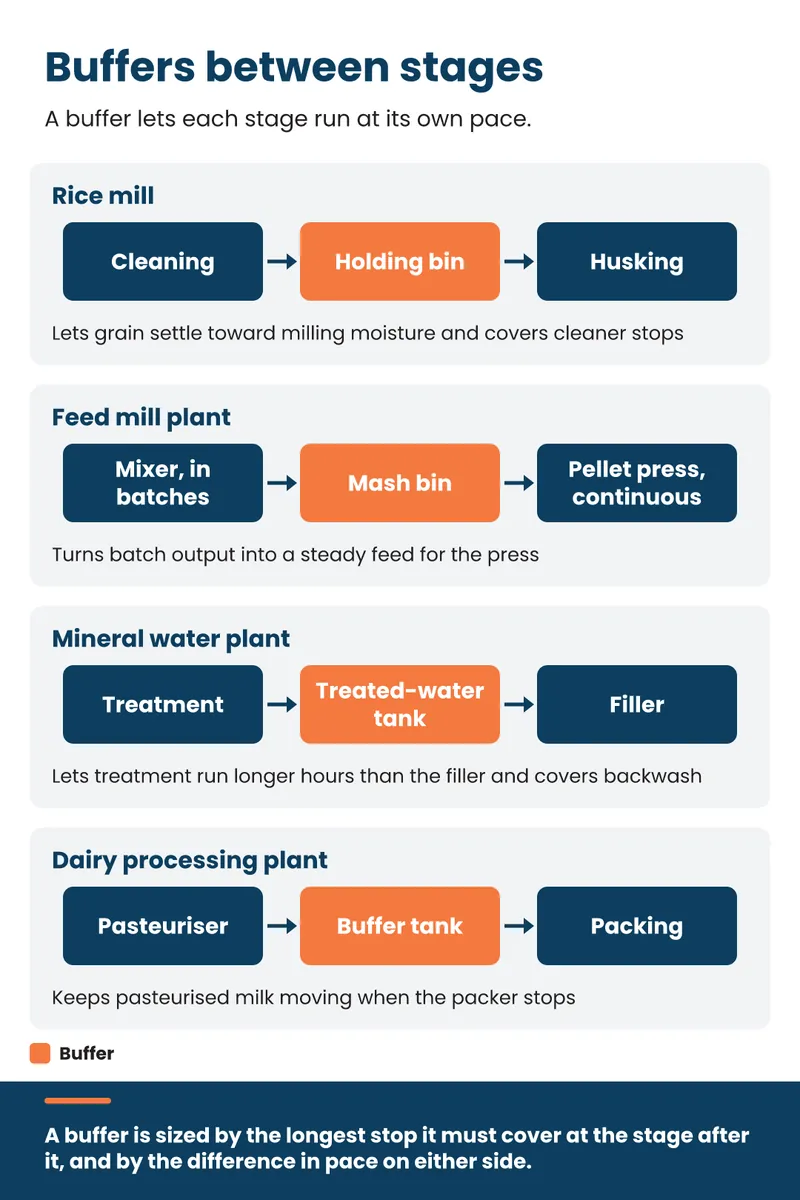
Each row is a short flow: cleaning, holding bin, husking for rice; mixer, mash bin, pellet press for feed; treatment, treated-water tank, filler for water; pasteuriser, buffer tank, packing for dairy. The table gives the reason for each.
| Plant | Stage before | Buffer | Stage after | Why the buffer is there |
|---|---|---|---|---|
| Rice mill | Cleaning | Holding bin | Husking | Lets grain settle toward milling moisture and covers cleaner stops |
| Feed mill plant | Mixer, in batches | Mash bin | Pellet press, continuous | Turns batch output into a steady feed for the press |
| Mineral water plant | Treatment | Treated-water tank | Filler | Lets treatment run longer hours than the filler and covers backwash |
| Dairy processing plant | Pasteuriser | Buffer tank | Packing | Keeps pasteurised milk moving when the packer stops |
A buffer is sized by the longest stop it must cover at the stage after it, and by the difference in pace on either side. That makes it a question about cleaning cycles, backwash intervals and repair times, which the plant’s own operating plan has to answer.
A store at the end of the line is still a store
In the team’s experience, finished-goods storage is the store planned last. Product is made to be sold, so the plan assumes it will leave the gate soon after it’s packed.
In practice, product waits. Bagged rice or flour waits for a buyer’s truck, and bagged feed waits for the farms’ ordering cycle. Filled bottles wait for distributors, and packed dairy product waits in the cold room for the next delivery round.
When the finished-goods store holds a single day’s output, the plant has one day of freedom. A missed truck, a public holiday or a slow week in the market, and the store is full. Then the plant either stops or stacks product somewhere never meant to hold it, which means damaged bags for dry goods and spoilage for dairy.
The store also has rules of its own. Ghana’s Food and Drugs Authority, in its food storage facility guideline, requires a system that sends out first the products due to expire first, and segregation of rejected, expired, recalled or returned products (Food and Drugs Authority, Ghana) [9]. Each of those rules needs floor space. A store with room only for the day’s pallets has no room to segregate, rotate or inspect.
Bagged feed follows the same discipline. FAO’s good feed manufacturing practice, written for aquaculture feed mills, says sacked feed must be stored off the ground on pallets away from sunlight, with space between pallets for air, on a first-in, first-out basis (FAO, Good Aquaculture Feed Manufacturing Practice) [10].
For dairy, the finished-goods store is a cold room at +4 °C. As an example of scale, one packed-milk store design measuring 20 x 10 x 3.5 m holds 16,000 litres. Set a figure like that against your delivery rounds before the pasteuriser is chosen.
In the team’s experience, the right size for a finished-goods store comes from the dispatch and order cycle. Ask how often product actually leaves, in what quantities, and what happens in a bad week. Then size the store so that a bad week leaves the plant running.
Size the finished-goods store to your worst normal week of dispatch.
Rice mill plant storage: sizing the mill backward from the smallest store
The method the team uses is simple to state. Size the stores first, each against its own constraint. Fix the processing rate only after that.
For a rice mill plant, the steps run in this order:
- Map the intake calendar. Find when paddy arrives, over how many weeks, and from which seasons.
- Set the raw-material store. Decide how many months the mill must run after intake closes, then size dryers, bins or silos to carry that paddy at a safe moisture.
- Set the in-process bins. Size the tempering and holding bins against the line’s moisture needs and the longest stop each must cover.
- Set the finished-goods store. Size the bagged-rice store against how often buyers collect, and against a bad week.
- Fix the milling rate. Choose the rate the stores can keep fed and cleared through the whole year.
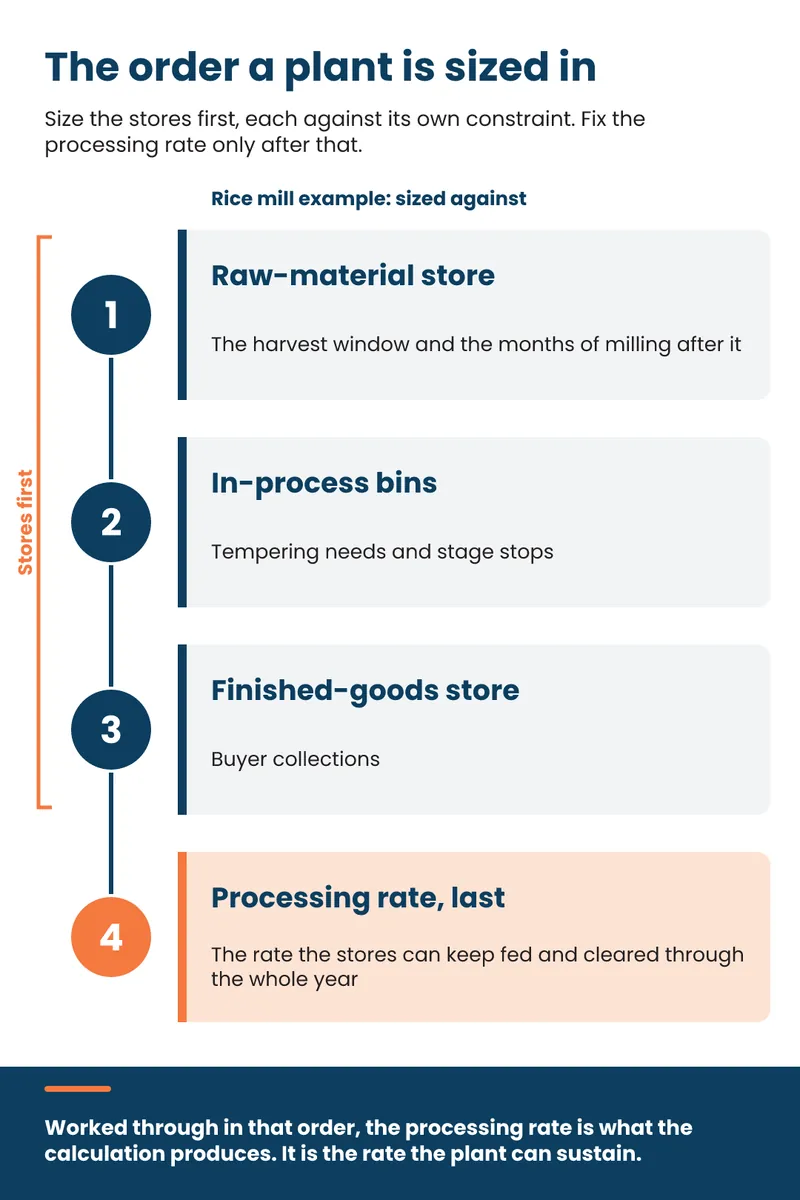
The order runs raw-material store, in-process bins, finished-goods store, and the processing rate last. The same sequence holds for the other plants, and only the constraint behind each store changes.
| Plant | Raw-material store, sized against | In-process buffers, sized against | Finished-goods store, sized against |
|---|---|---|---|
| Rice mill | The harvest window and the months of milling after it | Tempering needs and stage stops | Buyer collections |
| Maize milling plant | The spread of the maize harvest you buy from | Conditioning time before milling | Flour dispatch |
| Feed mill plant | The supply pattern of each ingredient, especially protein | Mixer batches and press stops | The farms’ ordering cycle |
| Mineral water plant | The reliability of the water source | Backwash and cleaning cycles | Distributor collections |
| Dairy processing plant | The collection schedule and the seasonal swing | The pasteuriser-to-packing sequence and cleaning | Delivery rounds and cold-room space |
Worked through in that order, the processing rate is what the calculation produces. It’s the rate the plant can sustain, and the only figure worth putting into a repayment plan.
The arithmetic surprises some owners. Every extra tonne of storage raises the year’s output, up to the point where the mill’s rating is reached. Every extra tonne an hour of milling capacity sits idle until storage catches up.
What this means in Ghana, Cote d’Ivoire, Uganda and Rwanda
Ghana. FAO’s GIEWS brief puts Ghana’s 2024 aggregate cereal production at about 6.2 million tonnes, approximately 27 percent above the average of the previous five years (FAO GIEWS Country Brief: Ghana) [3]. A larger harvest arriving in the same window makes the storage question bigger. Finished-goods stores there also answer to the Food and Drugs Authority’s storage guideline (Food and Drugs Authority, Ghana) [9].
Cote d’Ivoire. The US Department of Agriculture’s Foreign Agricultural Service forecasts milled rice production at 1.6 million tonnes for 2025/2026, up 6.7 percent from 1.5 million tonnes in 2024/2025 (USDA FAS, Cote d’Ivoire Grain and Feed Annual) [5]. The same report forecasts consumption at 2.95 million tonnes (USDA FAS, Cote d’Ivoire Grain and Feed Annual) [5]. For a rice mill plant there, a growing harvest means more paddy to dry and hold, so the dryer and raw-material store should grow ahead of the mill.
Uganda. The 2026 dry spell reported by the Daily Monitor ran from May into August and hit milk supply across the cattle corridor (Daily Monitor, 24 August 2026) [1]. A dairy processing plant there is best sized to the milk it can reliably collect in a season like that one. Its collection plan and its products that keep are then planned together.
Rwanda. The national survey shows maize concentrated in Season A and paddy rice split across both seasons (NISR, Seasonal Agricultural Survey 2025) [4]. A rice mill plant there takes in two intakes of similar size, so its raw-material store carries the mill across a shorter gap. A maize mill has to carry most of a year’s grain from one season.
What skipping this step costs, and how to check a proposal
When storage is planned after the machines, the costs show up in three places. The first is idle capacity: a machine runs well under its rating because the stores can’t keep it fed or cleared. The second is degraded material, which never appears as a single line on a report and shows up as a gap between what came in and what was sold. The third is capital spent on a larger main machine when it was needed for storage.
In the team’s experience, this is how a sound business can end up with a plant that never reaches the output it was bought for.
| Mistake | What it costs | Better practice |
|---|---|---|
| Sizing the mill to the harvest-week peak | Idle capacity for the rest of the year | Size the dryer to the peak and the mill to what the stores supply across the year |
| Planning storage after the machinery budget | Bins and warehouses squeezed into what’s left | Budget the stores first, then the machines |
| Leaving out buffers between stages | The whole line stops whenever one stage stops | Place a buffer before each stage that stops for cleaning, backwash or changes |
| Sizing the finished-goods store to a day’s output | The plant stops when a truck is missed | Size it to the worst normal week of dispatch |
| Sizing a store for volume alone | Material lost to heat, mould or souring | Specify drying, aeration, chilling or rotation with the store |
The time to settle storage is the time you settle the machinery, while you’re comparing proposals. Ask the same questions of every proposal:
- How long will raw material sit before processing, and what keeps it in condition while it waits?
- Which intake calendar was the plant sized against, and for which year?
- Where are the buffers between stages, how much does each hold, and which stop does each cover?
- How many days of finished goods can the plant store before it has to stop?
- What rate can the plant sustain in the leanest month of supply?
The answers decide how much of the main machine’s rating your plant will ever use. Until each question has an answer, only the machine has been sized.
How Sonika Impex LLP can help
Sonika Impex LLP supplies complete plants, standalone machinery and working capital materials from a single point of service. The team has implemented 200+ projects, and the family brings close to five decades of export experience. For a plant where storage sets the output, that covers:
- A needs assessment that sets out what you need now, what you’ll need later and a plan for both, including a plain word when something isn’t needed yet.
- Rice mill plants from 100 kg/hour to 10 TPH of paddy, with paddy dryers of 5 to 48 tonnes per batch.
- Grain silos of 100 to 5,000 tonnes, and conditioning and tempering bin sets.
- Feed mill plants from 500 kg/hour to 30 TPH.
- Mineral water plants from 1,000 to 10,000 litres/hour.
- Milk processing plants from 500 to 50,000 litres/day, with bulk milk coolers, milk storage tanks of 1,000 to 30,000 litres and dairy cold rooms.
- Pre-shipment inspection, with third-party inspection by SGS or Bureau Veritas as required, then export, erection and commissioning.
- Training for project and maintenance staff at your site, and after-sales support.
- Introductions to banks, financial institutions and other institutions that can help the project. Sonika does not lend, arrange or guarantee finance.
For a useful proposal, send us what you want to make and how much of it. Send your raw material availability across the year, month by month, and how often product leaves the plant. Tell us about the site, the power and the water, and anything already installed.
Write to archit@sonikaimpex.com or call +91 99027 67900.
Frequently asked questions
Can storage be added later if the plant starts small?
Yes, provided the first layout leaves room for it. Bins, silos and cold rooms need foundations, conveyors and floor space that are hard to retrofit once the plant is built around them. Plan the full plant at the start, then buy it in the order it’s needed.
Do husk, bran and brokens need a store of their own?
Yes. A rice mill puts out husk, bran and brokens for as long as it runs, and if they can’t be cleared the mill stops just as it would for a full rice store. Husk can be burnt in a husk-fired boiler, so part of that store becomes the plant’s fuel store. Plan where each by-product goes, and how often it leaves, alongside the bagged-rice store.
Does parboiling change the storage plan?
Yes. A parboiling section soaks and steams paddy in batches, and the parboiled paddy has to be dried again before it can be milled or stored. That adds a stage with its own rhythm between intake and milling. The plan needs room for paddy waiting to be soaked and for parboiled paddy waiting for the dryer, sized against the batch cycle.
Should paddy be held in bags or in bulk?
Both work, and the choice follows the tonnage and the labour on site. Bagged paddy in a warehouse needs little equipment to start with, though every bag is handled in and out and a stack is harder to ventilate. Bulk bins and silos need conveyors and aeration from the first day. In return they hold grain with less handling and keep air moving through it.
Can I rent warehouse space for raw material during harvest?
For bagged dry goods, a rented store can work if it is dry, clean and free of pests. Bulk grain that needs drying and aeration is harder to hold off site. Count the extra handling and transport in your costs before you rely on it.
What records should I keep to size stores for an expansion?
Keep intake by month, dispatch by week and stoppages by stage, with their causes. Those records show which store has been the ceiling in practice. An expansion sized from them starts from your own plant’s evidence.
How often should the storage plan be checked again?
Check it whenever the intake calendar, the product mix or the buyers change. A second crop, a new pack size or a new distributor can each move the ceiling to a different store. Go over it before every expansion and after any year when supply was unusual.
Does a mineral water plant on a reliable supply still need raw-water storage?
Yes, because even a reliable supply has interruptions, pressure drops and maintenance days. The raw-water tank also lets the treatment section draw at a steady rate. Size it to the longest interruption you’ve actually seen on that supply.
Who should size the stores, the owner or the supplier?
Both have a part. You hold the facts that decide the sizes: your intake calendar, your buyers’ collection habits and your site. The supplier turns those facts into equipment sizes, so the quality of the proposal depends on the quality of what you send.
Final thoughts
The question most owners start with is how fast the machine should run. The more useful question is how long your material waits, where it waits, and what keeps it in condition while it does.
Answer that for the raw material, for each stage of the line and for the finished goods. The processing rate then follows from the answers, and it’s a rate the plant can keep up through the leanest month and the slowest week of dispatch.
That’s the rate worth putting in front of the bank, and the one your repayments can rest on. Plan the stores first. Then size the machine to what they can carry.
Sources
- Daily Monitor (Uganda), Dry spell cuts milk supply, pushes prices higher in Ankole, Kigezi, 2026-08-24, https://www.monitor.co.ug/uganda/news/national/dry-spell-cuts-milk-supply-pushes-prices-higher-in-ankole-kigezi-5568754
- Ministry of Food and Agriculture, Ghana, Strategic Brief: Business Model, Rice, undated (no date on the document), https://mofa.gov.gh/site/images/pdf/Strategic_Brief_Business_Model_rice.pdf
- FAO Global Information and Early Warning System (GIEWS), GIEWS Country Brief: Ghana, 2025-08-19, https://www.fao.org/giews/countrybrief/country.jsp?code=GHA
- National Institute of Statistics of Rwanda, Seasonal Agricultural Survey Annual Report 2025 (summary), 2025-12, https://statistics.gov.rw/sites/default/files/documents/2025-12/SAS%202025%20summary%20in%20English.pdf
- USDA Foreign Agricultural Service, Cote d’Ivoire: Grain and Feed Annual (IV2025-0007), 2025-04, https://www.fas.usda.gov/data/cote-divoire-grain-and-feed-annual-6
- Food and Agriculture Organization of the United Nations (FAO), Gateway to dairy production and products: Milk preservation, undated web page, https://www.fao.org/dairy-production-products/processing/milk-preservation/en
- Food and Agriculture Organization of the United Nations (FAO), Feed mill storage of raw materials and finished feed (document X6930E), undated web document, https://www.fao.org/4/x6930e/X6930E15.htm
- Food and Agriculture Organization of the United Nations (FAO), RICE: Post-harvest Operations (INPhO post-harvest compendium), undated web document, https://www.fao.org/fileadmin/user_upload/inpho/docs/Post_Harvest_Compendium_-_RICE.pdf
- Food and Drugs Authority, Ghana, Guidelines for the Establishment of a Food Storage Facility (FDA/FID/CP-DFW/2020/01, Version 02), 2020-05-21, https://fdaghana.gov.gh/guidelines-for-the-establishment-of-food-storage-facility
- Food and Agriculture Organization of the United Nations (FAO), Good Aquaculture Feed Manufacturing Practice, section 12: Warehousing and shipping, 2001, https://www.fao.org/4/y1453e/y1453e0f.htm
Related resource: Unlocking the Power of Format Factory v5.22.0 for Your Business Workflows