Wheat and Maize Milling Machines: Where the Tonnage Goes Between the Truck and the Rolls
November 24, 2026
Turnkey Dairy Plant Storage: Chilled Reception, Raw Milk Silos and Cold Rooms Sized to Your Collection
Uganda’s cattle corridor went into a long dry spell in May 2026, and the Daily Monitor reported in late August 2026 that milk supply was down across Ankole, Kigezi and parts of greater Masaka [1]. The Dairy Development Authority says production in most of the corridor normally falls by 40 to 50 per cent in the dry season, according to a September 2026 report in The Independent of Kampala [2]. In Rwanda, The New Times reported in May this year that output rises in the rains and falls when cattle move onto stored feed [3]. A turnkey dairy plant takes its milk on that swing, and its stores have to absorb it.
This article is for the owner planning a first plant who wants the stores sized before the quote is signed. It covers the four places milk waits inside a plant: chilled reception, raw milk silos, the buffer tank before packing, and the cold room.
In short:
- Milk arrives in a few heavy windows a day and swings by season, so each store is sized to the heaviest load it must absorb.
- Reception has to chill milk within hours of milking, so the chiller is sized to the busiest arrival window.
- Raw milk silos are sized in hours of milk held, with one silo free for cleaning while another fills.
- A buffer tank lets the pasteuriser keep running when the packer pauses.
- The cold room is sized to your delivery round and product shelf life, with room for a missed truck.
Contents
- Milk arrives in bursts and swings with the season
- Reception and chilling must match the morning peak
- Raw milk silos are sized in hours of milk held
- The buffer tank sits between the pasteuriser and packing
- The cold room is sized to the delivery round
- Each store in a turnkey dairy plant is sized from the one before it
- What this means in Ghana, Cote d’Ivoire, Uganda and Rwanda
- What should I ask about the stores before I sign?
- How Sonika Impex LLP can help
- Frequently asked questions
- Final thoughts
- Sources
Milk arrives in bursts and swings with the season
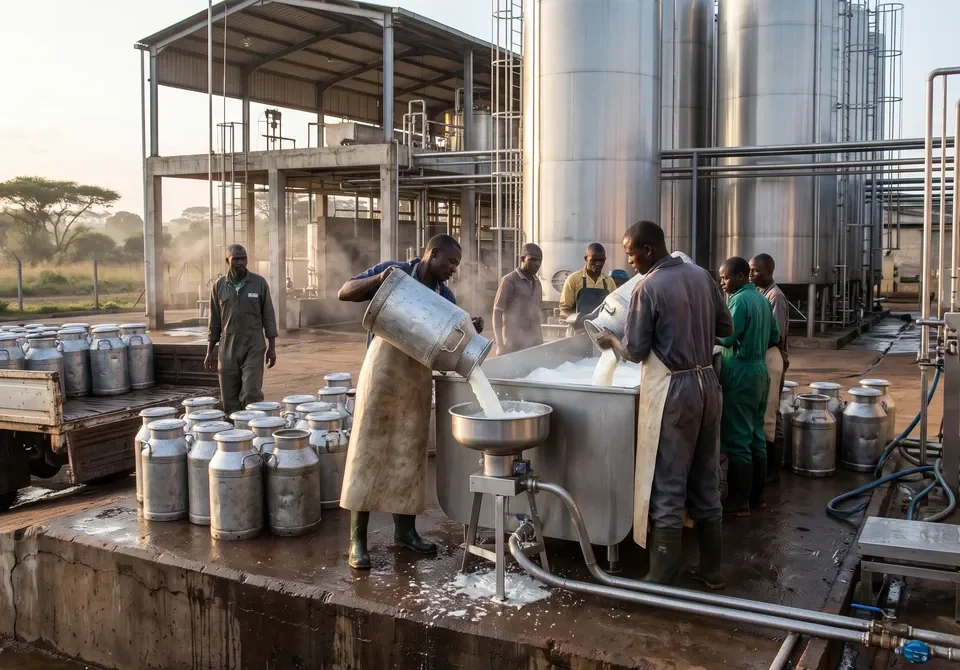
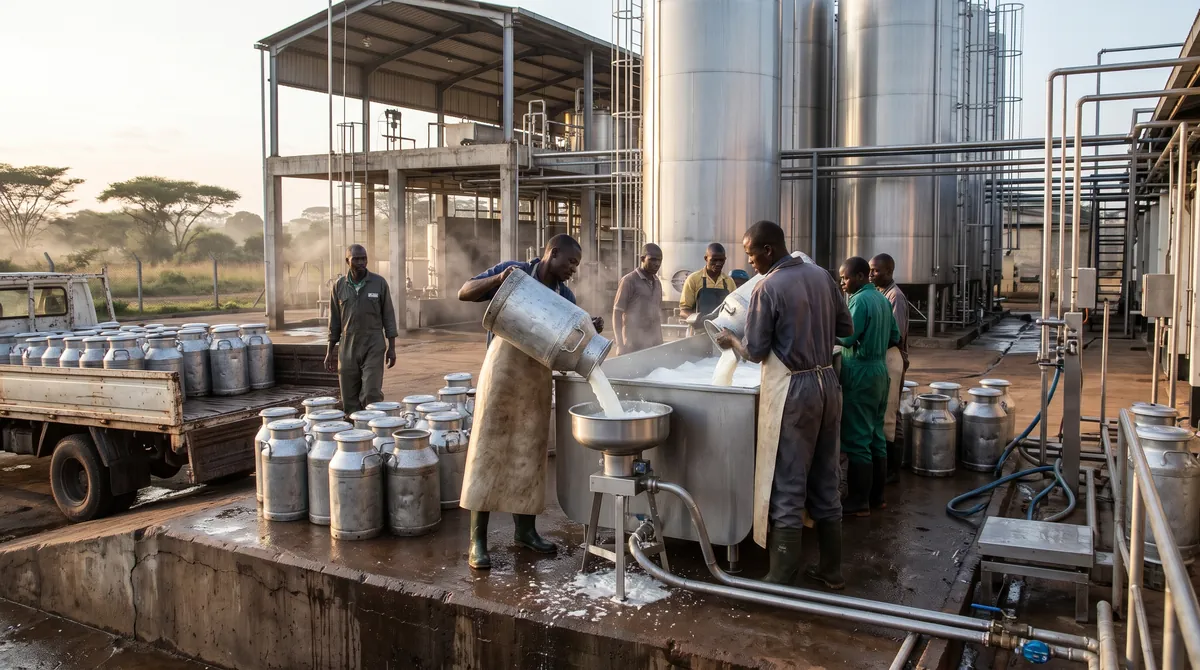
Every store in a dairy plant answers one question: how much milk will wait here, and for how long? The answer starts with your collection pattern, which belongs to the farms and the season. If your milk comes in rounds, as cans or tanker loads from collection centres after the morning milking, reception sees its heaviest load in a short window.
The season then changes the size of that window. A plant’s intake moves with the rains, so the stores have to work at both the wet-season peak and the dry-season low.
The pasteuriser runs at a steady rate. Milk arrives in bursts. The stores absorb the difference between the two, so before sizing any of them, take two figures from your own records: litres in the heaviest collection window of a wet-season day, and litres on a typical dry-season day.
Reception and chilling must match the morning peak
Reception is where milk either keeps its quality or starts to lose it. FAO’s guidance on milk preservation notes that natural inhibitors in fresh milk hold bacterial numbers down for three to four hours after milking, and that cooling should happen within that window [4]. FAO’s Small-Scale Dairy Farming Manual gives about 4°C as the best holding temperature [5].
The Codex Alimentarius Code of Hygienic Practice for Milk and Milk Products asks that milk be cooled on arrival at the plant, held so microbial growth stays minimal, and processed in the order it arrived [6]. So the chiller has to keep pace with the trucks.
FAO’s Milk Producer Group Resource Book sets out the platform checks that open a typical five-step reception sequence:
- Unload and inspect: smell, appearance, can cleanliness and sediment.
- Test: alcohol and acidity tests, with acidity above 0.19% lactic acid marking poor milk in the FAO resource book, plus a fat test [7].
- Measure and record: volume, density, fat and amount for each supplier.
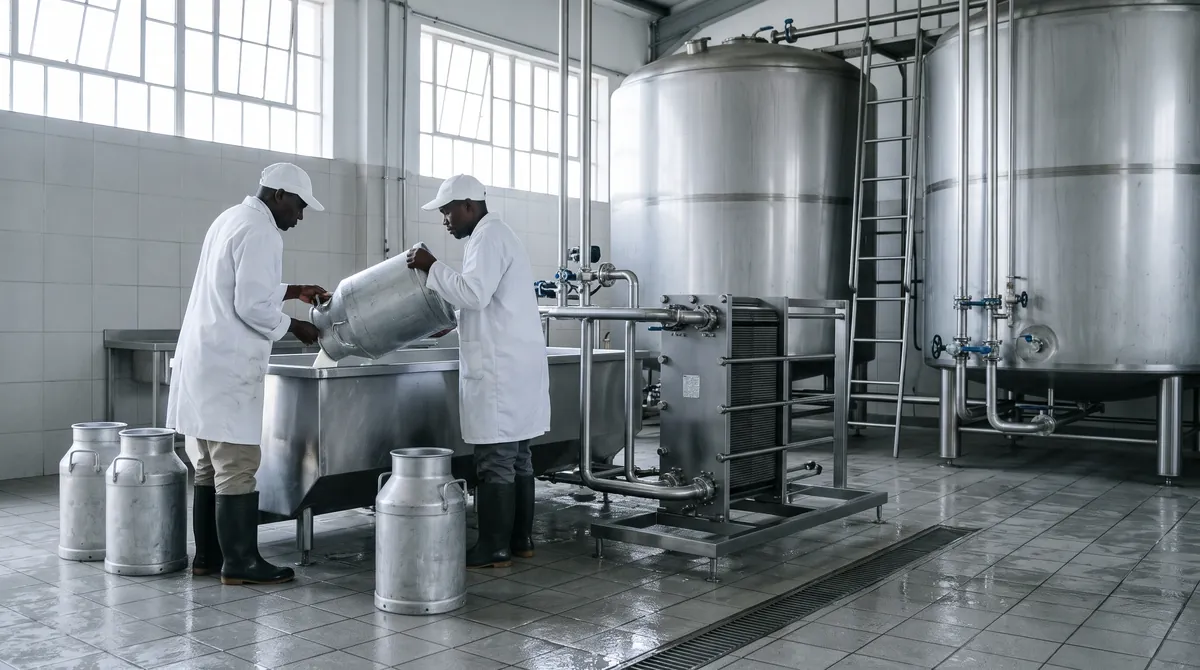
- Filter and chill: milk passes a filter and a plate chiller on its way to storage.
- Transfer: chilled milk goes to a raw milk silo, with the time and silo noted.
Written as a flow: milk is unloaded, inspected, tested, measured, filtered, chilled and pumped to a silo.
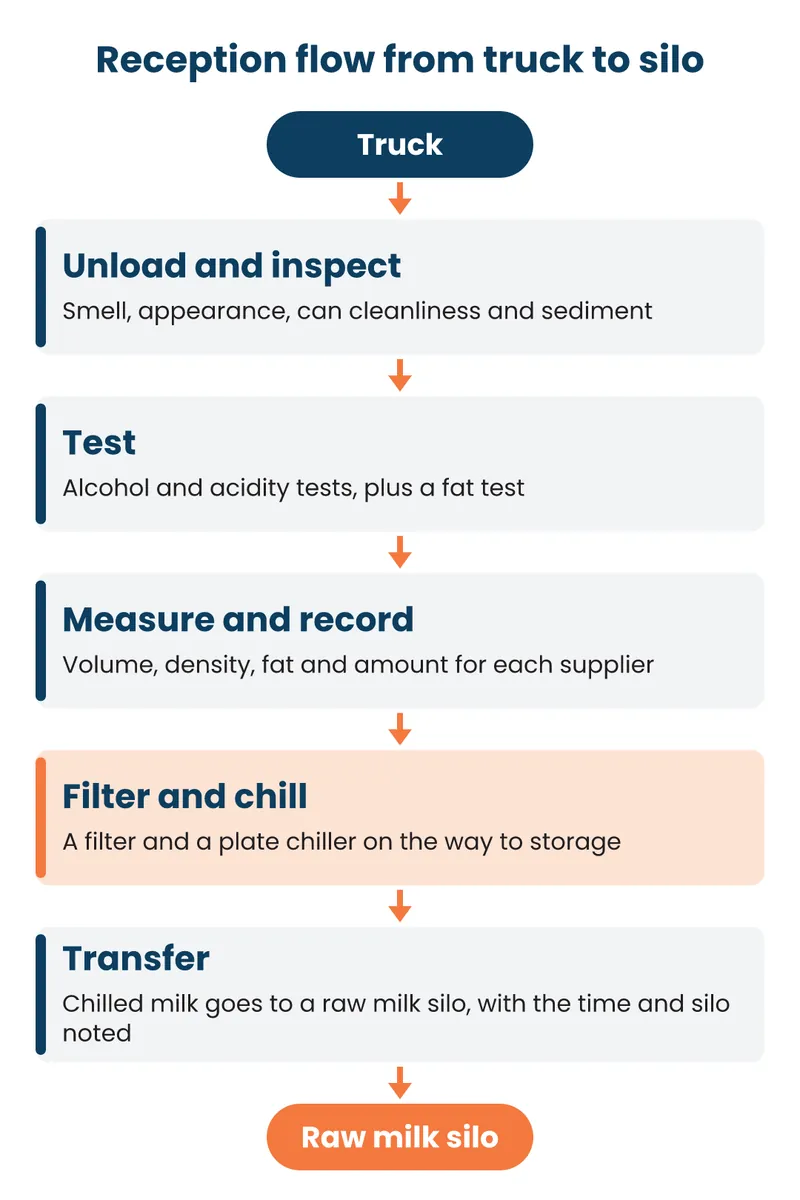
Size the chiller to the heaviest arrival window.
Raw milk silos are sized in hours of milk held
Think of a raw milk silo’s size in hours of milk, from the first litre received to the last processed. If reception runs early in the day and processing runs across a longer shift, the silo must hold the difference at its largest point. Add milk that arrives later from distant collection points, and a margin for a late start.
Then add the cleaning. A silo is cleaned when empty, through a clean-in-place cycle of pre-rinse, caustic wash, rinse, acid rinse, sanitising and post-rinse, as a university extension fact sheet on clean-in-place sets out [8]. With a single silo, reception and cleaning compete for the same tank. With two or more, one can be cleaned while another fills, and milk still goes to processing in arrival order.
Plan for the seasonal case at both ends. A silo sized for the dry-season day overflows when the rains return. A silo sized for the wet-season peak still has to keep a small volume cold in the dry months, so insulation and agitation matter there too.
The buffer tank sits between the pasteuriser and packing
The buffer tank lets the pasteuriser and the packer each keep its own pace. A continuous pasteuriser is built to run at a steady flow. After heating, the East African pasteurised milk standard used in Uganda and Rwanda, as notified by the Uganda National Bureau of Standards, requires milk to be cooled immediately and rapidly to 10°C or less [9]. Stopping and restarting that process costs time and product.
The packer stops for its own reasons: a film roll change, a jam, a short repair. Each packer stop without a buffer becomes a pasteuriser stop. With one, pasteurised milk collects in the tank while the packer catches up.
Size the buffer to the longest routine packer stop, plus the time the pasteuriser needs to move to recirculation. If the pasteuriser and packer are cleaned at different times, the buffer must also cover the gap while one is cleaned and the other runs. Ask for both figures in the proposal, stated in minutes of flow.
The cold room is sized to the delivery round
The cold room is where finished product waits for the next vehicle. A room sized to a single day’s packing leaves the plant one missed truck away from a full room. Shelf life sets the outer limit, and FAO’s Milk Producer Group Resource Book gives pasteurised milk two to three days, or up to 12 days at 4°C [7].
The delivery round sets the working size. Ask how often each route leaves, how much each vehicle takes, and what happens on a holiday or a slow market day. In Uganda and Rwanda, the East African pasteurised milk standard requires each pack to carry a date of manufacture and an expiry date [9]. So stock must rotate oldest first, which needs aisle space as well as volume.
Each store in a turnkey dairy plant is sized from the one before it
Work through them in this order.
- Map arrivals: litres per collection window, for a heavy wet-season day and a typical dry-season day.
- Size reception: chiller and receiving capacity to clear the heaviest window while milk is still inside its cooling window.
- Size the silos: the largest gap between milk received and milk processed, plus a margin, plus one silo free for cleaning.
- Size the buffer: the longest routine packer stop and the cleaning offset between pasteuriser and packer.
- Size the cold room: the longest gap between dispatches plus a bad week, within shelf life.
As a flow: arrivals set reception, reception and processing hours set the silos, packer stops set the buffer, and the delivery round sets the cold room. The table sets out what limits each store and the figure a proposal should state for it.
| Store | What limits it | What sets its size |
|---|---|---|
| Chilled reception | Hours before milk loses quality without cooling | Litres in the heaviest arrival window |
| Raw milk silos | Holding temperature and cleaning time | Largest gap between receiving and processing, plus a silo free for cleaning |
| Buffer tank | Pasteuriser running conditions | Longest routine packer stop and cleaning offset |
| Cold room | Product shelf life at holding temperature | Longest gap between dispatches, plus a bad week |
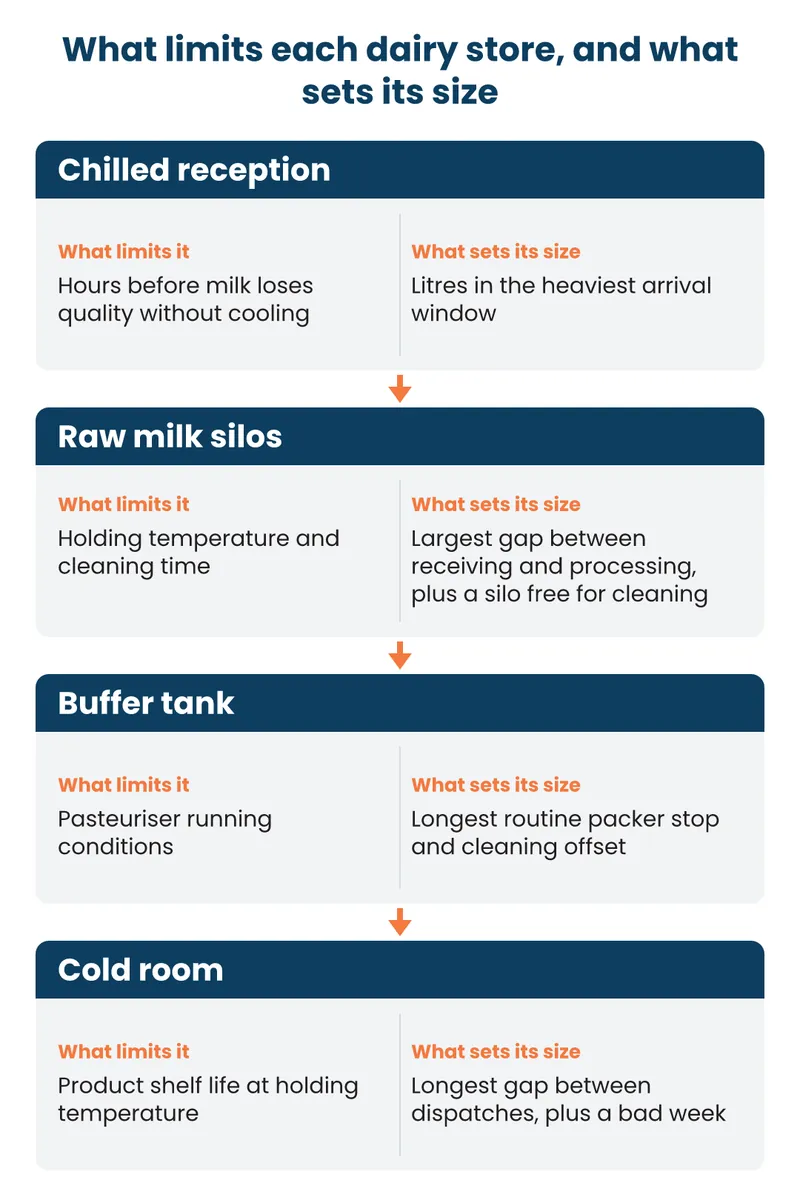
Caption: What limits each dairy store, and what sets its size. Source: FAO [4], the Codex hygiene code [6], the East African pasteurised milk standard [9].
What this means in Ghana, Cote d’Ivoire, Uganda and Rwanda
Uganda
The Dairy Industry Act, in its revised edition of 31 December 2023, gives the Dairy Development Authority the duty to register and license milk processors and traders, and to coordinate milk standards with the Uganda National Bureau of Standards [11]. Confirm with the authority what it inspects at reception and in the stores before the layout is fixed.
Uganda’s government Dairy Industry Profile FY 2024/25 puts milk production at 5.4 billion litres a year and counts 145 dairy processing facilities [12]. With that many buyers, size reception and the silos to the litres your own collection points commit in the dry months. The Independent report gives the normal dry spell as June to early August [2], and the Daily Monitor dates this year’s from May [1]. Size the silos’ low-intake case to that longer spell.
Rwanda
Rwanda’s ministerial order on the collection, transportation and selling of milk requires milk to be collected at a collection centre with a milk cooling room, and limits uncooled transport to two hours; cooled tankers must hold milk at no more than 4°C [13]. We found no later order replacing it. Ask your collection centres how they cool and how long their trucks take, because that sets how much chilling your reception still has to do.
Ghana
Ghana’s Food and Drugs Authority registers food products and licenses food manufacturing and storage premises under Part 7 of the Public Health Act, 2012 [14]. Confirm its storage premises requirements, and raw milk standards with the standards authority, before the cold room is drawn.
Cote d’Ivoire
Decree n° 2016-1152 of 28 December 2016 makes a list of dairy standards mandatory, including NI 4635 on expiry dating, microbiological criteria and milk composition [15]. The decree itself sets no storage temperatures [15]. Expiry dating decides how many days of stock the cold room may hold, so obtain NI 4635 from the national standards body before the cold room is sized [15]. Until you have it, plan the room around the shortest shelf life you expect.
What should I ask about the stores before I sign?
Each question asks for a figure tied to your own milk.
- What arrival pattern was reception sized to, and what does the chiller handle in the heaviest window?
- How many silos are proposed, and which one is cleaned while another fills?
- How many hours of milk do the silos hold at your wet-season peak?
- What packer stop does the buffer tank cover?
- How many days of each product does the cold room hold, and at what temperature?
Three mistakes are worth naming. Reception sized to the daily average leaves milk waiting warm at the peak. A single silo leaves no room for cleaning. A cold room drawn to fit the building fills on the first missed truck.
How Sonika Impex LLP can help
For dairy projects, Sonika supplies:
- Milk processing plants from 500 to 50,000 litres a day of plant capacity, turnkey or as standalone machinery.
- Lines for liquid milk, yoghurt, ice cream, butter, ghee, cream, cheese, and UHT with aseptic packaging.
- Milk reception dump tanks of 300 to 2,000 litres, milk storage tanks and silos of 1,000 to 30,000 litres, dairy cold rooms and boilers.
- A needs assessment covering what you need now and later, including what is not needed yet.
- Pre-shipment inspection and packing, with third-party inspection by SGS or Bureau Veritas as required.
- Export FOB preferred, or CIF where you prefer.
- Erection and commissioning, training for project and maintenance staff at your site, and after-sales support.
Send us:
- What you want to make: products, pack sizes and how much of each.
- Daily milk intake by month across the year, including your wettest and driest months.
- Collection points, distances and arrival times.
- Delivery routes and how often each runs.
- Site layout, power and water details.
- Anything already installed: tanks, chillers, a cold room, a boiler.
+91 99027 67900 · sonikaimpex.com
Frequently asked questions
Should morning and evening milk go into the same silo?
FAO’s [Small-Scale Dairy Farming Manual](https://www.fao.org/4/t1265e/t1265e06.htm) advises keeping warm morning milk apart from cooled evening milk, or cooling it before the two are mixed [5]. Mixing warm milk into a cold tank raises the temperature of the whole batch. Separate silos, or a chiller ahead of a shared silo, avoid that.
What can collection points do where there is no power for cooling?
FAO’s [milk preservation guidance](https://www.fao.org/dairy-production-products/processing/milk-preservation/en) describes the lactoperoxidase system, which can extend raw milk keeping time by seven to eight hours at 30°C [4]. The [same FAO guidance](https://www.fao.org/dairy-production-products/processing/milk-preservation/en) says it should be applied only by trained people at collection points, as a holding step ahead of pasteurisation [4]. Ask your regulator whether its use is permitted in your market before relying on it.
At what farm volume does a mechanical cooling tank make sense?
FAO’s [Small-Scale Dairy Farming Manual](https://www.fao.org/4/t1265e/t1265e06.htm) suggests that farms producing 400 to 500 litres a day use an electric mechanical cooling tank [5]. If your farms are smaller, ask where their milk is cooled. That decides how warm it is when it reaches your reception bay.
Does reception need its own laboratory?
A reception bench with simple test equipment covers the daily platform tests, and FAO’s [Milk Producer Group Resource Book](https://www.fao.org/4/y3548e/y3548e06.htm) advises cleaning that equipment after each use [7]. A fuller laboratory for microbiology can come later as volumes grow. Plan bench space and a sink beside the reception bay from the start.
Which edition of the East African pasteurised milk standard applies?
The current edition, EAS 69:2018, was declared in the [East African Community gazette](https://www.kebs.org/wp-content/uploads/2023/09/EAC-Gazette-Notice-No-7_29thMay2019_EAS-Gazetted-Standards.pdf) in 2019 [10], and we found no later edition. Confirm with your national standards body before the plant is drawn, because its cooling and pack dating rules shape the buffer tank and the cold room.
How should a plant plan for power cuts at the silos and cold room?
Chilled stores lose temperature once refrigeration stops. A standby generator sized to carry the refrigeration load, the silo agitators and the cold room covers an outage. Its size depends on your connected load, so it belongs in the needs assessment.
What does Ghana’s food regulator expect of a cold store?
The Food and Drugs Authority’s [guideline for food storage facilities](https://fdaghana.gov.gh/guidelines-for-the-establishment-of-food-storage-facility) asks for a system that sends out first the products due to expire first [16]. It asks for temperature monitoring records kept for at least the shelf life of the stored product plus one year, and for rejected, expired or returned products to be kept physically apart [16]. Plan a marked area for returns and a temperature logger into the cold room from the start.
Does a milk collection centre in Rwanda need its own licence?
Yes. Collection centres register and apply for an operating licence from the national inspectorate through the [government’s online service portal](https://support.new.irembo.gov.rw/en/support/solutions/articles/47001286089-how-to-apply-for-a-milk-collection-center-license), and the inspectorate visits the premises before the licence is issued [17]. If you plan to run your own collection centres, build that visit into the project plan.
Can yoghurt, ice cream, butter and UHT milk share the cold room?
Yoghurt can share with pasteurised milk, because the team’s dairy cold rooms hold both at +4 °C. Butter needs a colder room, which the team builds at −25 °C, and ice cream also needs a colder store. UHT milk in aseptic packs is shelf-stable; the [Codex hygiene code](https://www.fao.org/fileadmin/user_upload/livestockgov/documents/CXP_057e.pdf) calls it commercially sterile and asks that it be kept away from temperature extremes [6].
Do the silos and tanks need to be dismantled for cleaning?
The [university extension fact sheet on clean-in-place](https://extension.okstate.edu/fact-sheets/print-publications/fapc-food-and-agricultural-products-center/what-is-clean-in-place-cip-a.pdf) describes systems that clean processing equipment without disassembly, using validated procedures [8]. The [same fact sheet](https://extension.okstate.edu/fact-sheets/print-publications/fapc-food-and-agricultural-products-center/what-is-clean-in-place-cip-a.pdf) advises testing spray device coverage at installation and after any change to the system [8]. Ask for those tests to be part of commissioning.
Final thoughts
The decision at the start was how to size a new plant’s stores before the quote is signed. Put plainly, it is a question about time: when your milk arrives, how long each store holds it, and how long the delivery round leaves product waiting. Your own records for the wettest and driest months answer it. With those answers, every tank and room in a proposal can be checked against your milk before you sign.
For the full picture, read our guide: [Rice Mill Plant Storage Sizing: Why the Smallest Store Sets the Output of Any Processing Plant](/rice-mill-plant-storage-sizing-smallest-store-sets-output/).
Sources
- Daily Monitor | Dry spell cuts milk supply, pushes prices higher in Ankole, Kigezi, 24 August 2026 | https://www.monitor.co.ug/uganda/news/national/dry-spell-cuts-milk-supply-pushes-prices-higher-in-ankole-kigezi-5568754 (accessed 2026-10-19)
- The Independent (Kampala) | Uganda: Drought Effect On Regional Milk Industry As Kenya Turns to Uganda, 9 September 2026 | https://allafrica.com/stories/202609090271.html (accessed 2026-10-19)
- The New Times | Rwanda: Milk Shortage Slows Cheese Industry Growth, 29 May 2026 | https://allafrica.com/stories/202605290534.html (accessed 2026-10-19)
- FAO | Gateway to dairy production and products: Milk preservation, undated | https://www.fao.org/dairy-production-products/processing/milk-preservation/en (accessed 2026-10-19)
- FAO | Small-Scale Dairy Farming Manual, Technology Unit 4: Milk Preservation, undated | https://www.fao.org/4/t1265e/t1265e06.htm (accessed 2026-10-19)
- FAO/WHO Codex Alimentarius Commission | Code of Hygienic Practice for Milk and Milk Products, CAC/RCP 57-2004, adopted 2004, amended 2007 and 2009 | https://www.fao.org/fileadmin/user_upload/livestockgov/documents/CXP_057e.pdf (accessed 2026-10-19)
- FAO | Milk Producer Group Resource Book: milk collection, cooling and reception, undated | https://www.fao.org/4/y3548e/y3548e06.htm (accessed 2026-10-19)
- University cooperative extension fact sheet (United States) | What is Clean-in-Place? FAPC-251, undated | https://extension.okstate.edu/fact-sheets/print-publications/fapc-food-and-agricultural-products-center/what-is-clean-in-place-cip-a.pdf (accessed 2026-10-19)
- Uganda National Bureau of Standards, WTO notification | DUS DEAS 69:2018 Pasteurized milk: Specification, reproducing EAS 69:2018 third edition, 2018 | https://members.wto.org/crnattachments/2018/SPS/UGA/18_2862_00_e.pdf (accessed 2026-10-19)
- East African Community Gazette, Legal Notice EAC/60/2019, hosted by the Kenya Bureau of Standards | Declaration of East African Standards, 29 May 2019 | https://www.kebs.org/wp-content/uploads/2023/09/EAC-Gazette-Notice-No-7_29thMay2019_EAS-Gazetted-Standards.pdf (accessed 2026-10-19)
- Republic of Uganda | Dairy Industry Act, 1998, revised edition of 31 December 2023 | https://ulii.org/akn/ug/act/1998/11 (accessed 2026-10-19)
- Ministry of Finance, Planning and Economic Development, Uganda | The Dairy Industry Profile FY 2024/25, May 2025 | https://doingbusiness.finance.go.ug/sites/default/files/2025-05/Diary%20Industry%20Profile%20Changed%20File%20Q2%20Version.pdf (accessed 2026-10-19)
- Ministry of Agriculture and Animal Resources, Rwanda | Ministerial Order N° 001/11.30 of 10/02/2016 Regulating the Collection, Transportation and Selling of Milk, 10 February 2016 | https://faolex.fao.org/docs/pdf/Rwa175358.pdf (accessed 2026-10-19)
- Food and Drugs Authority, Ghana | Food Division, undated | https://fdaghana.gov.gh/food.php (accessed 2026-10-19)
- Republic of Cote d’Ivoire | Décret n° 2016-1152 du 28 décembre 2016 rendant certaines normes d’application obligatoire, 28 December 2016 | https://civlii.laws.africa/en/akn/ci/act/decree/2016/1152/fra@2023-06-21/source (accessed 2026-10-19)
- Food and Drugs Authority, Ghana | Guidelines for the Establishment of a Food Storage Facility, Version 02, 21 May 2020 | https://fdaghana.gov.gh/guidelines-for-the-establishment-of-food-storage-facility (accessed 2026-10-19)
- Government of Rwanda online service portal | How to apply for a milk collection center license, undated | https://support.new.irembo.gov.rw/en/support/solutions/articles/47001286089-how-to-apply-for-a-milk-collection-center-license (accessed 2026-10-19)