Automatic Bottle Filling and Capping Machine: Building Pouch, Bottle and Jar Lines for Custom-Label Orders
November 17, 2026
Mineral Water Plant Machinery Maintenance: Membranes, Filters, UV, Ozone and the Daily Checks
November 19, 2026
Water Bottling Plant: Making Your Own Bottles or Buying Them, and Securing the Preform Supply
On 2 April 2026, Citi Newsroom reported that Ghana’s sachet and packaged water producers were raising their prices because packaging polymers had become scarce and global supply chains were disrupted [1]. Citi Newsroom’s report quoted the producers’ vice president saying the little material they could still buy had risen in price by about 40%, and that bottled water would be addressed soon, because the bottle is made from the same polymer [1]. For anyone running a water bottling plant, that points at an input bought every month: the empty bottle, or the preform it is blown from.
A filler waiting for bottles is a failure the team has seen more than once, and its root cause is usually a bottle supply planned after the filler was bought. This article covers three ways to supply bottles, what a blow moulder needs around it, preforms, caps, and when to automate. It is for the owner planning a first mineral water plant and the processor adding bottles to a pouch or jar plant.
In short:
- You can buy finished bottles, blow your own on a semi-automatic machine, or blow them on an automatic one.
- Blowing in-house brings a compressor, air treatment, a chiller, power and floor space into the budget.
- Preform weight and neck finish are fixed early, because the moulds, caps and capping heads follow them.
- Qualify a second preform source, hold a buffer, and match caps to the neck on paper.
- Start where volume and capital allow, and reserve room for an automatic blow moulder.
Contents
- Three ways to supply bottles to the filler
- What a blow moulding machine needs around it
- Bought-in, semi-automatic or automatic: what each route costs and gives
- Preforms: weight, neck finish and local or imported supply
- Matching caps to the neck finish
- When to add an automatic blow moulder to your water bottling plant
- What this means in Ghana, Cote d’Ivoire, Uganda and Rwanda
- What to ask before you decide how to supply bottles
- How Sonika Impex LLP can help
- Frequently asked questions
- Final thoughts
Three ways to supply bottles to the filler
A bottle line needs clean, empty bottles at the speed the filler runs, and each way of providing them moves cost, labour and risk to a different place. The first is to buy finished bottles, which puts your capital into treatment and filling. Here’s the catch: an empty bottle is mostly air, so a month of bottles takes far more store space than a month of preforms. You also depend on one outside maker for every bottle.
The second is to blow bought preforms on a semi-automatic machine. Preforms pack densely, so the store shrinks, and the machine costs less than an automatic one. Operators load the heater and transfer preforms, so output and consistency depend on them.
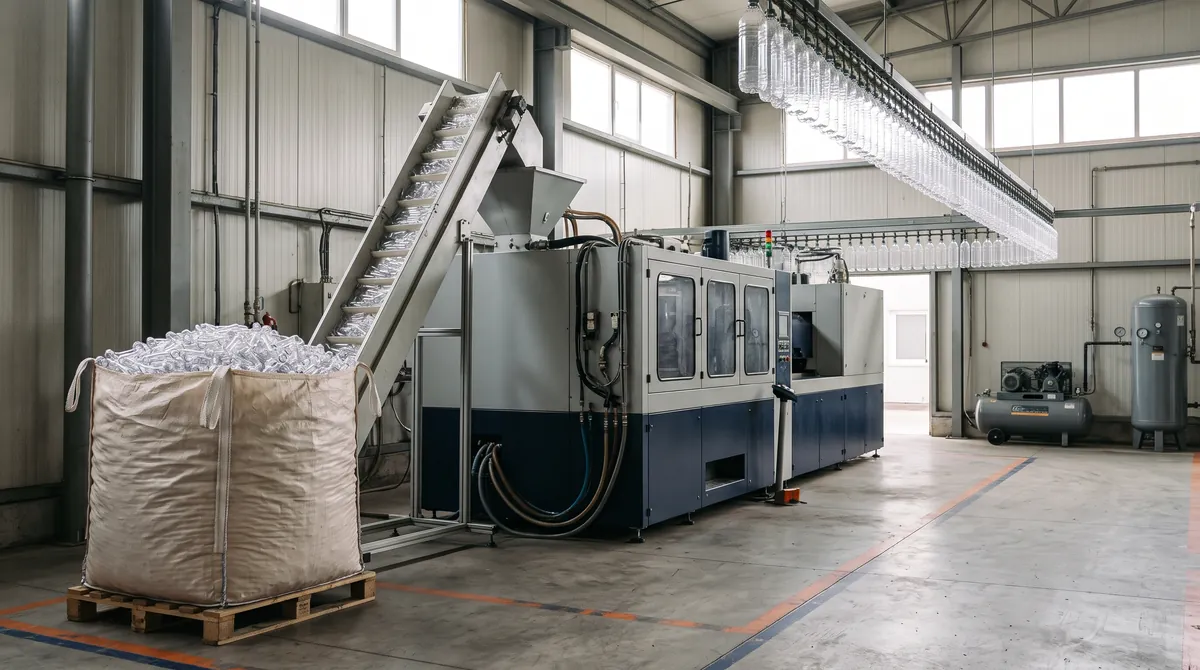
The final route is an automatic blow moulder fed from a preform hopper. It runs with few hands, gives a consistent bottle, and costs the most, so it pays on steady volume. For all three, the hidden cost sits in what the route needs around it.
What a blow moulding machine needs around it
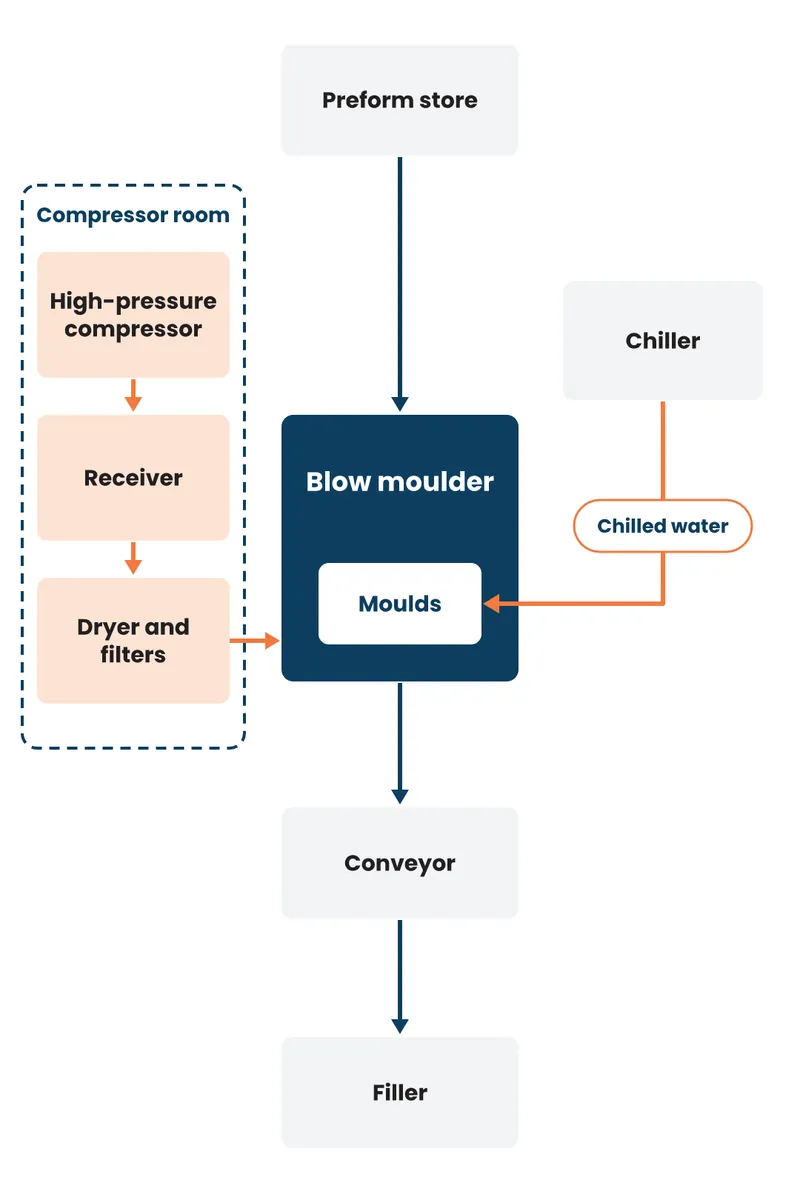
Here’s the mechanism, written as a flow: heating, stretching, blowing, cooling, release. Step by step:
- Heating. The preform passes through an oven until the PET softens.
- Stretching. A rod stretches the soft preform to the length of the bottle.
- Blowing. Compressed air blows it out against the walls of the mould.
- Cooling. The chilled mould sets the PET in the bottle’s shape.
- Release. The mould opens and the bottle moves to the conveyor.
Everything around the machine serves heat, air or cooling, and air comes first. Blowing uses air at a much higher pressure than plant air, so it needs its own compressor, receiver and pipework. That air goes straight into the bottle your customer drinks from.
The Codex Standard for Natural Mineral Waters requires sealed containers suitable for preventing adulteration or contamination of the water [2]. The Codex General Standard for Bottled/Packaged Drinking Waters asks that packaged drinking water be packaged in line with the Codex hygienic code for those waters [3]. Treat the blowing air as part of that container, so dry and filter it.
The moulds are cooled by chilled water, so a chiller is part of the package, sized for your hottest season. The oven and compressor are heavy loads, so size power and standby generation for the whole plant running together.
| Item | What it does | What to check on the quote |
|---|---|---|
| High-pressure compressor | Supplies blowing air | Matched to the blow moulder at your bottle sizes |
| Air dryer and filters | Remove moisture, oil and particles | Air quality suited to bottle contact |
| Chiller | Cools the moulds | Capacity in your hottest season |
| Power supply | Runs oven, compressor and chiller | Sized with the whole plant running |
| Floor and stores | Machine, compressor room, preform store | Space for the next stage too |
A blow moulder without these rows cannot run, so budget them before you compare prices.
Bought-in, semi-automatic or automatic: what each route costs and gives
With the auxiliaries counted, the routes can be compared on what changes your capital, monthly cost and supply risk.
| Factor | Bought-in bottles | Semi-automatic | Automatic |
|---|---|---|---|
| Capital for blowing | None | Lower | Highest |
| Auxiliaries | None | Compressor, air treatment, chiller | The same, at larger size |
| Labour for blowing | None | Operators load and transfer | Few operators |
| Store space | Large | Small | Small |
| Bottle consistency | Set by the bottle maker | Depends on operators | Set by the machine |
| Supply depends on | One bottle maker | Preform makers | Preform makers |
| Suits | Testing the market | First bottle line | Steady volume, several sizes |
Bought-in bottles carry no blowing capital, and they cost you store space and control over supply. Both blowing routes move your dependence to the preform maker, so preform supply decides whether the plant runs.
Preforms: weight, neck finish and local or imported supply
Specify a preform by weight, neck finish and the bottle sizes it can be blown into, and fix all three before you order moulds. The neck finish is the threaded top, moulded with the preform and unchanged through blowing. It fixes the cap, the capping head and the grippers for as long as you use that preform, so changing it later means changing all of them.
Weight sets how much PET goes into each bottle. A heavier preform gives thicker walls that stand up better to stacking. A lighter one uses less resin, which matters when polymer prices rise, as Citi Newsroom reported they did in Ghana in April 2026 [1]. Test sample bottles stacked in your own store.
A local maker means shorter supply lines and smaller orders. Imports arrive a shipment at a time, tying up working capital and store space, and a delay at sea stops your filler. Either way, qualify a second source on the same weight and neck finish.
Storage matters too. A 2023 review in the journal Molecules found that antimony migration from PET bottles into drinks increases with storage time and heat, and that hot storage can take it above EU or USA limits [4]. Keep preforms, bottles and finished goods covered and out of the sun.
Ask every preform maker for a food-contact declaration and test reports against your market’s standard. Keep them on file with each batch.
Matching caps to the neck finish
A cap is made for one neck finish. Its thread, height and tamper-evident band fit that neck, and the capping head is set up for that cap. Here’s the catch: a cap made for another finish can screw on at the bench and still leak in a hot truck, or fail to break its tamper band cleanly. The table shows how far the neck decision reaches through the line.
| Part | Why it follows the neck finish |
|---|---|
| Cap | Thread and tamper band fit one finish |
| Capping head | Chucks and torque are set for one cap |
| Blow moulder | Preform holders grip the neck |
| Rinser and filler | Grippers hold the bottle by the neck |
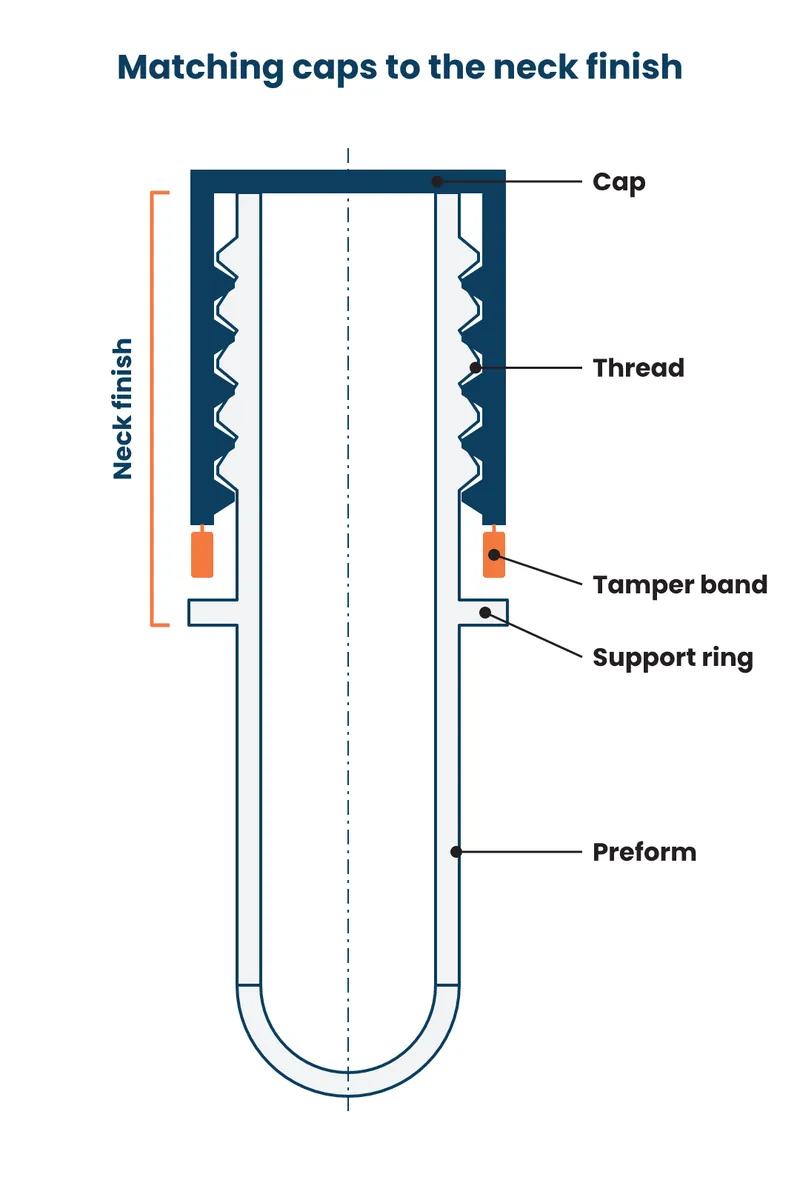
Treat the neck finish as a plant-wide decision: send the preform maker’s neck drawing to the cap and machinery suppliers, and ask for a torque and leak test with your chosen caps at commissioning. Stock caps in step with preforms, because preforms with no matching caps fill nothing. Order both against the same forecast.
When to add an automatic blow moulder to your water bottling plant
The trick is to stage it. A first plant can start at the size its capital and market allow, and the blowing side can grow in the same steps. Each step is bought when the one before it is full.
Signals to watch:
- Bottle shortages. Deliveries from the bottle maker run late and the filler waits.
- Long shifts. The semi-automatic machine no longer keeps pace with the filler.
- Custom-label orders. Several sizes need quick, consistent changeovers.
- Rising labour. Loading preforms by hand costs nearly what an automatic machine costs to run.
- Full stores. Bottles compete with finished goods for space.
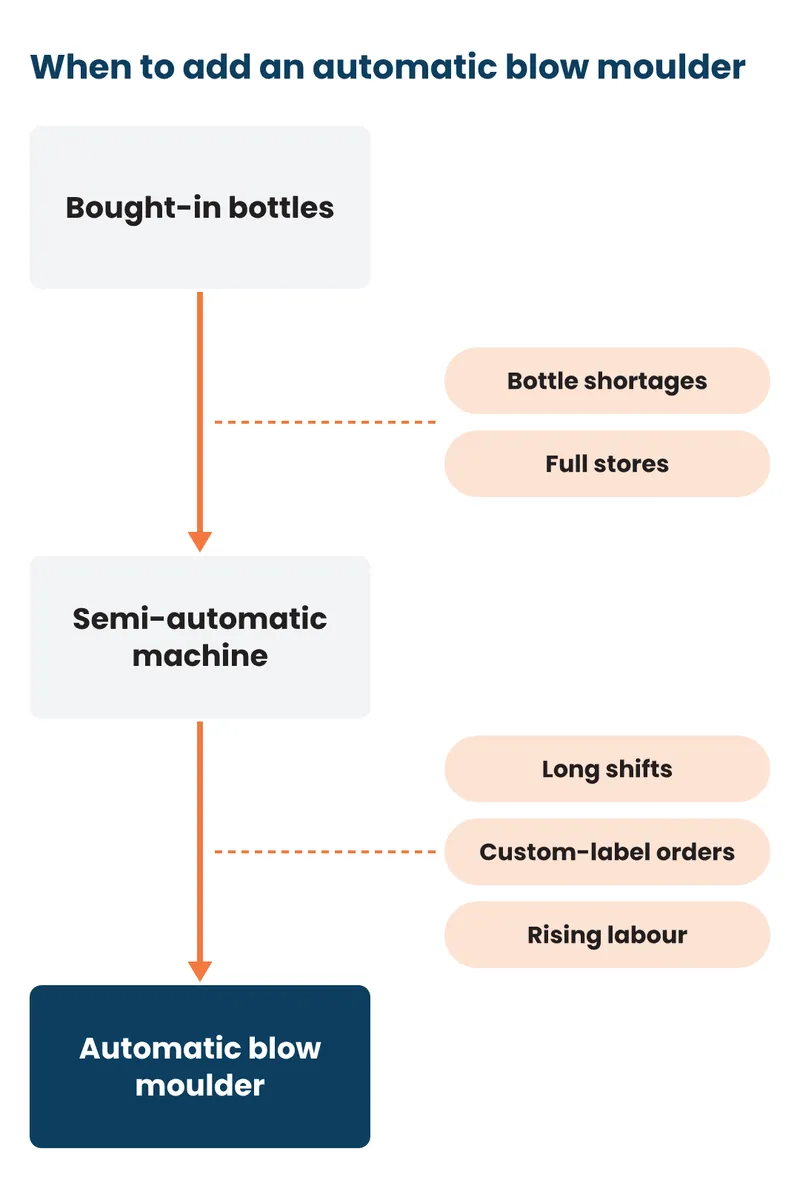
Written as a flow: start on bought-in bottles or a semi-automatic machine, track these signals, and add the automatic machine once volume is steady. Plan that step on day one. Reserve the floor, compressor room, power and chiller capacity the automatic machine will need. The costliest machine on the bottle side is then bought against sales you already have.
What this means in Ghana, Cote d’Ivoire, Uganda and Rwanda
Rules on packaged water and plastics differ by market. Each one bears on how you source bottles, preforms and caps, and where a point is unpublished, the text names who to ask.
Ghana
The Ghana News Agency has reported that the Food and Drugs Authority’s inspection of packaged water plants covers packaging materials as well as water, and that the finished product must meet GS 175-1 for drinking water or GS 220 for mineral water [5]. So ask the Authority which documents it expects for preforms and caps before you choose a supplier.
Cote d’Ivoire
Decree 2013-327 bans the production, import, sale, possession and use of plastic sachets, and a later decree, published on FAOLEX, extended the time to comply [6]. Whether water pouches fall within it is unclear from both texts, so check with the environment ministry. If they do, pouch volume moves to bottles and jars, and your preform plan must be sized for it.
Uganda
The Uganda National Bureau of Standards gazetted the East African packaged drinking water standard from 21 April 2015, as the tripartite non-tariff barriers mechanism records [7]. The East African Community’s 2024 catalogue of standards lists a 2018 edition [8], later than the one gazetted in Uganda. Confirm which edition your bottles are tested against. Ask the Bureau which requirements apply to preforms and caps.
Rwanda
Law No. 17/2019, in the Official Gazette of 23 September 2019, prohibits the manufacture, import, use and sale of single-use plastic items, allows a written application for exceptional authorisation, and places an environmental levy on imported goods packaged in plastic [9]. Ask the environment authority whether PET water bottles need that authorisation and whether imported preforms attract the levy, because either changes the cost of your route.
The Rwanda Standards Board lists the revised East African packaged drinking water standard among those that apply [10]. In April 2025 the Board opened draft East African standards for plastic cups, plates and tables to public comment, and its public review notice lists none for PET bottles, preforms or closures [11]. So ask the Board which requirements apply to yours.
What to ask before you decide how to supply bottles
- How many bottles of each size will you sell each month, now and at the next stage?
- Who supplies your preform weight and neck finish, and who is the second source?
- How long does a preform order take to arrive, and what stock covers that time?
- Do your caps match the neck drawing?
- Are the compressor, air treatment, chiller, power and floor space on the quote?
The team has seen what skipping them costs: a blow moulder idle for want of its compressor and chiller, and caps for the wrong finish that leak. Write the answers down before you ask for quotes, so every supplier prices the same plant.
How Sonika Impex LLP can help
Sonika Impex LLP starts from a needs assessment: what your plant needs now and later, and a plan for both, including saying plainly when something is not needed yet. For the bottle side:
- Mineral water plants from 1,000 to 10,000 litres/hour, turnkey, or standalone mineral water plant machinery
- Blow moulding machines with the compressor sized to the machine, bottle filling and capping, and labelling machinery
- Preforms and other working capital materials, from a single point of service
- Pre-shipment inspection and packing, with inspection by SGS or Bureau Veritas as required
- Export on FOB terms, preferred, or CIF to your port, typically Tema, Abidjan, Mombasa or Dar-es-Salaam
- Erection, commissioning, training for project and maintenance staff at your site, and after-sales support that continues after the warranty period ends
Send us:
- What you want to bottle, in which sizes, and how much each month, now and at the next stage
- Your water source, its yield across the year, and any water analysis
- How you supply bottles today, and your preform, neck finish and cap, with drawings
- Your site, power available and nearest port
- Anything already installed, such as a filler, compressor or pouch line
+91 99027 67900 · sonikaimpex.com
Frequently asked questions
Can one blow moulder make several bottle sizes?
Yes, if each size has its own mould and the preform suits it. Sizes that share a neck finish can often use related preforms, which keeps cap and capping changes small. Ask for the list of sizes, the moulds included and the changeover steps in the proposal.
Can I change the bottle shape for a custom-label customer?
A new shape needs a new blow mould, and it may need a different preform weight. Keep the same neck finish so your caps and capping head still fit. Price the mould against the size of the order before you agree to it.
Should I test incoming preforms?
Yes. Check a sample from each batch against the specification sheet for weight and neck dimensions, and blow a few bottles before releasing the batch to production. Keep retained samples from every batch, so any later leak or failure can be traced.
Can the blowing compressor also supply plant air?
It can, through a pressure regulator, if the compressor has spare capacity at your full blowing load. A separate low-pressure compressor costs more and keeps a stop on one side from stopping the other. Decide by how much plant air your valves and cylinders use, and have the chosen layout shown on the utilities drawing.
Which spares should sit on the shelf for a blow moulder?
Ask the supplier for a list of wear parts with their part numbers: heater lamps, seals, valves and the parts of each mould that wear. Keep the items that would stop the machine in your own store. Reorder before the shelf runs empty.
Where should the blow moulder stand in the plant?
Close to the filler, so blown bottles travel a short, covered path to the rinser. Keep the compressor in its own room, away from the filling hall, because it brings heat, noise and oil mist. Leave access around the machine for mould changes.
Can I sell blown bottles to other water plants?
It is possible once your own filler is covered and your bottles are consistent. The buyer will expect the same food-contact documents you ask of your preform maker. Check with your regulator whether that activity needs its own registration.
What happens to rejected bottles and preform waste?
Rejects and scrap PET need a clean, separate store and a route out of the plant. Keep scrap clean and sorted by type, because clean PET is easier to pass on for recycling. Plastics rules in your market may set what you must do with it, so confirm with the environment authority.
Final thoughts
The Citi Newsroom report of 2 April 2026 was about scarce polymer and the higher price of what could still be bought [1]. The question at the start was whether to make bottles or buy them, and both routes work. The better question is which route keeps your filler supplied at each stage, with the neck finish, caps, utilities and preform sources fixed early.
For the full picture, read our guide: [Mineral water plant cost starts at the source](/mineral-water-plant-cost-starts-at-the-source)
Sources
- Citi Newsroom | Sachet water producers justify price hike | 2 April 2026 | https://citinewsroom.com/2026/04/sachet-water-producers-justify-price-hike/ (accessed 2026-10-19)
- FAO/WHO Codex Alimentarius Commission | Codex Standard for Natural Mineral Waters, CODEX STAN 108-1981 | adopted 1981, amended 2011 | https://www.fao.org/input/download/standards/223/CXS_108e.pdf (accessed 2026-10-19)
- FAO/WHO Codex Alimentarius Commission | General Standard for Bottled/Packaged Drinking Waters (Other than Natural Mineral Waters), CODEX STAN 227-2001 | 2001 | https://www.fao.org/input/download/standards/369/CXS_227e.pdf (accessed 2026-10-19)
- Molecules, vol. 28, no. 20, article 7166 | Antimony in Polyethylene Terephthalate-Bottled Beverages: The Migration Puzzle | 19 October 2023 | https://www.mdpi.com/1420-3049/28/20/7166 (accessed 2026-10-19)
- Ghana News Agency | Ghana to end water importation after passage of Ghana Accreditation Service Bill, Trade Minister | 13 June 2023 | https://gna.org.gh/2023/06/ghana-to-end-water-importation-after-passage-of-ghana-accreditation-service-bill-trade-minister/ (accessed 2026-10-19)
- Republic of Côte d’Ivoire (via FAOLEX) | Décret n° 2013-803 du 22 novembre 2013, extending the compliance period of Décret n° 2013-327 on plastic sachets | 22 November 2013 | https://faolex.fao.org/docs/pdf/ivc140523.pdf (accessed 2026-10-19)
- COMESA-EAC-SADC Non-Tariff Barriers Reporting, Monitoring and Eliminating Mechanism | US EAS 153:2014, Packaged drinking water, Specification | gazetted 21 April 2015 | https://tradebarriers.org/ntm/regulations/view/907 (accessed 2026-10-19)
- East African Community Secretariat (hosted by tralac) | Catalogue of East African Standards 2024 | October 2024 | https://www.tralac.org/documents/resources/eac/6012-catalogue-of-east-african-standards-2024.html (accessed 2026-10-19)
- Republic of Rwanda, Official Gazette n° 37 bis | Law n° 17/2019 of 10/08/2019 relating to the prohibition of manufacturing, importation, use and sale of plastic carry bags and single-use plastic items | 23 September 2019 | https://policyvault.africa/wp-content/uploads/policy/RWA514.pdf (accessed 2026-10-19)
- Rwanda Standards Board | Safe drinking water | undated, page on the 2018 revision of the East African drinking water standards | https://www.rsb.gov.rw/updates/news-detail/safe-drinking-water (accessed 2026-10-19)
- Rwanda Standards Board | Public review notice: draft East African standards for plastic cups, plates and tables | April 2025 | https://www.rsb.gov.rw/updates/news-detail/public-review-notice-54 (accessed 2026-10-19)