Water Bottling Plant: Making Your Own Bottles or Buying Them, and Securing the Preform Supply
November 18, 2026
Mineral Water Plant Project Report: What the Bank Needs to See, and How to Plan Your Costing, Cash Flow and ROI
November 20, 2026
Mineral Water Plant Machinery Maintenance: Membranes, Filters, UV, Ozone and the Daily Checks
In May 2026, the Upper East office of Ghana’s Food and Drugs Authority told sachet water producers that working ultraviolet sterilisation is non-negotiable, as the Ghana News Agency reported on 6 May 2026 [1]. The same report said the Authority warned that UV bulbs lose effectiveness after a set running time even while they still glow, and that every bulb change must be recorded so inspectors can check run time [1]. In July 2026, the Ghana News Agency reported inspections in Greater Accra that found algae in water pipelines and plants with no UV sterilisation equipment [2].
Those are maintenance findings. Mineral water plant machinery usually fails by drifting: a filter loads up, a membrane fouls, a lamp passes its rated hours. The drift shows in a reading long before it shows in the product.
This article covers the treatment side of a running plant, for the plant manager and engineer, and for the owner who wants to know what the daily checks are for.
In short:
- Treatment stoppages usually begin as slow drift in an untracked reading, so the shift log is the main tool.
- Filter vessels are backwashed, regenerated and re-filled on pressure difference and outlet quality.
- RO membranes are cleaned and replaced on normalized trends read against start-up figures.
- UV depends on lamp hours, clean sleeves, clear water and a working sensor; ozone is set against your bromide figure.
- A calendar, with spares on the shelf, keeps the routine honest.
Contents
- What stops mineral water plant machinery
- Keeping sand, carbon and softener filters working
- RO membranes: fouling, cleaning and replacement
- UV lamps and ozone dosing
- The testing bench and the shift log: what to record each shift
- A maintenance calendar for the treatment side
- What this means in Ghana, Cote d’Ivoire, Uganda and Rwanda
- Common maintenance mistakes and what to ask before you buy
- How Sonika Impex LLP can help
- Frequently asked questions
- Final thoughts
What stops mineral water plant machinery
A water plant stops in two ways. One is mechanical: a pump trips, or membrane pressure climbs past its limit. The other is regulatory: an inspector finds a fault and production halts.
In April 2025, the Ghana News Agency reported that the Food and Drugs Authority’s Upper East office had found weak cleaning regimes and failed UV lights, and had halted production until the lights were replaced [3]. In December 2024, 3News reported two sachet water plants in the Western Region closed for unsanitary conditions, including filters not replaced regularly [4].
Here’s the catch. Faults like these show first on a gauge, a sensor or a cleaning record. The water safety plan chapter of the World Health Organization’s Guidelines for drinking-water quality builds on this: each control measure gets an operational limit, and when monitoring shows the limit crossed, a corrective action decided in advance follows [5].
So maintenance comes down to three things. Know what each stage should do. Measure whether it does. Act when the reading drifts.
Keeping sand, carbon and softener filters working
A sand filter holds back suspended matter. WHO’s annex on treatment methods and performance explains that the solids are removed by backwashing with treated water [6]. A rising pressure difference across the vessel calls for a backwash.
A carbon filter removes taste, odour and chlorine until its capacity runs out, and a softener works by ion exchange. The same annex states that carbon bed life depends on the carbon’s capacity, which the source water strongly affects, and that exhausted softener resin is regenerated with a sodium chloride solution [6]. Exhausted carbon has to be changed, and hardness leaking into the softened water is the usual sign that regeneration is late.
Each vessel has its own task and its own warning sign:
| Vessel | Routine task | Signal that it is due |
|---|---|---|
| Sand filter | Backwash; media top-up or change | Rising pressure difference; rising outlet turbidity |
| Carbon filter | Backwash; media replacement | Taste or odour returning |
| Softener | Brine regeneration | Hardness in softened water |
| Micron cartridges | Cartridge change | Pressure difference at the maker’s limit |
Caption: Filter tasks and the reading that says each is due. Source: the WHO treatment methods annex cited above; cartridge limits from the maker.
Each row’s reading warns you before the product does.
RO membranes: fouling, cleaning and replacement
Particles, scale, organic matter and biofilm build up on the membrane surface and in the feed channels. The plant then needs more pressure for the same flow, pressure drop along each vessel rises, and more salt passes into the permeate.
Raw readings move with feed temperature and pressure, so trends are read from figures corrected to standard conditions, which is what “normalized” means on an RO log. A 2024 pilot study in the journal Desalination measured fouling in exactly these terms: falling normalized permeate flow and rising feed channel pressure drop [7].
The trick is to set the baseline early. Record normalized flow, pressure drop and permeate conductivity once the plant settles after commissioning. Judge every later reading against them.
Cleaning in place is the answer to drift. A 2024 study of a seawater RO plant, published in The Maldives National Journal of Research, scheduled cleaning when differential pressure passed a set point and recorded an average of 152 days between cleanings [8]. The same study found that citric acid cleaning alone could not restore performance and left biological fouling untreated [8]. So match the cleaning chemical to the foulant.
Replacement is judged from the same data. The Maldives study cites the industry practice of discarding membranes once flow and quality fall more than 15% from initial values, recommends replacing them only when cleaning can no longer recover performance, and reports spiral-wound seawater membranes at that plant typically lasting 5 to 6 years [8]. A borehole plant runs on very different water, so your interval comes from your own log.
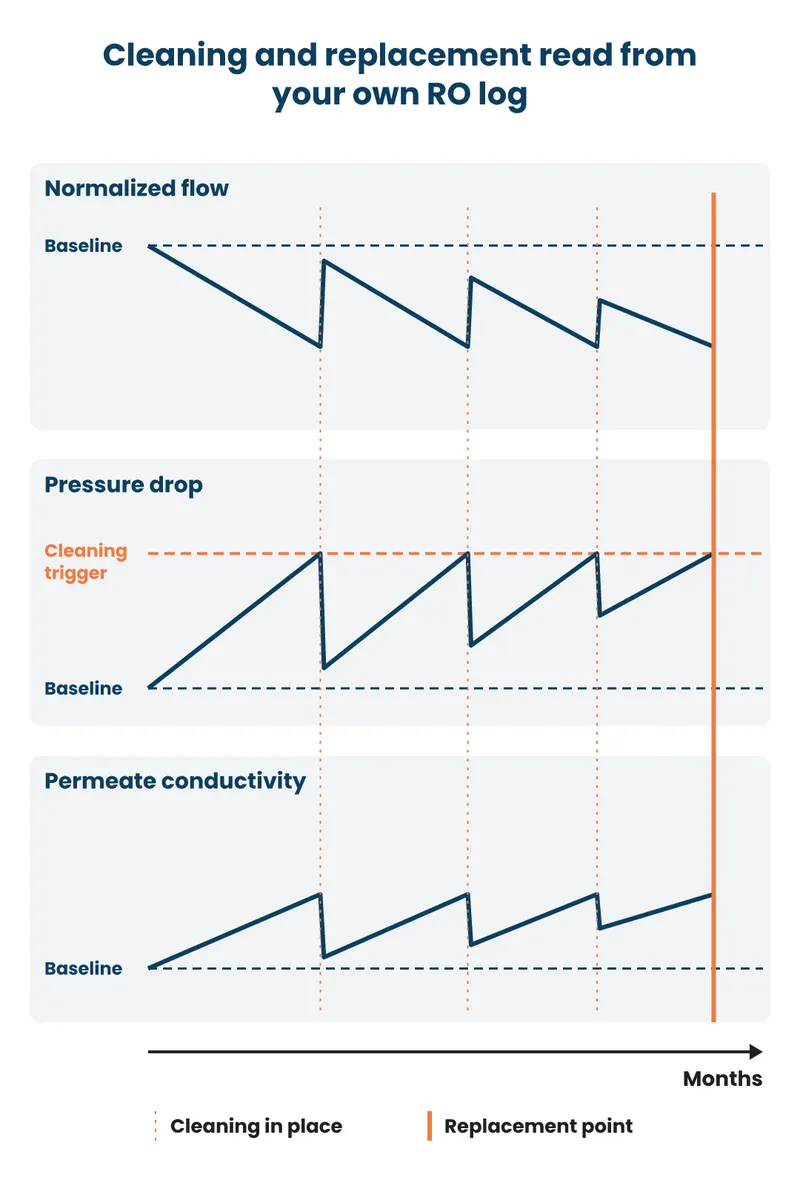
Caption: Cleaning and replacement read from your own RO log. Source: method from the two RO studies cited above.
UV lamps and ozone dosing
Disinfection is where most of the Ghana findings above began.
WHO’s chapter on microbial aspects states that UV effectiveness depends on the delivered fluence, that turbidity and certain dissolved substances inhibit it, and that turbidity should be kept below 1 NTU [9]. Lamp output falls with age, and the quartz sleeve collects a film that blocks light. So the lamp needs an hour meter and its maker’s replacement interval, the sleeve a cleaning schedule, and the sensor reading a line in the log.
A lamp that glows can still under-dose. The hour meter and the sensor reading are the checks.
Ozone is sometimes used for final disinfection before bottling, as WHO’s chapter on application of the Guidelines in specific circumstances notes [10]. One safety detail worth knowing: WHO’s chemical fact sheets state that bromate forms mainly during ozonation when bromide is present, and that it is difficult to remove once formed [11]. WHO’s chemical summary tables give a provisional guideline value for bromate of 10 µg/L [12].
So set the ozone dose from the bromide figure in your source analysis. Keep the generator’s air feed and cooling checked. Test the product for bromate on the schedule your regulator sets.
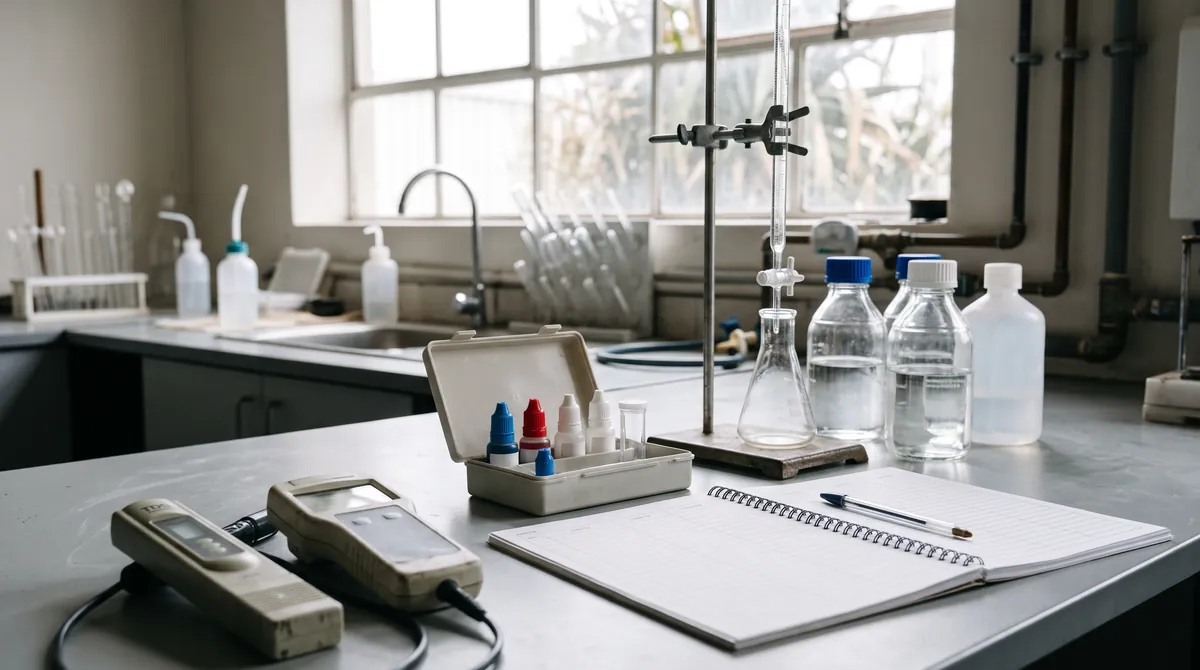
The testing bench and the shift log: what to record each shift
The shift log is where the operational limits described above meet the plant.
A useful shift log records, at fixed times on every shift:
- Raw water. Tank level and turbidity.
- Filters. Inlet and outlet pressure on each vessel, and any backwash or regeneration.
- RO. Feed, reject and permeate pressures and flows, and permeate conductivity.
- Disinfection. UV sensor reading, lamp hours, any lamp change, and the ozone setting.
- Product. pH, conductivity and the batch code filled.
- Actions. What was adjusted, cleaned or replaced, and by whom.
As a flow: raw water, filters, RO, disinfection, product checks, then actions, signed off by the shift.
Print each reading’s limit and the action it triggers beside it on the sheet, so the operator who sees a reading cross its line knows what to do.
A maintenance calendar for the treatment side
Treat the calendar as a template, and revise it once your logs show real trends.
| Interval | Tasks |
|---|---|
| Daily | Log pressures, flows, conductivity, UV reading and product checks; backwash or regenerate where readings call for it; check for leaks |
| Weekly | Review RO normalized trends against the baseline; check cartridge pressure difference; test softened water hardness |
| Monthly | Clean UV sleeves; calibrate bench meters; send samples to an accredited laboratory as your regulator requires; check spares |
| Yearly | Inspect or change filter media; replace UV lamps on rated hours; review membranes for cleaning or replacement; repeat the full source analysis |
Caption: A starting calendar; set each interval against your own log and your regulator. Source: WHO guidance and the RO cleaning study cited above.
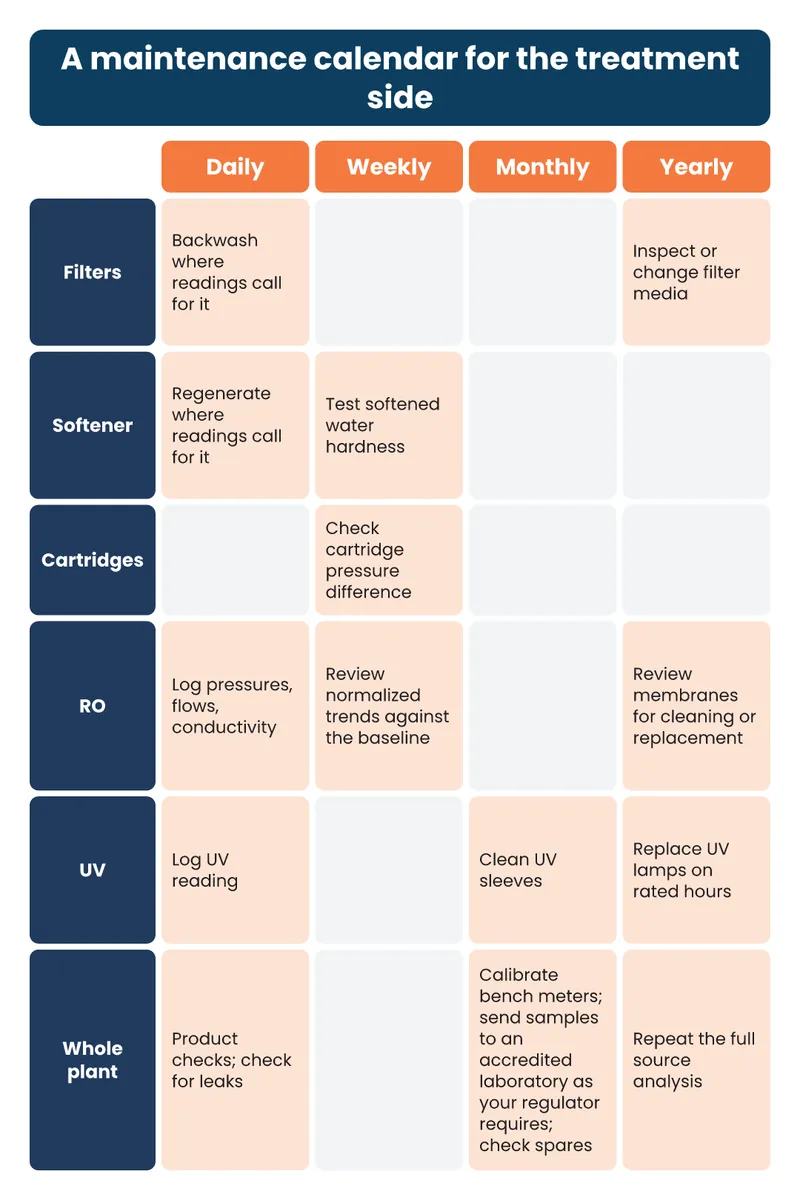
Caption: The calendar as a wall chart for the plant room. Source: the table above.
Cartridges, lamps, sleeves, seals, a spare dosing pump and cleaning chemicals are small items that stop a water bottling plant when they run out. Keep them on the shelf.
What this means in Ghana, Cote d’Ivoire, Uganda and Rwanda
Each market’s checks land on your log or calendar.
Ghana
The Food and Drugs Authority’s recent actions turned on UV lamps, filter changes and sanitation. So the UV hour meter and the bulb and filter change records are what an inspector will ask to see.
Registration must be renewed every year, as the Ghana News Agency reported in July 2026 [2]. In October 2025 the Ghana News Agency reported nine producers in the Western North Region suspended over expired licences [13]. Put the renewal date on the calendar beside the lamp changes.
Cote d’Ivoire
Côte d’Ivoire’s Water Code, Law No. 2023-902 of 23 November 2023, places the bottling of mineral, spring and table waters under the supervision of the competent administrations, and requires operators to give officials access [14]. Your shift log and cleaning records are your evidence at any visit. Confirm the sampling and testing frequency expected of you with the ministry in charge of health.
Uganda
According to the COMESA-EAC-SADC non-tariff barriers mechanism, the Uganda National Bureau of Standards issued US EAS 153:2014 for packaged drinking water, implemented from 21 April 2015, with methods of sampling and test [15]. Your bench and laboratory results are judged against those methods. Confirm with the Bureau which edition it enforces and how often it inspects.
Rwanda
The Rwanda Standards Board reports that the revised East African standard for packaged drinking water, EAS 153:2018, emphasises hygiene and water safety plans [16]. Your shift log, with its limits and recorded actions, is that plan at work. Confirm the inspection and testing regime with the food and drugs regulator.
Common maintenance mistakes and what to ask before you buy
The common mistakes follow from the sections above: no RO baseline, cleaning by date alone, one chemical for every foulant, trusting the lamp glow, ozone set without a bromide figure, and spares ordered after the breakdown. Most of them are settled at purchase, so before you buy, ask for these on paper:
- An operating and maintenance manual for each stage.
- The RO cleaning procedure, with chemicals named per foulant.
- A way to normalize RO data.
- Rated lamp hours, an hour meter, a UV intensity sensor and the sleeve cleaning method.
- Gauges and sample points on every vessel.
- A recommended spares list with part numbers.
For a plant being expanded or modernised, put the same questions to each new stage, and set a fresh baseline after any membrane or media change.
How Sonika Impex LLP can help
Sonika Impex LLP works from a needs assessment that sets out what the plant needs now, what it will need later, and a plan for both, saying plainly when something is not needed yet. For new and running plants:
- Mineral water plants turnkey, or standalone treatment, filling, labelling and blow moulding machines for an existing plant
- Treatment from sand and carbon filters through RO, UV and ozone, for plants from 1,000 to 10,000 litres/hour
- Working capital materials, including preforms, from a single point of service
- Pre-shipment inspection and packing, with inspection by SGS or Bureau Veritas as required
- Erection and commissioning, and training for project and maintenance staff at your site
- After-sales support, available after the warranty period ends
Send us:
- What you make and how much, now and later
- Your source water analysis, and how the borehole’s yield and quality change across the year
- The treatment stages and anything else installed, with specifications if known
- Recent log readings and the problems you see
- Site, nearest port, power supply and water storage
+91 99027 67900 · sonikaimpex.com
Frequently asked questions
Can RO membranes be left standing if the plant stops for several weeks?
Yes, with preservation. Membranes left standing without flushing can grow biofilm that is hard to clean later. Ask your supplier for the shutdown and preservation procedure for your membranes, and follow it every time the plant stands idle.
Should we clean the RO membranes ourselves or call in a contractor?
A plant with a cleaning-in-place skid and a written procedure can clean on site. The skill lies in choosing the right chemical, temperature and sequence for the foulant. Where a clean fails to recover performance, an outside cleaning or a membrane autopsy can show what the fouling actually is.
Do we need to test the reject water from the RO?
Your local authority decides what you may discharge and whether it must be tested. Reject conductivity and flow are still worth logging, because they show how hard the membranes are working. Agree the discharge route and any tests with the authority before the plant starts.
What should we do when the borehole changes after heavy rain or a long dry spell?
Have the source tested again before the plant runs long on the changed water. A source that changes can overload a route designed for the earlier water, so carbon and softener beds exhaust sooner and RO pressure climbs faster. Keep every report with the shift logs so the two can be compared.
Can a suspect batch be held back until the results arrive?
Yes, and packaged water allows it, because WHO’s [guidance on packaged water](https://cdn.who.int/media/docs/default-source/wash-documents/water-safety-and-quality/dwq-guidelines-4/gdwq_4ed_with_third-addenda_application-of-the-guidelines.pdf?sfvrsn=9b3a4a7e_5) notes that batches can be held until results are available [10]. That only works if every batch carries a code that ties it to the shift log and the samples taken. Agree the holding area and the release rule before the first suspect result.
Is a bench conductivity meter enough to check the product?
It is a good daily check on the RO and on consistency between batches. Microbial quality, bromate and many specific chemicals need an accredited laboratory, on the schedule your regulator sets. The bench tells you when to send a sample early.
Should the UV unit be interlocked with the water flow?
It is worth asking for. An interlock stops or diverts the feed when the intensity sensor reads below its limit or the lamp fails. That builds into the machine the rule Ghana’s Food and Drugs Authority states, that production stops when the UV fails, as [reported in May 2026](https://www.ghanaweb.com/GhanaHomePage/NewsArchive/Ultraviolet-sterilisation-mandatory-for-safe-water-production-FDA-warns-2033199), so it no longer rests on an operator noticing [1].
How long should shift logs and cleaning records be kept?
Your regulator sets the minimum, so ask. Beyond that, keep them at least as long as the product they cover is on the market, and keep the RO records for the life of the membranes, because the replacement decision rests on the whole trend. A log thrown away each month cannot show drift.
Can the shift log be kept on a tablet or in the plant controller?
Yes, if it records the same readings at the same times and shows who took them. Where the RO controller stores pressures and flows itself, the operator still records the actions and the bench results. Keep a printed or exported copy for inspections, because an inspector will want to read it on the spot.
Which spares cause the longest stoppages when they run out?
Items with long supply lines and no substitute: membranes of the size fitted, UV lamps and sleeves of the exact model, ozone generator parts and dosing pumps. Cartridges and seals are cheap and stop the plant just as surely. Match each item on the shelf to the spares list by part number.
Final thoughts
The opening came down to a lamp: when was it last changed, and how do you know it still works? The first part can be answered from memory, and the second needs an hour meter, a sensor reading and a log.
That is the real question in mineral water plant machinery maintenance, at every stage: are the readings that warn you taken, written down and acted on? A plant with a baseline, a log and a calendar sees its problems early, when they are cheapest to fix.
For the full picture, read our guide: [Mineral water plant cost starts at the source](/mineral-water-plant-cost-starts-at-the-source).
Sources
- Ghana News Agency, via GhanaWeb | Ultraviolet sterilisation mandatory for safe water production, FDA warns, published 6 May 2026 | https://www.ghanaweb.com/GhanaHomePage/NewsArchive/Ultraviolet-sterilisation-mandatory-for-safe-water-production-FDA-warns-2033199 (accessed 2026-10-19)
- Ghana News Agency | FDA shuts 59 food manufacturing, cold storage facilities over safety breaches, published 24 July 2026 | https://gna.org.gh/2026/07/fda-shuts-59-food-manufacturing-cold-storage-facilities-over-safety-breaches/ (accessed 2026-10-19)
- Ghana News Agency | We will not allow sacrifice of public safety for money, FDA, published 28 April 2025 | https://gna.org.gh/2025/04/we-will-not-allow-sacrifice-of-public-safety-for-money-fda/ (accessed 2026-10-19)
- 3News | FDA shuts down two sachet water companies in Takoradi amid cholera outbreak, published 20 December 2024 | https://3news.com/health/fda-shuts-down-two-sachet-water-companies-in-takoradi-amid-cholera-outbreak (accessed 2026-10-19)
- World Health Organization | Guidelines for drinking-water quality, fourth edition with addenda: Water safety plans, published 17 June 2026 | https://cdn.who.int/media/docs/default-source/wash-documents/water-safety-and-quality/dwq-guidelines-4/gdwq_4ed_with_third-addenda_water-safety-plans.pdf?sfvrsn=216e2592_5 (accessed 2026-10-19)
- World Health Organization | Guidelines for drinking-water quality, fourth edition with addenda: Annex 5, Treatment methods and performance, published 17 June 2026 | https://cdn.who.int/media/docs/default-source/wash-documents/water-safety-and-quality/dwq-guidelines-4/gdwq_4ed_with_third-addenda_ann-5-treatment-methods.pdf?sfvrsn=5f033730_5 (accessed 2026-10-19)
- Desalination journal, via university research portal | Osmotic-induced cleaning is effective in long-term fouling mitigation of reverse osmosis elements at pilot plant level, published 14 June 2024 | https://pure.kfupm.edu.sa/en/publications/osmotic-induced-cleaning-is-effective-in-long-term-fouling-mitiga/ (accessed 2026-10-19)
- The Maldives National Journal of Research | Evaluation of Effectiveness of Cleaning-in-Place of Membranes and Optimum Period of Membrane Replacement on a Seawater Reverse Osmosis Plant, published 30 November 2024 | https://mnjr.mnu.edu.mv/journal/article/view/180 (accessed 2026-10-19)
- World Health Organization | Guidelines for drinking-water quality, fourth edition with addenda: Microbial aspects, published 17 June 2026 | https://cdn.who.int/media/docs/default-source/wash-documents/water-safety-and-quality/dwq-guidelines-4/gdwq_4ed_with_third-addenda_microbial-aspects.pdf?sfvrsn=f26fb85b_5 (accessed 2026-10-19)
- World Health Organization | Guidelines for drinking-water quality, fourth edition with addenda: Application of the Guidelines in specific circumstances, published 17 June 2026 | https://cdn.who.int/media/docs/default-source/wash-documents/water-safety-and-quality/dwq-guidelines-4/gdwq_4ed_with_third-addenda_application-of-the-guidelines.pdf?sfvrsn=9b3a4a7e_5 (accessed 2026-10-19)
- World Health Organization | Guidelines for drinking-water quality, fourth edition with addenda: Chemical fact sheets, published 17 June 2026 | https://cdn.who.int/media/docs/default-source/wash-documents/water-safety-and-quality/dwq-guidelines-4/gdwq_4ed_with_third-addenda_chemical-fact-sheets.pdf?sfvrsn=77d972e1_5 (accessed 2026-10-19)
- World Health Organization | Guidelines for drinking-water quality, fourth edition with addenda: Annex 3, Chemical summary tables, published 17 June 2026 | https://cdn.who.int/media/docs/default-source/wash-documents/water-safety-and-quality/dwq-guidelines-4/gdwq_4ed_with_third-addenda_ann-3-chemical-summary-tables.pdf?sfvrsn=d834e6a9_5 (accessed 2026-10-19)
- Ghana News Agency | FDA suspends operations of nine sachet water producers in Western North Region, published October 2025 | https://gna.org.gh/2025/10/fda-suspends-operations-of-nine-sachet-water-producers-in-western-north-region/ (accessed 2026-10-19)
- Republic of Côte d’Ivoire, Journal Officiel (via FAOLEX) | Loi n° 2023-902 du 23 novembre 2023 portant Code de l’Eau, published 15 January 2024 | https://faolex.fao.org/docs/pdf/IVC228174.pdf (accessed 2026-10-19)
- COMESA-EAC-SADC Non-Tariff Barriers Reporting, Monitoring and Eliminating Mechanism | US EAS 153:2014, Packaged drinking water, Specification, published 21 April 2015 | https://tradebarriers.org/ntm/regulations/view/907 (accessed 2026-10-19)
- Rwanda Standards Board | Safe drinking water, undated | https://www.rsb.gov.rw/updates/news-detail/safe-drinking-water (accessed 2026-10-19)